Educator Resource
Chapter 4 The Early Republic: 1789-1800 Inquiry Organizer
How can a nation stay unified despite divisions?

Founding Principles
Natural/Inalienable Rights, Checks and Balances, Due Process, Equality, Federalism, Freedom of Religion, Liberty, Rule of Law, Separation of Powers
Virtues
Courage, Honor, Integrity, Justice, Moderation, Respect, Responsibility
In this organizer
- Lesson10
- Narrative8
- Primary Source11
- Point-Counterpoint2
- Decision Point3
Compelling question
How can a nation stay unified despite divisions?
Chapter objectives
- Students will be able to analyze the foreign and domestic policies of the Washington and Adams administrations and evaluate the constitutional basis for those policies and the opposition to them.
- Students will be able to describe and compare the shaping of a unified American identity across various regions, the reasons for continued regional differences, and the effects of unity or differences in responses to national issues.
Supporting questions and resources
The filter narrows the resources under every question. Each card opens the resource.
Supporting question 1
What unified the thirteen former colonies as a new nation in 1789?
- LessonGeorge Washington in American Art
- NarrativeJames Madison and the Bill of Rights
- LessonActions of the First Congress
- Decision PointThe Compromise of 1790
- Primary SourceThomas Jefferson on the Compromise of 1790
- Primary SourceGeorge Washington, First Inaugural Address, 1789
- Primary SourceThe Judiciary Act of 1789
Supporting question 2
What political, social and cultural issues caused internal divisions in the new nation?
- NarrativeBenjamin Franklin and the First Abolitionist Petitions
- NarrativeEli Whitney and the Cotton Gin
- LessonThe Founder’s Failure to End Slavery
- NarrativeAlexander Hamilton and the National Bank
- Point-CounterpointStrict” or “Loose”: Was the National Bank Constitutional?
- LessonThe National Bank Debate
- Decision PointRobert Carter and Manumission
- Primary SourceThomas Jefferson and Alexander Hamilton, Writings on the National Bank, 1785-1792
- LessonMethods of Slave Resistance DBQ
Supporting question 3
How was the new nation challenged in its interactions with other nations?
- LessonThe Global Impact of the American Revolution DBQ
- Decision PointGeorge Washington and the Proclamation of Neutrality
- NarrativeThe Battle of Fallen Timbers
- NarrativeThe XYZ Affair and the Quasi-War with France
- NarrativeThe Jay Treaty
- Primary SourceThe Royal Proclamation of 1763 and the Treaty of New York, 1790
- Primary SourceThe Jay Treaty, 1795
- Primary SourcePinckney’s Treaty, 1796
- Primary SourceCartoon Analysis: Property Protected—à la Françoise, 1798
- Primary SourceCartoon Analysis: Congressional Pugilists
Supporting question 4
How did the Washington and Adams Administrations respond to challenges?
- Primary SourceGeorge Washington, Farewell Address, 1796
- NarrativeThe Alien and Sedition Acts
- Primary SourceKentucky and Virginia Resolutions, 1798 and 1799
- Point-CounterpointThe Whiskey Rebellion: Unjust taxation or enforcing the rule of law?
- LessonBe Washington: Whiskey Rebellion
- Chapter 4 Introductory Essay: 1789-1800
- BRI Homework Help Video: Partisanship
- LessonUnit 2 Civics Connection: An Apple of Gold in a Frame of Silver
- LessonGeorge Washington’s Views on Slavery
- LessonUsing Political Cartoons to Understand History
Standards
You may also need
More of this category

This Lesson can be used at the beginning of Chapter 4 to reinforce and review the key events of the American Revolution covered in Chapter 3. This activity will also introduce students to the effects the Revolution had on the world stage in the late eighteenth and early nineteenth centuries.

Students should have a solid foundation of the regional differences in the former colonies, now states, as well as an understanding of the ratification of the Constitution. This Lesson is best used after students have read The Constitutional Convention and The Ratification Debate on the Constitution Narratives in Chapter 3. The James Madison and the Bill of Rights Narrative in Chapter 4 can be used as background for the Lesson or can be assigned as homework after the Lesson to reinforce main ideas.

This activity should be completed after students have completed the Actions of the First Congress Lesson, The Compromise of 1790 Decision Point, and George Washington, First Inaugural Address, 1789 Primary Source Activity. This Lesson should be followed by the Alexander Hamilton and the National Bank Narrative or the "Strict" or "Loose": Was the National Bank Constitutional? Point-Counterpoint, either of which can be completed as a homework assignment to follow this Lesson.

Use this Lesson to have students examine how enslaved men and women resisted slavery during the late 1700s and early 1800s.

This Lesson is best used at the end of the unit, after students have studied Washington's leadership during the Revolutionary War in Chapter 3 and the major events of his presidency in Chapter 4.

A review lesson for Unit 2 (1763-1800) that asks students to evaluate the link between constitutional principles and the content studied.

Before completing this Lesson, students should be familiar with the societal, cultural, and economic conditions of eighteenth-century American life that sustained the institution of slavery. Anti-slavery sentiment can be explored in the Benjamin Franklin and the First Abolitionist Petitions Narrative.
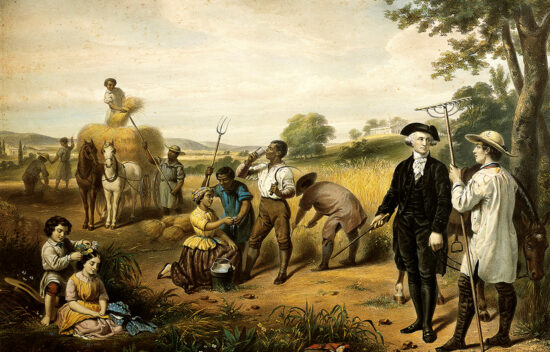
Students should be familiar with the debates surrounding slavery in the Constitutional Convention in Chapter 3. Students should read the James Madison and the Bill of Rights Narrative and Benjamin Franklin and the First Abolitionist Petitions Narrative for context before reading this Lesson.

Students can further explore the context surrounding the Jay Treaty in the George Washington and the Proclamation of Neutrality Decision Point, The Jay Treaty Narrative, and in the excerpt from the treaty itself in The Jay Treaty, 1795 Primary Source. The Alexander Hamilton and the National Bank Narrative and The National Bank Debate Lesson provide more context on the founding of the bank.

Use this Lesson as a supplement to The Whiskey Rebellion: Unjust Taxation or Enforcing the Rule of Law? Point-Counterpoint.