Skip to Main Content

Curriculum

Life, Liberty, and the Pursuit of Happiness for U.S. History

Essential Question

Has the American nation lived up to the ideals of its experiment in liberty? Invite your students to explore the rich tapestry of American history and actively participate in the ongoing experiment that defines our nation's identity. Help your students gain insights into the nature of the American experiment - the ongoing quest for a more perfect union.

Grade
9–12
Published
Dec 22, 2020

Resource Overview:

Through narratives, primary sources, and point-counter-point debates, students will gain insights into the nature of the American experiment – the ongoing quest for a more perfect union. Containing contributions from over 90 scholars, this 16-chapter U.S. History and AP U.S. History yearlong curriculum resource can be used in place of a textbook or as a textbook supplement. The 16 chapters are grouped into 8 units to allow students to connect themes during their study. The lessons highlighted below are intended to be used at the conclusion of each unit. Explore the full resource design.

Each Chapter Contains:

  • An introductory essay and an Inquiry Organizer to orient students to the topics and questions contained in it.
  • Primary Sources that help students build out background or facts for an argument.
  • Narratives that further an understanding of history as the connection of people and events in a timeline affected by experiences.
  • Decision Points that help students understand actions, consequences, and a chain of events.
  • Point-Counterpoints about big historical questions presented as differing sides of an argument by scholars.

Teachers Say:

“I appreciated most things about this, but the first thing that jumped out to me was how each topic could be implemented in class without the teacher having to make any adjustments. It’s one of the most user-friendly resources I have come across in my teaching.” Christopher Evans, Arizona teacher


“It was organized well with very good primary and secondary sources. The activities, such as point-counterpoint, were well thought out. I’m always looking for activities like that to do in class. Overall, this is better than the American history textbooks I have seen. Very well aligned to the AP curriculum. I like that it is split into smaller sections for the units rather than one big long text. Excellent.” Carl S., Pennsylvania teacher


Units

Historical illustration depicting agricultural practices with figures farming and various crops and livestock.
Chapter 1: The Columbian Exchange 1491-1607
  • 6 Lessons
  • 7 Activities
  • 9 Essays

Invite students to explore how the collision of cultures created a "New World" and evaluate the impact of European contact with Native Americans and the Americas.

This is a 1670 painting showing bare-chested, barefoot black men in knee-length pants, doing various tasks associated with tobacco drying. Some stand in sheds hanging the leaves up to dry.
Chapter 2: The Colonial Era 1607-1763
  • 4 Lessons
  • 8 Activities
  • 17 Essays

Invite students to explore the religious, political, and social movements and events that fostered a sense of autonomy from Great Britain among the American colonists between 1607 and 1763.

Washington crossing the Delaware River with soldiers during the American Revolution, depicting a historical moment.
Chapter 3: The American Revolution 1763-1789
  • 9 Lessons
  • 12 Activities
  • 17 Essays

Invite students to identify the causes of the Declaration of Independence, evaluate the causes and effects of key events in the Revolutionary War, and compare various perspectives on constitutional principles and the structure of the new Union under the Constitution.
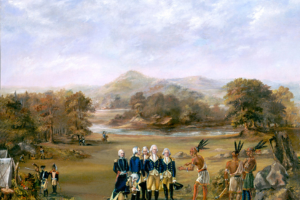
A historical painting depicting colonial figures and Indigenous Americans in a natural landscape.
Chapter 4: The Early Republic 1789-1800
  • 9 Lessons
  • 13 Activities
  • 12 Essays

Invites students to explore how a nation can stay unified despite divisions.
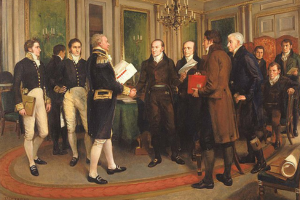
A historical meeting featuring men in formal attire discussing documents in an elegant room.
Chapter 5: The Era of Good Feelings 1800-1828
  • 2 Lessons
  • 6 Activities
  • 12 Essays

Invite students to explore if the early republic was truly an Era of Good Feelings.
A historical painting depicting figures in military uniforms and Indigenous people in a natural landscape.
Chapter 6: The Jacksonian Era 1828-1844
  • 3 Lessons
  • 13 Activities
  • 13 Essays

Invite students to explore if the democratization of politics during the Jacksonian era was a shift from Founding era political theory.

Chapter 7: The Antebellum Period 1844-1860
  • 4 Lessons
  • 17 Activities
  • 17 Essays

Invite students to explore if the Civil War was inevitable.
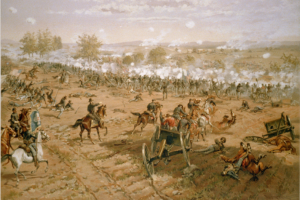
A historical battle scene with cavalry, infantry, and artillery in action on a battlefield.
Chapter 8: The Civil War and Reconstruction 1860-1877
  • 3 Lessons
  • 12 Activities
  • 15 Essays

Invites students to explore if the Civil War helped create a more perfect Union.

Load more units

Standards