Skip to Main Content

Unit

Chapter 6: The Jacksonian Era 1828-1844

Guiding question

Invite students to explore if the democratization of politics during the Jacksonian era was a shift from Founding era political theory.
Grade
9–12
Published
Oct 5, 2021
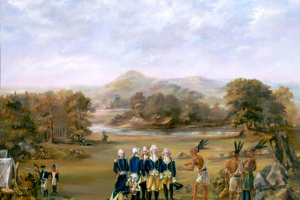
A historical painting depicting figures in military uniforms and Indigenous people in a natural landscape.

Chapter 6 of Life, Liberty, and the Pursuit of Happiness, BRI’s U.S. History Curriculum Resource, invites students to explore whether the democratization of politics during the Jacksonian era was a shift from Founding-era political theory. Discover our suggested sequence for Chapter 6.

Teacher resource

Chapter 6: 1828-1844 Inquiry Organizer

Was the democratization of politics during the Jacksonian era a shift from Founding era political theory?

Download

Lessons

Portrait of a Native American man with traditional feathered headdress and painted face.
Responses to the Cherokee Removal Mini DBQ
  • 1 Activity
  • 95 min

This Lesson can be used alongside The Trail of Tears Narrative to highlight the plight of American Indians during the Jackson presidency.

Abstract artwork depicting a stylized map of the United States with drips of paint and faded state labels.
American Indians in American Art

Students should be familiar with the increasing tensions between American Indians and U.S. settlers discussed in the Chapter 5 Introductory Essay: 1800-1828 and the following Narratives: The Lewis and Clark Expedition ,Old Hickory: Andrew Jackson and the Battle of New Orleans , and Tecumseh and the Prophet.

Image of women's rights protest
The Women’s Movement and the Seneca Falls Convention
  • 55 min

This Lesson should follow the Elizabeth Cady Stanton and the Struggle for Women's Suffrage Narrative.

Unit resources

White marble statue of a man in formal attire, displayed on a stone pedestal within an arched architectural setting.
ActivityIs the Concurrent Majority Theory Faithful to the Ideals of the Constitution?

Did John C. Calhoun's political theories on the dangers of majority rule adhere to the Framers goal of protecting the rights of all? Barton A. Myers and James H. Read debate this question.

Portrait of a man with gray hair, dressed in formal attire, set against a dark background.
ActivityJohn C. Calhoun, South Carolina Exposition and Protest, 1828

Use this primary source text to explore key historical events.

Illustration from "Walker's Appeal," depicting a figure holding a banner, with text on the opposite page.
ActivityDavid Walker, “An Appeal to the Coloured Citizens of the World,” 1829

Use this primary source text to explore key historical events.

Portrait of Daniel Webster.
ActivityWebster-Hayne Debates, 1830

Use this primary source text to explore key historical events.

Historical scene depicting people on horseback and wagons in a landscape, representing movement and travel.
ActivityIndian Removal Act, 1830, and Cherokee Chief John Ross’s Memorial and Protest to Congress, 1836

Use this primary source text to explore key historical events.

A historical illustration depicting a large crowd gathered outside a grand building during a festive event.
ActivityAndrew Jackson, Bank Veto Message, 1832

Use this primary source text to explore key historical events.

Portrait of a young man in a dark coat, with curly hair, set against a neutral background.
ActivityAlexis de Tocqueville, Democracy in America, 1835

Use this primary source text to explore key historical events.

A vintage envelope addressed to R.S. Blanchard, Belleville, Jeff Co, New York, with cancellation marks.
ActivityJedediah Burchard, Revivalist Sermon, 1835

Use this primary source text to explore key historical events.

Portrait of a woman with a serious expression, wearing a bonnet and a collared dress. Black and white image.
ActivitySarah M. Grimké, Letters on the Equality of the Sexes and the Condition of Women, 1837

Use this primary source text to explore key historical events.

Black and white portrait of a man with dark hair and sideburns, wearing a bow tie and suit.
ActivityRalph Waldo Emerson, “The American Scholar,” 1837

Use this primary source text to explore key historical events.

Portrait of a man with gray hair, dressed in formal attire, set against a dark background.
ActivityJohn C. Calhoun, “Slavery as a Positive Good,” 1837

Use this primary source text to explore key historical events.

Black and white portrait of a woman with long hair styled in a bun, wearing a high-collared garment.
ActivityDorothea Dix, Memorial to the Legislation of Massachusetts, 1843

Use this primary source text to explore key historical events.

Load more

Standards