Lesson
Elections
Guiding question
Who should be involved in the election process?

Elections have consequences. They decide who holds power and therefore the laws that we live under. But they also reflect principles of federalism and consent of the governed, as well as the complexity of the American system.
Founding Principles
Consent of the Governed, Representative / Republican Government
Guiding Questions
- Who should be involved in the election process?
- Is the Electoral College a good idea?
- How does the Constitution address voting rights?
- Why is the right to vote essential to personal liberty?
- Who was involved in expanding voting rights?
- What role should corporations play in elections?
Objectives
- Students will evaluate Hamilton’s reasons for the establishment of the electoral college.
- Students will analyze the constitutional expansion of voting rights.
- Students will evaluate the role individual citizens played in expanding voting rights.
- Students will trace the history of campaign finance reform.
- Students will analyze the Supreme Court opinions in 2010 Citizens United v. FEC.
Materials
Educator Resources
Student Handouts
- Elections Essay
- Electoral Map (or choose your own online electoral map)
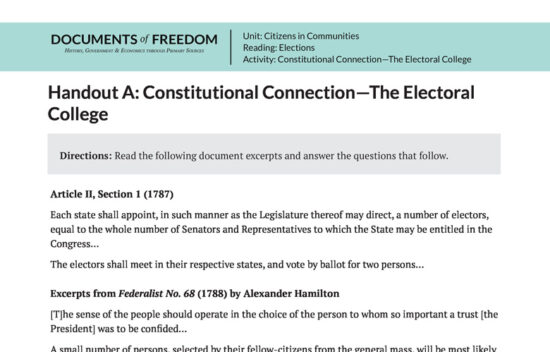
- Handout A: A Constitutional Connection – The Electoral College
- Handout B: Background Essay – Voting Rights Amendments
- Handout C: The Suffrage Amendments
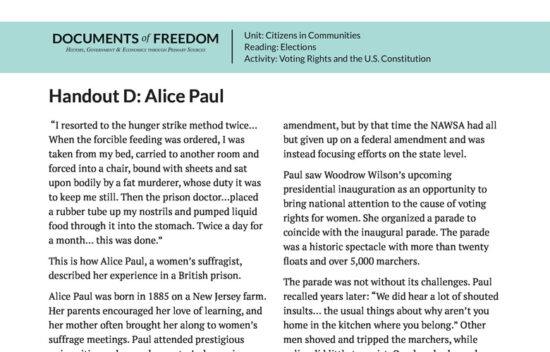
- Handout D: Alice Paul
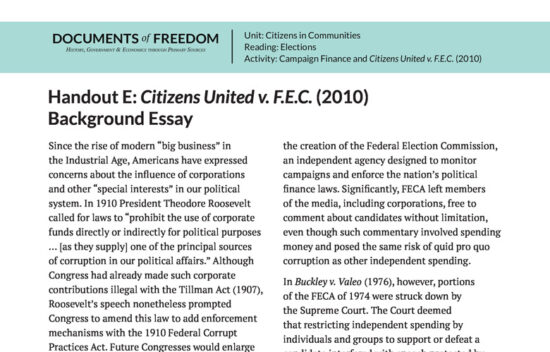
- Handout E: Citizens United v. FEC (2010) Background Essay
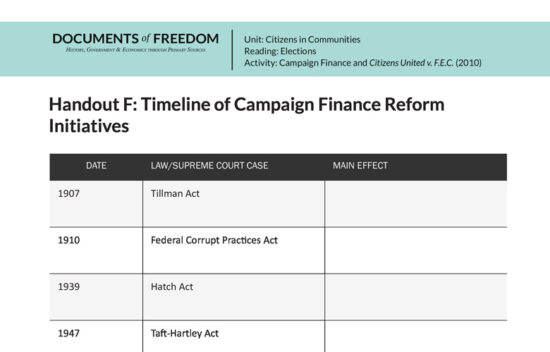
- Handout F: Timeline of campaign finance reform initiatives
- Handout G: Citizens United v. FEC (2010) Majority Opinion
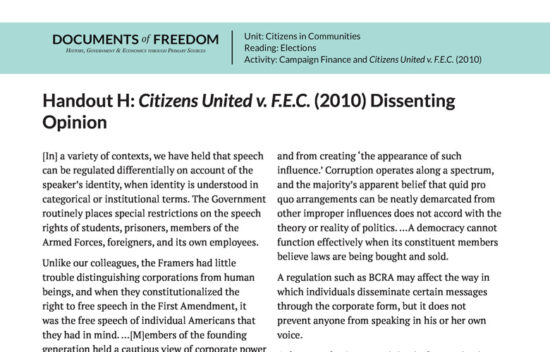
- Handout H: Citizens United v. FEC (2010) Dissenting Opinion
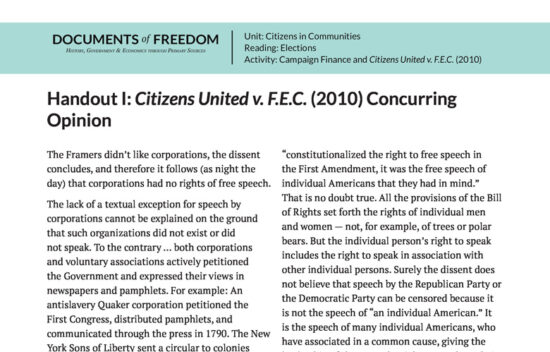
- Handout I: Citizens United v. FEC (2010) Concurring Opinion
- Handout J: Evaluation of Citizens United v. FEC (2010)
Lesson Components


ActivityHandout D: Alice Paul


EssayEssay: Elections
Elections have consequences. They decide who holds power and therefore the laws that we live under. But they also reflect principles of federalism and consent of the governed, as well as the complexity of the American system.
Lesson plan
140 minClick a phase to open it
Key Terms
- separation of powers
- Thomas Jefferson
- Electoral College
- popular sovereignty
- founders