Skip to Main Content

Unit

Chapter 9: The Gilded Age 1877-1898

Guiding question

Invite students to explore how a changing view of government’s responsibility during the Gilded Age affected American society.
Grade
9–12
Published
Oct 5, 2021
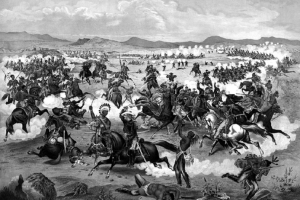
A historical illustration depicting a chaotic battle scene with cavalry and Native American warriors.

Chapter 9 of Life, Liberty, and the Pursuit of Happiness, BRI’s U.S. History Curriculum Resource, invites students to explore how a changing view of government’s responsibility during the Gilded Age affected American society. Discover our suggested sequence for Chapter 9.

Teacher resource

Chapter 9: 1877-1898 Inquiry Organizer

How did a changing view of government’s responsibility during the Gilded Age affect American society?

Download

Lessons

The photograph shows marines lined up in a clearing surrounded by palm trees.
The Annexation of Hawaii DBQ
  • 1 Activity
  • 100 min

Use this Lesson with The Annexation of Hawaii Narrative to show how American policymakers and businesses looked outside U.S. borders to continue expanding American influence.

The illustration depicts workers building a wall labeled with derogatory terms, reflecting anti-Chinese sentiment in the past.
Industry and Immigration in the Gilded Age
  • 3 Activities
  • 1 Essay
  • 85 min

Use this Lesson with the Cartoon Analysis: Immigration in the Gilded Age, 1882–1896 Primary Source to highlight the way immigrants were regarded and treated during the Gilded Age.

Black and white photo of an older man in a patterned coat and cap, standing by a stone railing outdoors.
Debating Industrial Progress: Andrew Carnegie vs. Henry George
  • 2 Activities
  • 65 min

Use this Lesson with the Andrew Carnegie and the Creation of U.S. Steel Narrative and the Were the Titans of the Gilded Age "Robber Barons" or "Entrepreneurial Industrialists"? Point-Counterpoint to highlight the impact businessmen like Carnegie had on industry and philanthropy in the Gilded Age.

Political cartoon depicting wealthy monopolists influencing senators in a legislative chamber.
Populists and Socialists in the Gilded Age
  • 3 Activities
  • 75 min

Use this Lesson with the Ignatius Donnelly and the 1892 Populist Platform Narrative and the William Jennings Bryan, "Cross of Gold," speech 1896 speech Primary Source to give students a deeper understanding of Gilded Age political platforms.

Black and white portraits of two distinguished men in formal attire, facing each other against a textured background.
Debating Strategies for Change: Booker T. Washington vs. W.E.B. Du Bois
  • 2 Activities
  • 65 min

Use this Lesson with the Booker T. Washington, "Speech to the Cotton States and International Exposition," 1895 Primary Source to allow students to analyze and compare arguments for the early African American civil rights movement.

Unit resources

Political cartoon depicting historical figures engaging in conflict over a map of an island, with exaggerated features and actions.
ActivityWere the Titans of the Gilded Age “Robber Barons” or “Entrepreneurial Industrialists”?

Was the economic growth in the country during the Gilded Age justified if it was built on the backs of American workers? Mark Summers and John Steele Gordon debate this question.

A large hand with a watch points down at a cartoonish map of New Jersey, depicting dominance and control.
ActivityWere Urban Bosses Essential Service Providers or Corrupt Politicians?

Were urban leaders more like "Boss" Tweed, who is infamous for his corruption, or did most benefit their communities by providing services that local governments did not? Stephanie Hinnershitz and Mark Summers debate which narrative about these urban bosses was more accurate.

Map showing settled areas in the U.S. in 1860, with patterns indicating settlements from 1830 to 1860.
ActivityWas Frederick Jackson Turner’s Frontier Thesis Myth or Reality?

Did western expansion fuel the individualism seen in the American character? Andrew Fisher and Bradley J. Birzer debate the validity of Frederick Jackson Turner's Frontier Thesis.

Cartoon of a rotund man with a dollar sign for a head, captioned about Tammany's victory at a convention.
ActivityCartoon Analysis: Thomas Nast Takes on “Boss” Tweed, 1871

Use this primary source imagery to analyze major events in history.

Promotional poster for Indian land for sale, listing properties and prices in various states. Historical context included.
ActivityThe Dawes Act, 1887

Use this primary source text to explore key historical events.

Black and white photograph of a group of ten Indigenous individuals posed outdoors, with a building in the background.
ActivityImages from the Carlisle Indian School, 1880s

Use this primary source imagery to analyze major events in history.

Black and white portrait of a man with a mustache, wearing a suit and bow tie.
ActivityGrover Cleveland’s Veto of the Texas Seed Bill, 1887

Use this primary source text to explore key historical events.

Portrait of Edward Bellamy alongside the cover of his book "Looking Backward."
ActivityEdward Bellamy, Looking Backward, 2000–1887, 1888

Use this primary source text to explore key historical events.

The front page of a pamphlet titled Southern Horrors, Lynch Law in All Its Phases.
ActivityIda B. Wells, “Lynch Law,” 1893

Use this primary source text to explore key historical events.

A man in period clothing sits at a desk surrounded by stacks of books and documents in a vintage office setting.
ActivityFrederick Jackson Turner, “The Significance of the Frontier in American History,” 1893

Use this primary source text to explore key historical events.

A historical black-and-white photo of a man speaking to a large crowd outdoors.
ActivityBooker T. Washington, “Speech to the Cotton States and International Exposition,” 1895

Use this primary source text to explore key historical events.

A caricature of Uncle Sam speaking to an immigrant at a gateway, depicting issues of immigration and nationality.
ActivityCartoon Analysis: Immigration in the Gilded Age, 1882–1896

Use this primary source imagery to analyze major events in history.

Load more

Standards