Lesson
The Annexation of Hawaii DBQ

Use this Lesson with The Annexation of Hawaii Narrative to show how American policymakers and businesses looked outside U.S. borders to continue expanding American influence.
Objectives:
- Students will examine how and why makers of foreign policy looked outside the United States to gain greater influence and control over markets and natural resources.
- Students will contextualize the annexation of Hawaii.
- Students will compare the annexation of Hawaii with previous territorial acquisitions in United States history.
Materials
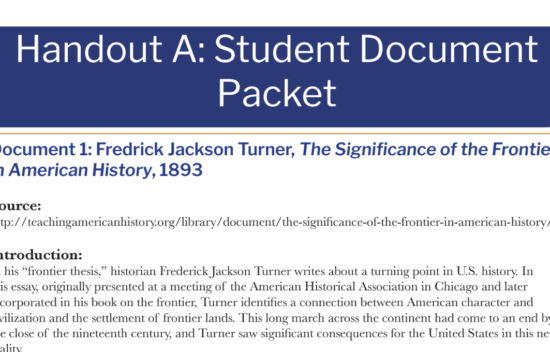
Handout A: Student Document Packet
- Document 1: Fredrick Jackson Turner, The Significance of the Frontier in American History, 1893
- Document 2: Alfred Thayer Mahan, The Interest of America in Sea Power, Present and Future, 1897
- Document 3: Map of U.S. Imperial Acquisitions 1865–1900
- Document 4: 1887 “Bayonet” Constitution of the Kingdom of Hawaii
- Document 5: President Grover Cleveland, Message about Hawaii, December 18, 1893
- Document 6: Petition against the annexation of Hawaii, 1897
- Document 7: Newlands Resolution, July 7, 1898
Lesson Components
ActivityPrimary Source Packet: Annexation of Hawaii
Seven primary sources that help students enter into the discussion foreign policy holders had about the annexation of the Hawaiian Islands.
Lesson plan
100 minClick a phase to open it
More Information
Students can work individually or in pairs to examine the documents.
Standards
Advanced Placement
- Topic 6.6 · The Rise of Industrial Capitalism
- Topic 6.12 · Controversies over the Role of Government in the Gilded Age
- Theme · Work, Exchange, and Technology
- Theme · Politics and Power
- Learning Objective · Unit 6E
- Learning Objective · Unit 6J
- Historical Development · 6.1.I.E.i
- Historical Development · 6.1.I.E.ii
- Reasoning Skill · Sourcing and Situation
- Reasoning Skill · Source Claims and Evidence
- Reasoning Skill · Contextualization
- Reasoning Skill · Making Connections
- Reasoning Skill · Argumentation
- Reasoning Process · Comparison
- Reasoning Process · Continuity and Change
Check whether this resource aligns with your state’s standards →
Related materials