

Life, Liberty, and the Pursuit of Happiness Chapter 9
43 items

Were the Titans of the Gilded Age “Robber Barons” or “Entrepreneurial Industrialists”?
Activity
Activity
40 Min
Was the economic growth in the country during the Gilded Age justified if it was built on the backs of American workers? Mark Summers and John Steele Gordon debate this question.

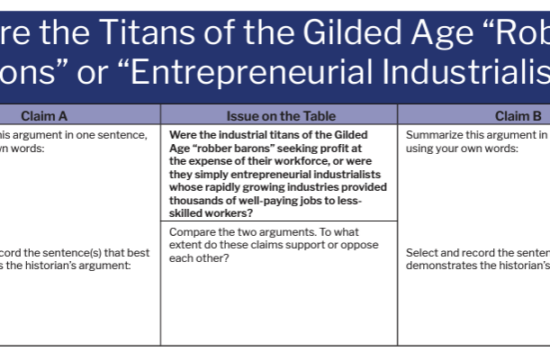
Were the Titans of the Gilded Age “Robber Barons” or “Entrepreneurial Industrialists” Graphic Organizer
Activity
Activity
40 Min
A handout to accompany the scholarly claims made in the corresponding Point-Counterpoint readings that helps student synthesize the claims put forth.

Were Urban Bosses Essential Service Providers or Corrupt Politicians?
Activity
Activity
40 Min
Were urban leaders more like "Boss" Tweed, who is infamous for his corruption, or did most benefit their communities by providing services that local governments did not? Stephanie Hinnershitz and Mark Summers debate which narrative about these urban bosses was more accurate.

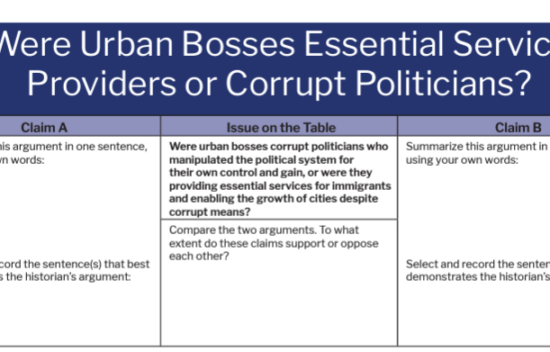
Were Urban Bosses Essential Service Providers or Corrupt Politicians Graphic Organizer
Activity
Activity
40 Min
A handout to accompany the scholarly claims made in the corresponding Point-Counterpoint readings that helps student synthesize the claims put forth.

Cartoon Analysis: Thomas Nast Takes on “Boss” Tweed, 1871
Activity
Activity
40 Min
Use this primary source imagery to analyze major events in history.

The Transcontinental Railroad
Essay - 2622 Words
Essay
2622 Words
What were the societal impact of the transcontinental railroad?

The Brooklyn Bridge
Essay - 2146 Words
Essay
2146 Words
By the end of this section, you will explain the causes and effects of the settlement of the West from 1877 to 1898.

Andrew Carnegie and the Creation of U.S. Steel
Essay - 2348 Words
Essay
2348 Words
Explore how Carnegie became one of the richest men in the U.S.

The Homestead Strike
Essay - 2602 Words
Essay
2602 Words
Why did unions and management battle each other in the 1890s?

Structured Academic Controversy Directions and Graphic Organizer
Activity
Activity
40 Min
A facilitation guide for a Structured Academic Controversy to address the themes of Is industrial progress as a positive force for human progress in the Andrew Carnegie and Henry George primary sources.

Industrial Progress Primary Sources
Activity
Activity
40 Min
Andrew Carnegie and Henry George primary sources that share contrasting views on industrial progress.

Ignatius Donnelly and the 1892 Populist Platform
Essay - 2871 Words
Essay
2871 Words
What sparked the rise of the Populist movement?

Populist Party Platform Excerpts
Activity
Activity
Primary Source: Populist Party 1892 Platform Excerpts.

Social Democratic Party Platform Excerpts
Activity
Activity
Primary Source: Declaration of Principles of the Social Democratic Party.

Comparison of Populist and Socialist Platforms
Activity
Activity
Compare and contrast the similarities and differences between the Populist and Socialist Party platforms.

Civil Rights and Economic Freedom Student Packet
Activity
Activity
40 Min
Narrative and timeline content that showcase the major governmental and political actions as relates to Civil Rights and Economic Freedom during the Gilded Age.

William Jennings Bryan, “Cross of Gold” Speech, 1896
Activity
Activity
40 Min
Use this primary source text to explore key historical events.

Jane Addams, Hull House, and Immigration
Essay - 2404 Words
Essay
2404 Words
How did Jane Addams help immigrants in the U.S.?

Edward Bellamy, Looking Backward, 2000–1887, 1888
Activity
Activity
40 Min
Use this primary source text to explore key historical events.

Ida B. Wells and the Campaign against Lynching
Essay - 1848 Words
Essay
1848 Words
How did Ida Wells fight for justice for African Americans?

Ida B. Wells, “Lynch Law,” 1893
Activity
Activity
40 Min
Use this primary source text to explore key historical events.

Plessy v. Ferguson
Essay - 2793 Words
Essay
2793 Words
How did Plessy v Ferguson affect segregation in the U.S.?

Booker T. Washington, “Speech to the Cotton States and International Exposition,” 1895
Activity
Activity
40 Min
Use this primary source text to explore key historical events.

Primary Sources: Washington and Du Bois
Activity
Activity
Two primary sources including Booker T. Washington's 'Speech before the Atlanta Cotton States and International Exposition', September 18, 1895 and W. E. B. Du Bois' 'Niagara Movement Speech', 1905.

Structured Academic Controversy Handout
Activity
Activity
A facilitation guide for a Structured Academic Controversy to address the themes of Civil Rights and Economic Freedom in the Washington and Du Bois primary sources.

The Chinese Exclusion Act
Essay - 2373 Words
Essay
2373 Words
By the end of this section, you will explain how cultural and economic factors affected migration patterns over time.

Cartoon Analysis: Immigration in the Gilded Age, 1882–1896
Activity
Activity
40 Min
Use this primary source imagery to analyze major events in history.

Background Essay: Immigrants and Industry
Essay - 940 Words
Essay
940 Words
How did the increase in industrialization during the period 1865–1898 fuel immigration to the United States and what was the result?

Nevada Manifest
Activity
Activity
Examine the manifest of the Nevada and analyze demographic information about the passengers of one voyage of one ship transporting immigrants to the United States.

Letters from Polish Immigrants to Their Families in Poland
Activity
Activity
Three letters that help students understand how the increase in industrialization fueled immigration and what was the results were.

Debate over Immigration Laws 1896–1897
Activity
Activity
In what ways did Henry Cabot Lodge and President Cleveland express different reactions to immigration and in what did those reactions reveal about American identity?

George Custer, Sitting Bull, and the Battle of the Little Bighorn
Essay - 3156 Words
Essay
3156 Words
By the end of this section, you will explain the causes and effects of the settlement of the West from 1877 to 1898.

The Dawes Act, 1887
Activity
Activity
40 Min
Use this primary source text to explore key historical events.

Images from the Carlisle Indian School, 1880s
Activity
Activity
40 Min
Use this primary source imagery to analyze major events in history.

Cowboys and Cattle Drives
Essay - 2795 Words
Essay
2795 Words
Why do Americans romanticize the image of cowboys?

Was Frederick Jackson Turner’s Frontier Thesis Myth or Reality Graphic Organizer
Activity
Activity
40 Min
A handout to accompany the scholarly claims made in the corresponding Point-Counterpoint readings that helps student synthesize the claims put forth.

Frederick Jackson Turner, “The Significance of the Frontier in American History,” 1893
Activity
Activity
40 Min
Use this primary source text to explore key historical events.

The Annexation of Hawaii
Essay - 2523 Words
Essay
2523 Words
Was the annexation of Hawaii an act of imperialism?

Primary Source Packet: Annexation of Hawaii
Activity
Activity
Seven primary sources that help students enter into the discussion foreign policy holders had about the annexation of the Hawaiian Islands.

Grover Cleveland’s Veto of the Texas Seed Bill, 1887
Activity
Activity
40 Min
Use this primary source text to explore key historical events.

African Americans in the Gilded Age | BRI’s Homework Help Series
Video
Video
5 Min
The first in our new Institute of History Series of Homework Help videos provides a general overview of the experience of African Americans during the pivotal years of the Gilded Age, from the 1860s to the early 1900s. Despite the passage of the 13th, 14th, and 15th Amendments to the Constitution after the Civil War, which abolished slavery and granted citizenship and voting rights to African American men, millions of African Americans across the nation still faced an uphill struggle for equality and civil rights. Political disenfranchisement was widespread and segregation in the form of "Jim Crow" laws affected nearly every facet of public and private life in the South. Many African Americans migrated from the South to the North and West during this period. This era also saw the rise of dozens of notable African American civil rights leaders including Ida B. Wells, Frederick Douglass, Booker T. Washington, and W.E.B. Du Bois. Groups like the N.A.AC.P. were also established during this period to fight for the expansion of liberty and equality for African Americans.
5 Min

The Story of “Boss” Tweed | BRI’s Homework Help Series
Video
Video
5 Min
This first in our new Homework Help Evidence of History series tells the story of William "Boss" Tweed. Tracing his rise to political power in post Civil War New York City, a metropolis whose population was booming from an influx of European immigrants, this video explores the question of whether Tweed was a hero, a villain, or something in between. Examine the evidence and decide for yourself.
5 Min

Entrepreneurs: A History of Robber Barons | BRI’s Homework Help Series
Video
Video
4 Min
"Entrepreneurs" is our latest Evidence of History Homework Help video focusing on the so-called "Robber Barons" or "Captains of Industry" of the late 19th and early 20th century, including Andrew Carnegie, John D. Rockefeller, J.P. Morgan, and Henry Ford. How did these men and those like them transform the U.S. economy during the Gilded Age, and what, if any, lessons do their stories have for us today? Watch and find out!
4 Min