Lesson
Debating Strategies for Change: Booker T. Washington vs. W.E.B. Du Bois

Objectives:
- Students will examine differing accounts on the best method for African Americans to achieve equality and integration into American society by reading and summarizing the arguments of Booker T. Washington and W. E. B. Du Bois
- Students will practice civil discourse by following the Structured Academic Controversy model of debate.
Materials
Lesson Components
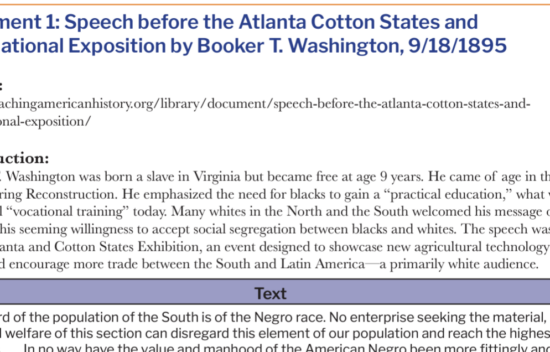
Two primary sources including Booker T. Washington's 'Speech before the Atlanta Cotton States and International Exposition', September 18, 1895 and W. E. B. Du Bois' 'Niagara Movement Speech', 1905.
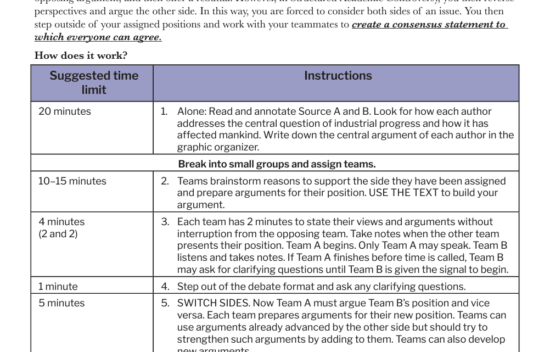
A facilitation guide for a Structured Academic Controversy to address the themes of Civil Rights and Economic Freedom in the Washington and Du Bois primary sources.
Lesson plan
More Information
Students can complete the readings for this activity in class or for homework. Note that the two documents are a decade apart. Evaluate the strength of each argument using these questions:
- Would Washington’s model of accommodation inevitably lead to political and social reform?
- Why did Du Bois demand legal and political equality, and how could he achieve such demands?
Standards
Advanced Placement
- Topic 6.4 · The “New South”
- Theme · American and National Identity
- Learning Objective · Unit 6C
- Historical Development · 6.3.II.C
- Reasoning Skill · Sourcing and Situation
- Reasoning Skill · Source Claims and Evidence
- Reasoning Skill · Contextualization
- Reasoning Skill · Making Connections
- Reasoning Skill · Argumentation
- Reasoning Process · Comparison
- Reasoning Process · Causation
Check whether this resource aligns with your state’s standards →
Related materials

Use this primary source text to explore key historical events.


How did Booker T. Washington, prominent African American educator and intellectual, contribute to understanding the Black experience in America? In this episode of our Scholar Talk series "Black Intellectuals and the African American Experience," BRI Senior Teaching Fellow Tony Williams is joined by Robert J. Norrell, Professor of History & Bernadotte Schmitt Chair of Excellence, the University of Tennessee and author of "Up from History: The Life of Booker T. Washington." Together, they explore the educational ideas of Washington and the ways he challenged racial discrimination and contributed to American culture broadly. What educational ideas and civic virtues did Washington promote for Black advancement?


How did W.E.B. Du Bois, prominent African-American intellectual, contribute to understanding the Black experience in America? In this video, BRI Senior Teaching Fellow Tony Williams is joined by Derrick P. Alridge, Professor of Education at the University of Virginia and affiliate faculty member in the Carter G. Woodson Institute for African-American and African Studies. Dr. Alridge is the author of "The Educational Thought of W.E.B. Du Bois: An Intellectual History." Together, they explore the educational ideas of Du Bois and the ways he challenged racial discrimination in "The Souls of Black Folk" and as editor of "The Crisis." How did his ideas about the "Talented Tenth” and Black education promote equality and justice?