Lesson
Immigration in the Gilded Age and Progressive Era

Founding Principles
Limited Government, Rule of Law, Liberty, Natural/Inalienable Rights
Objectives
- Students will identify what it means to be an immigrant and discover what was involved in the process of immigration.
- Students will investigate the impact immigration had upon the United States socially and economically.
- Students will assess the arguments given for and against the restriction of immigration.
Materials
- Handout A: Migration Experiment Graphic Organizer and Discussion Questions
- Handout B: Background Essay: The New Wave – Immigration in the Gilded Age and Progressive Era
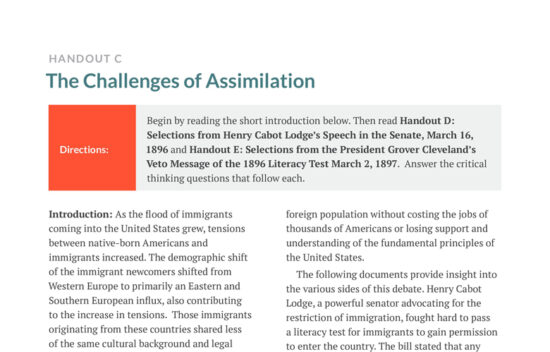
- Handout C: The Challenges of Assimilation
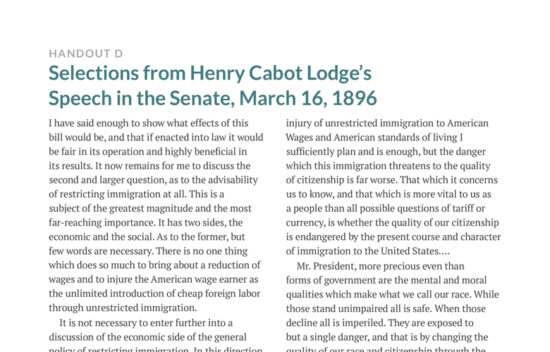
- Handout D: Selections from Henry Cabot Lodge’s Speech in the Senate, March 16, 1896
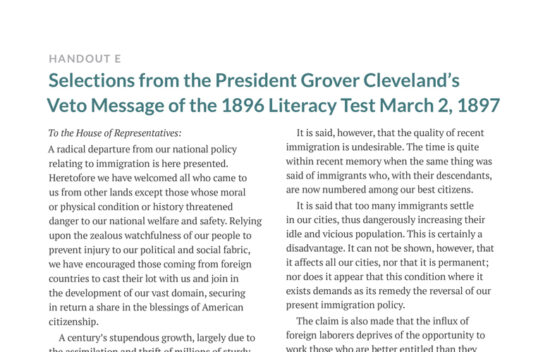
- Handout E: Selections from the President Grover Cleveland’s veto message of the 1896 Literacy test March 2, 1897
- Handout F: Immigration in the Progressive Era
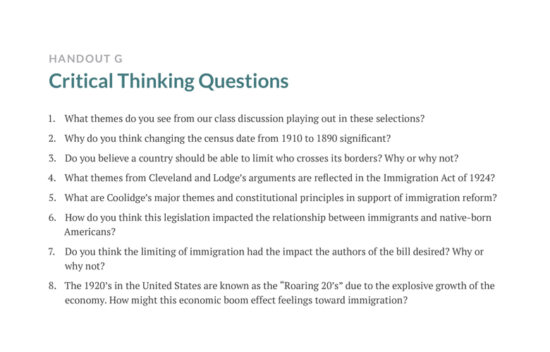
- Handout G: Class Discussion Questions
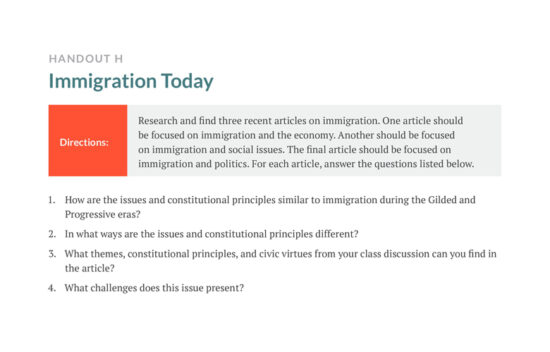
- Handout H: Immigration Today
Lesson Components



Lesson plan
Key Terms
- Migration
- Immigrant
- Ancestral
- Arduous
- Push factor
Standards
Advanced Placement
- National
Check whether this resource aligns with your state’s standards →
Related materials


Use this Lesson with the Cartoon Analysis: Immigration in the Gilded Age, 1882–1896 Primary Source to highlight the way immigrants were regarded and treated during the Gilded Age.

What is importance of immigration to the American story? Trace the history of immigration in the United States from its Founding to the first half of the twentieth century. Help students gain an understanding of the experience of immigrants in the 1800s, the factors that brought them to the United States, and the challenges they faced upon their arrival. Equip students to engage in the modern conversation on immigration in the United States.

What is the background history of immigration policy in the United States? Examine the philosophical origins, legal debates, and legal history from the Founding of the nation to the late 1900s. Give students tools to understand how American lawmakers have viewed immigrants and the reasoning behind the evolving nature of immigration policy.

Tony Williams is joined by Dr. Stephanie Hinnershitz, author and assistant professor of history at Cleveland State University, as they discuss her thought-provoking essay on the Chinese Exclusion Act of 1882 in BRI’s new digital textbook, Life, Liberty, and the Pursuit of Happiness. She chronicles the social, economic, and political factors that compelled many people to immigrate to the United States from China in the late 19th century, as well as the tragic violence and xenophobia that Chinese laborers routinely suffered. How did these tensions culminate in the passage of the Chinese Exclusion Act in 1882, and what impact did this discriminatory law have on society?

Have American views on immigration changed over time? In this episode, Mary walks through "The Anti-Chinese Wall" cartoon by Friedrich Graetz to understand the discriminatory reasons why many Americans objected to Chinese immigration in the late 19th century, and what they revealed about many Americans' beliefs during the time. How did the debate against Chinese immigration turn into the Chinese Exclusion Act?

May 6, 2020, marked 138 years since the signing of the Chinese Exclusion Act. Passed by Congress and signed by President Chester A. Arthur, the act banned Chinese immigration into the United States for ten years. Many in the U.S. despised Chinese immigrants, a group they believed did not integrate well into American culture and took jobs from Americans.