Unit
Chapter 13: The Cold War 1945-1960
Guiding question
Invite students to explore how anti-communist foreign policy, the liberal welfare state, and American cultural values shaped the postwar world from 1945 to 1960.
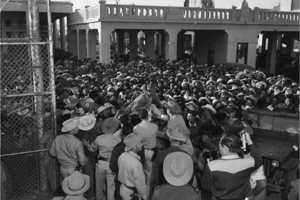
Chapter 13 of Life, Liberty, and the Pursuit of Happiness, BRI’s U.S. History Curriculum Resource, invites students to explore how anti-communist foreign policy, the liberal welfare state, and American cultural values shaped the postwar world from 1945 to 1960. Discover our suggested sequence for Chapter 13.
Teacher resource
Chapter 13: 1945-1960 Inquiry Organizer
How did anti-communist foreign policy, the liberal welfare state, and American cultural values shape the postwar world from 1945 to 1960?
Lessons

Use this lesson with The Postwar Red Scare Narrative to discuss the impact McCarthy and widespread fear of Communism had during the 1950s. This Lesson can also be used with the Cold War Spy Cases Narrative and the George Kennan ("Mr. X"), "Sources of Soviet Conduct," July 1947 Primary Source.

Use this lesson with The Nixon-Khrushchev Kitchen Debate Narrative and the Richard Nixon, "Checkers" Speech, September 1952 Primary Source to have students analyze the impact television made on the perception of politicians in the 1950s and 1960s.

Use this lesson with the Dr. Benjamin Spock and the Baby Boom Narrative and the Levittown Videos, 1947-1957 Primary Source to analyze the impact that the baby boom and urbanization had on American culture.
Unit resources

Were the large amount of money to keep up with the Soviet Union in space exploration and to be the first country to land a man on the moon worth it? Brian Domitrovic and Jeff Broadwater debate this question.

Which country, the United States or its previous ally, the Soviet Union, was responsible for the escalating tensions that led to the Cold War that would go on to last for decades? Two scholars debate this question.

Use this primary source text to explore key historical events.

Use this primary source imagery to analyze major events in history.

Use this primary source text to explore key historical events.

Use this primary source text to explore key historical events.

Use this primary source text to explore key historical events.

Use this primary source text to explore key historical events.

Use this primary source text to explore key historical events.

Use this primary source text to explore key historical events.

Use this primary source imagery to analyze major events in history.
