Lesson
The Constitutional Convention
Guiding question
To what extent did the Constitutional Convention correct the problems with the Articles of Confederation?

Founding Principles
Virtues
Guiding Questions
- To what extent did the Constitutional Convention correct the problems with the Articles of Confederation?
- Who were the delegates to the Constitutional Convention?
- How did the similarities and differences of the Framers affect the drafting of the Constitution?
- Did the Framers make the right compromises at the Constitutional Convention?
- Why is the Executive branch an essential part of government?
- How did the Founders view slavery?
- To what extent did the Framers agree that the Constitution should be ratified? Why?
Objectives
- Evaluate the similarities and differences of the Framers.
- Speculate how the similarities and differences of the Framers affected the drafting of the Constitution.
- Analyze the compromises made at the Constitutional Convention.
- Compare the Executive power of the Articles of Confederation and the US Constitution.
- Evaluate Madison’s definition of federalism.
- Summarize the arguments for and against slavery.
- Analyze George Mason’s objections to the Constitution.
- Predict how Mason might evaluate the Constitution if he could do so today.
Materials
Educator Resources
- Handout B: Bundle of Compromises Answer Key
- The Constitution and Executive Power Activity Handouts D-E Answer Keys
- Handout F: James Madison and Federalism Answer Key
- Slavery and the Founders Activity Handouts H-K Answer Keys
Student Handouts
- The Constitutional Convention Essay
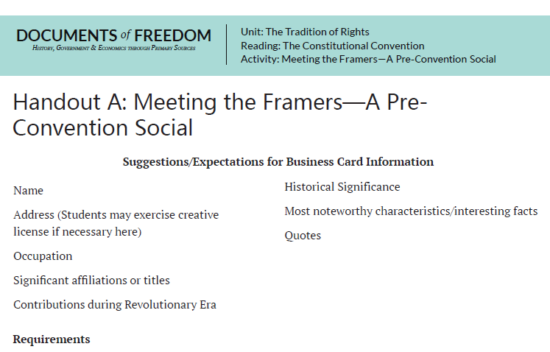
- Handout A: Meeting the Framers—A Pre-Convention Social
- Handout B: Bundle of Compromises
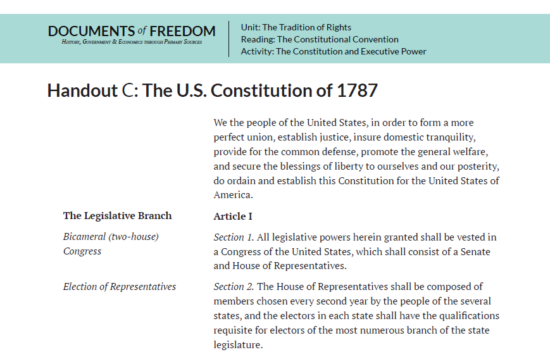
- Handout C: The U.S. Constitution of 1787
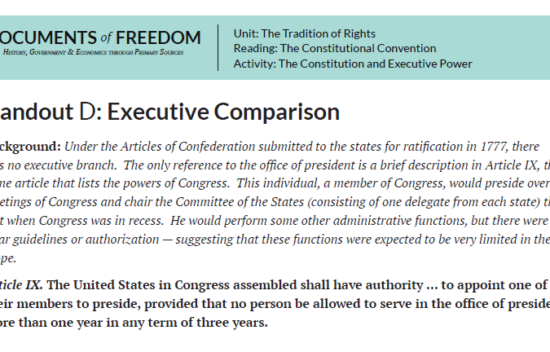
- Handout D: Executive Comparison
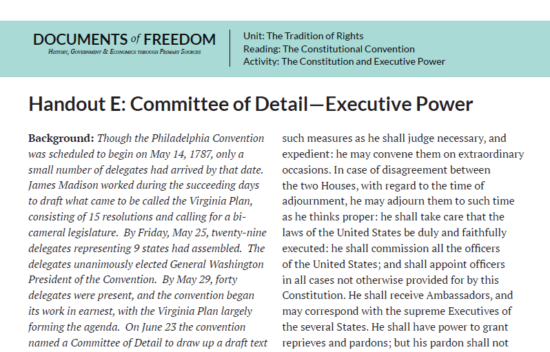
- Handout E: Committee of Detail – Executive Power
- Handout F: James Madison and Federalism – Excerpts from Federalist No. 39
- Handout G: Slavery and the Founders
- Handout H: Map — Emancipation in the Early Republic
- Handout I: Founders’ Quotes on Slavery
- Handout J: Readers’ Theater – Convention Debate on Slave Trade
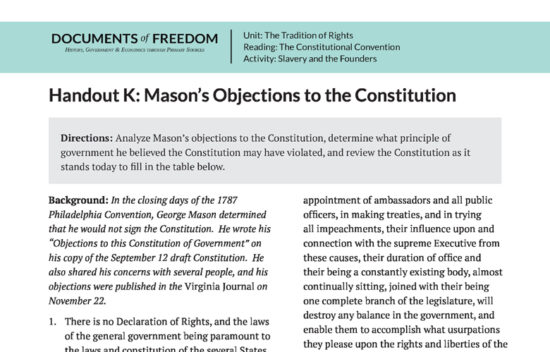
- Handout K: Mason’s Objections to the Constitution
Lesson Components


During the “critical period” after the American Revolution, many were concerned that the Articles of Confederation were inadequate for the states to grow commercially and economically. The Confederation Congress announced a meeting to revise the Articles of Confederation, but not everyone was convinced that the Articles needed revision—or even that the goals of the Convention were admirable. Divisions emerged among the delegates regarding centralized power, executive power, representation, and slavery.
Lesson plan
Key Terms
- Constitution
- Articles of Confederation
- Rule of law
- Second Amendment
- Alexis de Tocqueville
Standards
Related materials

What compromises were made at the Constitutional Convention?


Use this lesson with The Constitutional Convention Narrative and after students have done The Articles of Confederation, 1781 Primary Source activity.

What is the Quill Project at Oxford College? Learn more from Dr. Nicholas Cole, Senior Research Fellow at Pembroke College, University of Oxford and lead on the project.