Lesson
African Americans in the Gilded Age

Founding Principles
Equality, Property Rights, Rule of Law, Liberty, Natural/Inalienable Rights
Objectives
- Students will trace and evaluate efforts to achieve equality and protect the natural rights of blacks during the period following the Civil War.
- Students will analyze primary source documents and respond to a document-based question concerning efforts to achieve racial equality.
- Students will apply critical thinking skills to compare and evaluate proposals aimed at protection of life, liberty, and the pursuit of happiness for blacks in America.
- Students will participate in informed civil discourse aimed at solving problems related to controversial issues.
- Students will analyze documents and events to understand constitutional principles and essential virtues necessary for civil society.
Materials
- Handout A: Background Essay: African Americans in the Gilded Age
- Handout B: Ida B. Wells, “Lynch Law” 1893 (Excerpts)
- Handout C: Booker T. Washington: “The Atlanta Exposition Address” 1895 (Excerpts)
- Handout D: John Hope “We Are Struggling for Equality” 1896 (Excerpts)
- Handout E: John Marshall Harlan, Dissent from Plessy v. Ferguson (1896) (Excerpts)
- Handout F: W.E.B. DuBois, “The Talented Tenth,” 1903 (Excerpts)
- Handout G: W.E.B. DuBois: “Advice to a Black Schoolgirl” 1905
- Handout H: Niagara Movement Declaration of Principles 1905 (Excerpts)
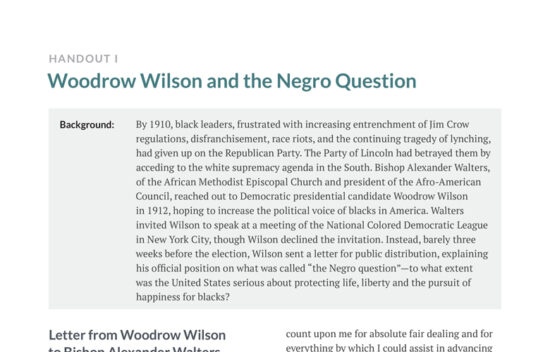
- Handout I: Woodrow Wilson and the Negro Question, 1912 & 1914
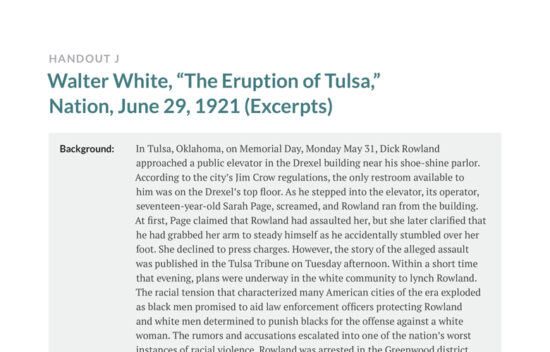
- Handout J: Walter White, “The Eruption of Tulsa,” Nation, June 29, 1921 (Excerpts)
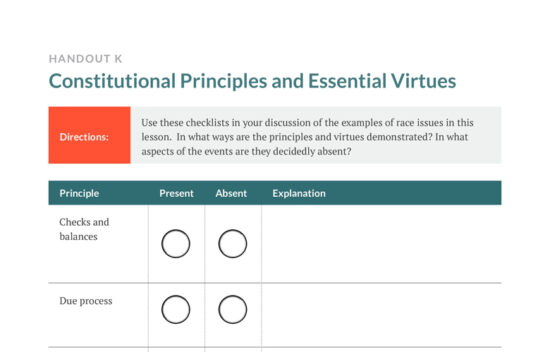
- Handout K: Constitutional Principles and Essential Virtues
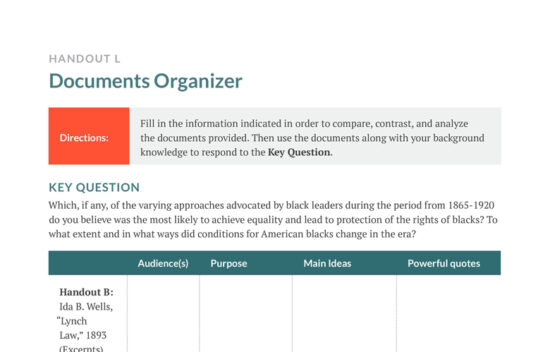
- Handout L: Documents Organizer
Lesson Components



Lesson plan
Key Terms
- Emancipation
- Disfranchisement
- Segregation
- Thirteenth Amendment
- Fourteenth Amendment
Standards
Advanced Placement
- National
Check whether this resource aligns with your state’s standards →
Related materials

The first in our new Institute of History Series of Homework Help videos provides a general overview of the experience of African Americans during the pivotal years of the Gilded Age, from the 1860s to the early 1900s. Despite the passage of the 13th, 14th, and 15th Amendments to the Constitution after the Civil War, which abolished slavery and granted citizenship and voting rights to African American men, millions of African Americans across the nation still faced an uphill struggle for equality and civil rights. Political disenfranchisement was widespread and segregation in the form of "Jim Crow" laws affected nearly every facet of public and private life in the South. Many African Americans migrated from the South to the North and West during this period. This era also saw the rise of dozens of notable African American civil rights leaders including Ida B. Wells, Frederick Douglass, Booker T. Washington, and W.E.B. Du Bois. Groups like the N.A.AC.P. were also established during this period to fight for the expansion of liberty and equality for African Americans.

What were the Founders’ concepts of justice, liberty, and rights and where did those concepts came from? How have these ideas changed over time? Use these primary sources to analyze.

In this lesson, students will read about and discuss how Booker T. Washington remained diligent about obtaining an education. They will draft an illustrated “map” of Booker T. Washington’s journey toward an education, and they will discuss how they can be diligent in their own lives.

Use this Lesson with the Booker T. Washington, "Speech to the Cotton States and International Exposition," 1895 Primary Source to allow students to analyze and compare arguments for the early African American civil rights movement.