Video
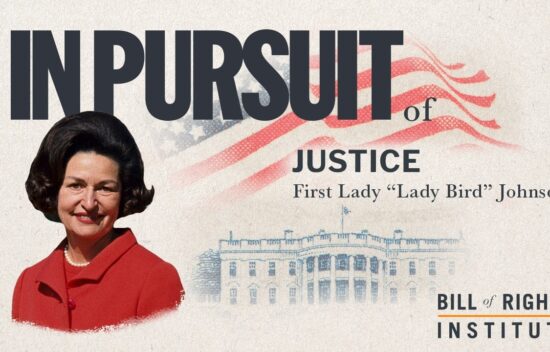
“Lady Bird” Johnson In Pursuit of Justice
Watch
About this video
In this video, students learn how Lady Bird Johnson used justice and civic responsibility to improve communities across America. Motivated by her belief that all people deserve beautiful and healthy public spaces, she championed environmental conservation and the Highway Beautification Act. Her efforts inspired citizens to take pride in their communities and demonstrated how small actions can contribute to the common good.
This video was based on an essay for In Pursuit written by First Lady Laura Bush.
This video was made in conjunction with In Pursuit. In Pursuit is a landmark initiative of More Perfect, a bipartisan alliance of 44 Presidential Centers, National Archives Foundation, American Academy of Arts and Sciences, Karsh Institute for Democracy at the University of Virginia, and more than 100 organizations working together to protect and renew our democracy as we approach the 250th anniversary of the Declaration of Independence and beyond.
0:06 In the mid-1960s, the interstate highway system was criss-crossing the United States and enabling Americans to drive their cars faster and further than ever before. But this system created some messes too, both politically and literally. As America’s highway system expanded,
0:26 roadways became littered with billboards, junkyards, and overgrown invasive plants. Lady Bird Johnson saw this as a reflection of national abandonment, not just of roadsides, but as a loss of respect for our land, so she decided to do something about it. Lady Bird Johnson
0:47 was born Claudia Alta Taylor. She became a Johnson when she married future president Lyndon Baines. She had a love for nature that was lifelong. During her childhood in East Texas, she grew up surrounded by towering pine trees, blooming dogwoods,
1:07 and the shimmering waters of Caddo Lake. She lost her mother at a young age, and she found comfort in the natural world that surrounded her. She would later say: “Where flowers bloom, so does hope.” She brought this quiet optimism and dedication to natural beauty with her
1:27 when her husband found himself in the White House following the assassination of President John F. Kennedy. Both of their lives changed rapidly following the president’s death. But even with the demands of political life, she never lost her love for the outdoors. And she used that love as a foundation for her life of public service.
1:50 When she got the chance to make a difference, Lady Bird lobbied Congress to pass the Highway Beautification Act. She pictured clean roadsides blooming with native wildflowers and scenic views unspoiled by ads. She wanted communities to take pride in their appearance, and with her determination, she persuaded Congress to
2:10 pass landmark legislation to that end. The law was even nicknamed “Lady Bird’s Bill.” She launched community-based beautification projects across the country. Schools and neighborhoods took part in the effort, and her work was part of the early spark for an environmental revival in the United States,
2:32 one that would later lead to the first Earth Day in 1970. For Lady Bird, her work was not merely about cosmetic improvement, but as a central feature of civic life.
3:00 After the presidential elections in 1964, Mrs. Lyndon Johnson felt that to be most effective as the nation’s first lady, she would concentrate her efforts in a few major areas of concern. During a meeting at the LBJ ranch, Mrs. Johnson was urged by Secretary of the Interior Stuart Udall
3:22 to share her lifelong interest in one of these areas: conservation and beautification. Putting this interest into practice would require organization and hard work. Mrs. Johnson wanted to make her adopted hometown an example for others to follow. Washington D.C.
3:43 would be a showcase for the nation. And so the Committee for a more beautiful capital was born. Beautification, to my mind, is far more than a matter of cosmetics. To me, it describes the whole effort to bring the natural world and the manmade world
4:04 into harmony, to bring order, usefulness, delight to our whole environment. “The environment is where we all meet,” and “it touches every part of our lives.” Johnson stood by the idea that when you plant a seed, you beautify a nation.
4:25 She wanted to encourage responsibility in the nation’s leadership, and in the lives of everyday citizens, as a virtue for public good. Her diligence made a real impact, and she proved that transforming society really can start with the smallest seed. Lady Bird Johnson’s work reminds us that we can’t measure progress
4:45 simply in laws passed or cities built. Every flower we see, every tree with strong roots, and every thriving community has to start somewhere. Often from the smallest seeds. We need to look at how we honor the land that sustains us. Even a single seed, when planted with care,
5:06 has the power to make our country more beautiful for the next generation to nurture and appreciate.
Standards
Related Resources
In Pursuit is a landmark initiative of More Perfect, a bipartisan alliance of 44 Presidential Centers, National Archives Foundation, American Academy of Arts and Sciences, Karsh Institute for Democracy at the University of Virginia, and more than 100 organizations working together to protect and renew our democracy as we approach the 250th anniversary of the Declaration of Independence and beyond.
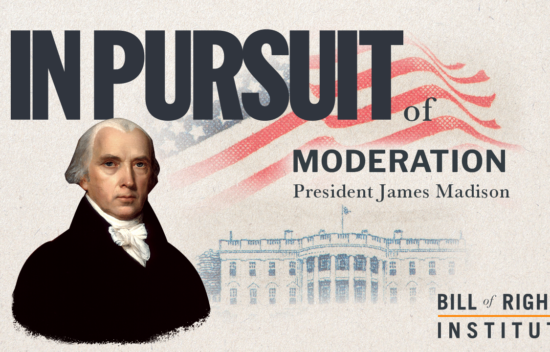
In this video, students learn how James Madison used moderation to build consensus during debates over the Constitution and the Bill of Rights. Although he initially opposed a bill of rights, Madison listened to concerns from Anti-Federalists, constituents, and fellow leaders. By seeking common ground and balancing competing viewpoints, he helped secure the Bill of Rights and strengthen confidence in the new constitutional government. This video was based on an essay for In Pursuit written by Jack Rakove: www.inpursuit.org/lessons/process-over-perfection Check out this video and other free teaching resources on BRI or In Pursuit websites at billofrightsinstitute.org/bri-x-in-pursuit/ or inpursuit.org/educators. This video was made in conjunction with In Pursuit. In Pursuit is a landmark initiative of More Perfect, a bipartisan alliance of 44 Presidential Centers, National Archives Foundation, American Academy of Arts and Sciences, Karsh Institute for Democracy at the University of Virginia, and more than 100 organizations working together to protect and renew our democracy as we approach the 250th anniversary of the Declaration of Independence and beyond.
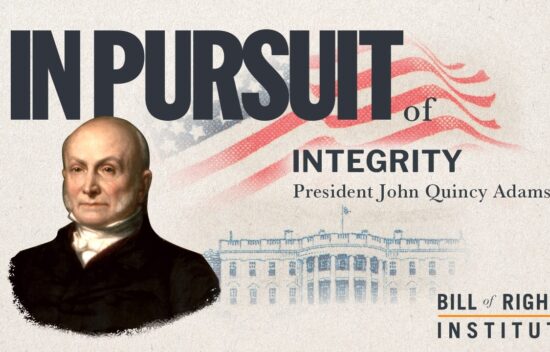
In this video, students learn how John Quincy Adams used integrity to shape American foreign policy during the nation's early years. From his diplomatic service in Europe to his role in developing the Monroe Doctrine, Adams balanced American interests with the nation's founding principles. His commitment to prudence, restraint, and self-government helped define America's place in the world. This video was based on an essay for In Pursuit written by Lindsay Chervinsky : www.inpursuit.org/lessons/short-term-defeat-does-not-end-long-term-influence Check out this video and other free teaching resources on BRI or In Pursuit websites at billofrightsinstitute.org/bri-x-in-pursuit/ or inpursuit.org/educators. This video was made in conjunction with In Pursuit. In Pursuit is a landmark initiative of More Perfect, a bipartisan alliance of 44 Presidential Centers, National Archives Foundation, American Academy of Arts and Sciences, Karsh Institute for Democracy at the University of Virginia, and more than 100 organizations working together to protect and renew our democracy as we approach the 250th anniversary of the Declaration of Independence and beyond.
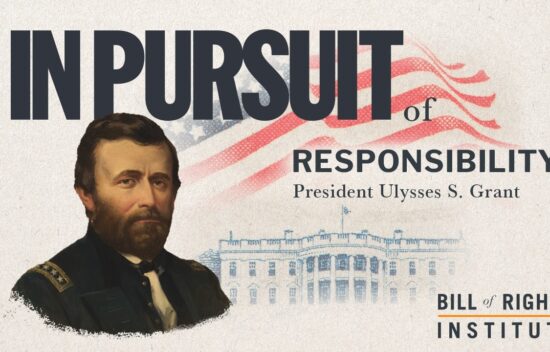
In this video, students learn how Ulysses S. Grant demonstrated responsibility during Reconstruction after the Civil War. Faced with political conflict and constitutional challenges, Grant remained committed to the rule of law and the protection of equal rights. His leadership during this pivotal period shows how civic responsibility can help preserve democratic institutions during times of national division. This video was based on an essay for In Pursuit written by General Stanley McChyrstal : www.inpursuit.org/lessons/loyalty-to-principle-is-harder-than-loyalty-to-power Check out this video and other free teaching resources on BRI or In Pursuit websites at billofrightsinstitute.org/bri-x-in-pursuit/ or inpursuit.org/educators. This video was made in conjunction with In Pursuit. In Pursuit is a landmark initiative of More Perfect, a bipartisan alliance of 44 Presidential Centers, National Archives Foundation, American Academy of Arts and Sciences, Karsh Institute for Democracy at the University of Virginia, and more than 100 organizations working together to protect and renew our democracy as we approach the 250th anniversary of the Declaration of Independence and beyond.
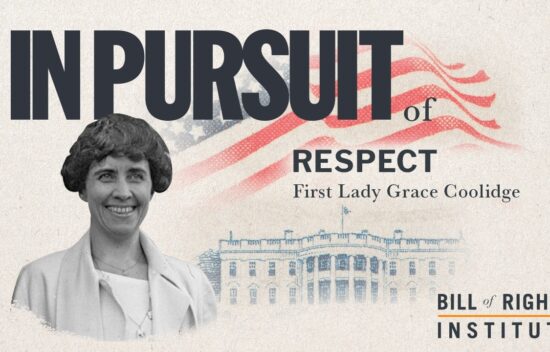
In this video, students learn how Grace Coolidge demonstrated respect through her public service, advocacy, and personal example. As First Lady, she welcomed visitors to the White House, championed educational opportunities, and promoted accessibility for people with disabilities. Her kindness, authenticity, and commitment to treating others with dignity helped her connect with Americans across the country. This video was based on an essay for In Pursuit written by Colleen Shogan. Check out this video and other free teaching resources on BRI or In Pursuit websites at billofrightsinstitute.org/bri-x-in-pursuit/ or inpursuit.org/educators. This video was made in conjunction with In Pursuit. In Pursuit is a landmark initiative of More Perfect, a bipartisan alliance of 44 Presidential Centers, National Archives Foundation, American Academy of Arts and Sciences, Karsh Institute for Democracy at the University of Virginia, and more than 100 organizations working together to protect and renew our democracy as we approach the 250th anniversary of the Declaration of Independence and beyond.