Video
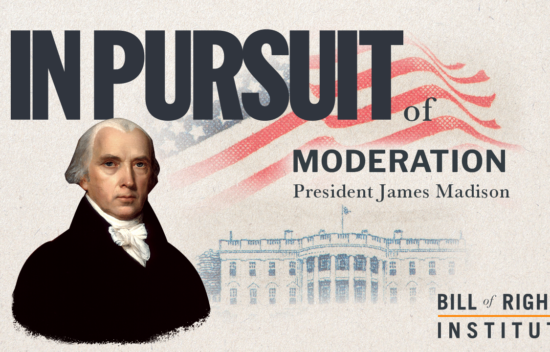
James Madison In Pursuit of Moderation
Watch
Virtues
About this video
In this video, students learn how James Madison used moderation to build consensus during debates over the Constitution and the Bill of Rights. Although he initially opposed a bill of rights, Madison listened to concerns from Anti-Federalists, constituents, and fellow leaders. By seeking common ground and balancing competing viewpoints, he helped secure the Bill of Rights and strengthen confidence in the new constitutional government.
This video was based on an essay for In Pursuit written by Jack Rakove: www.inpursuit.org/lessons/process-over-perfection
Check out this video and other free teaching resources on BRI or In Pursuit websites at billofrightsinstitute.org/bri-x-in-pursuit/ or inpursuit.org/educators.
This video was made in conjunction with In Pursuit. In Pursuit is a landmark initiative of More Perfect, a bipartisan alliance of 44 Presidential Centers, National Archives Foundation, American Academy of Arts and Sciences, Karsh Institute for Democracy at the University of Virginia, and more than 100 organizations working together to protect and renew our democracy as we approach the 250th anniversary of the Declaration of Independence and beyond.
0:06 On June 8th, 1789, Representative James Madison walked into Congress to give one of the most important speeches of his life. When he rose to speak that day, few wanted to listen: Congress was busy setting up the constitutional government and passing laws to bring in taxes. Many of his fellow representatives
0:28 thought Madison’s proposal for a bill of rights was a distraction to their important work. They did not think that a bill of rights was necessary. During the Constitutional Convention and the ratification debate, Madison had been one of the main opponents of a bill of rights. He believed an unjust majority would not be able to come together
0:49 to take liberties away in a large republic and that bills of rights were “parchment barriers” that a tyrannical government would ignore. He believed the Constitution was founded on principles designed to safeguard liberties. And, if some were written down, he feared, the ones that were not written down would not seem to be protected.
1:11 There were a few reasons for Madison to change his mind. First: Thomas Jefferson was a good friend of Madison, and he persuaded Madison that a bill of rights was “what the people are entitled to against every government on earth.” Second: Madison had made a promise to religious dissenters when he was running for a seat in Congress
1:31 that he would support a bill of rights protecting their freedom to practice as they chose. Third: Madison knew that to have confidence in the ratification process, the people needed to see their consent reflected. The process of ratification had to be respected, and ratification conventions had called for enumeration of specific rights.
1:54 Taken together, this meant that Madison was listening to his friends and mentors, his constituents, and his conscience. So Madison delivered his speech advocating for a bill of rights, believing that a bill of rights would promote greater political unity and harmony rooted in justice. He thought that reaching out to the Anti-Federalists
2:15 would advance the civic virtues of respect and moderation, encouraging them to support the new constitutional government. He also reminded the Federalists of the promise they had made to the opponents of the Constitution during the ratification debate. And Madison wanted to win over Rhode Island and North Carolina,
2:35 who withheld ratification because of the absence of a bill of rights. Most importantly, Madison argued a bill of rights would “expressly declare the great rights of mankind secured under the constitution.” Madison’s powerful speech persuaded many members of Congress.
2:55 He guided the Bill of Rights through Congress, proposing 19 specific amendments. He included amendments that protected individual liberties, not any that changed the structure of the Framers’ Constitution. The House passed 17 amendments by a two-thirds majority. The Senate approved 12, which were sent to the states
3:16 for ratification. Three-quarters of the states were needed to ratify them. The states, including key constitutional holdouts North Carolina and Rhode Island, ratified ten over the next two years. Virginia became the last state to ratify them on December 15, 1791.
3:40 These ten amendments became known as the Bill of Rights, part of the supreme law of the land. They have helped protect American liberties and unite the nation around the Constitution, reflecting the civic virtues of moderation and justice which Madison championed.
Standards
Related Resources

Why is James Madison called, "The Father of the Constitution"? What were his views on the Bill of Rights? What was his remedy for the problem of factions in a democratic republic?