Lesson
James Madison and the Ratification Debate In Pursuit Lesson Plan
Founding Principles
Liberty, Consent of the Governed, Representative / Republican Government
Virtues
Guiding questions
Essential Questions
- How do people weigh competing viewpoints to make principled decisions?
- How did James Madison do this during the debates over the Constitution and Bill of Rights?
Guiding Questions
- What competing viewpoints surrounded Madison, and how did he evaluate them?
- Why did Madison’s opponents see such danger in his proposal, and how did they structure their reasoning?
- How did Madison balance principle and compromise in deciding what to support?
Learning Objectives
Students will:
- Synthesize information about James Madison from several sources.
- Assess the causes and effects of James Madison’s decision making during the ratification debate for the Constitution.
Materials
Lesson resources
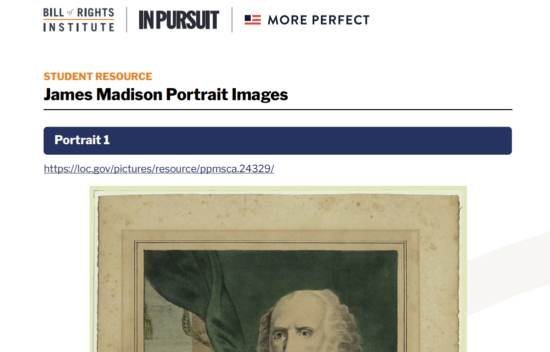
Analyze a variety of portraits of James Madison to explore his representation in history and culture.
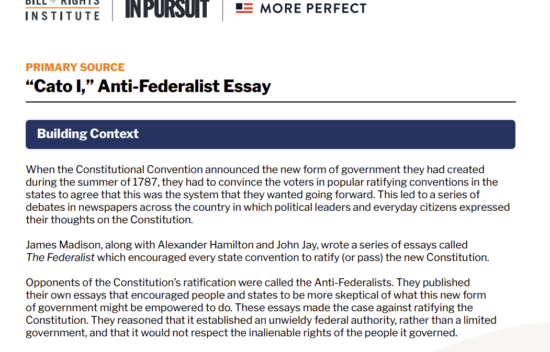
Analyze the arguments of Anti-Federalists and the impact they had on James Madison during the ratification debate
In this video, students learn how James Madison used moderation to build consensus during debates over the Constitution and the Bill of Rights. Although he initially opposed a bill of rights, Madison listened to concerns from Anti-Federalists, constituents, and fellow leaders. By seeking common ground and balancing competing viewpoints, he helped secure the Bill of Rights and strengthen confidence in the new constitutional government. This video was based on an essay for In Pursuit written by Jack Rakove: www.inpursuit.org/lessons/process-over-perfection Check out this video and other free teaching resources on BRI or In Pursuit websites at billofrightsinstitute.org/bri-x-in-pursuit/ or inpursuit.org/educators. This video was made in conjunction with In Pursuit. In Pursuit is a landmark initiative of More Perfect, a bipartisan alliance of 44 Presidential Centers, National Archives Foundation, American Academy of Arts and Sciences, Karsh Institute for Democracy at the University of Virginia, and more than 100 organizations working together to protect and renew our democracy as we approach the 250th anniversary of the Declaration of Independence and beyond.
Lesson plan
More Information
Teacher/Facilitation Background:
This video and lesson were developed in connection with the In Pursuit project: https://www.inpursuit.org/lessons. The essay for James Madison was written by historian Jack Rakove. It can be read for additional teacher background on this topic, and it might be well-suited to classroom use for higher-level readers. The full essay is available here: https://www.inpursuit.org/lessons.
Rakove provides an overview of Madison’s role in drafting the Constitution and, later, in supporting the passage of the Bill of Rights. The central lesson that Rakove’s essay imparts is: “In securing the adoption of the Constitution, it was less important to design a perfect model of government than to ensure that the sovereign American people would agree that the entire process was rightly conducted.”
This is one perspective on the life and work of James Madison. The video highlights another aspect of Madison’s legacy: the foundation of Madison’s actions in the practice of civic virtue. The video foregrounds Madison’s use of moderation while exploring how virtues work together in practice. In addition to moderation, the lesson highlights respect for differing viewpoints, institutions, and the rule of law as an essential virtue that supported Madison’s approach to governance and constitutional design. The Bill of Rights Institute defines these virtues in the following way:
- Moderation: The avoidance of excess or extremes.
- Respect: Regard for and defending the equal rights and inherent dignity of all human beings, including oneself.
- Prudence: Practical wisdom that applies reason and other virtues to discern the right courses of action in specific situations.
Encourage your students to critically engage with the material in the video, the primary source, and other context you may be providing to come to their own conclusion and assessment.
Standards
Related materials
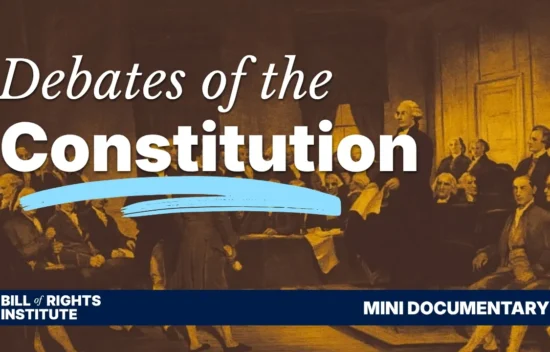
In the uncertain years after the American Revolution, the fate of the new republic hung in the balance. The Constitution—signed in Philadelphia after months of intense debate—was not yet the law of the land. Across the states, fierce battles erupted over its ratification. Would liberty be preserved or lost to centralized power? Federalists and Anti-Federalists clashed in newspapers, statehouses, and convention halls. From the impassioned arguments of Patrick Henry and George Mason to the razor-thin victories in Virginia and New York, this mini documentary captures the intensity and stakes of one of the most consequential debates in American history.

After the Constitution was completed and signed by 39 delegates on September 17, 1787, many of the debates from Independence Hall continued in the debates over ratification in the states. For the Constitution to go into effect, at least nine states would have to ratify (or agree to adopt) it. A party division arose: Federalists argued in favor of ratification, Anti-Federalists against. Leading Federalists James Madison and Alexander Hamilton made a case for ratification in the Federalist Papers. Leading Anti-Federalists were Patrick Henry and George Mason. Mason had attended the Convention but refused to sign the final document, arguing that the central government created by the Constitution would be a threat to liberty and would take away power from the individual states.