Lesson
The Ratification Debate
Guiding question
Who were the Federalists and Anti-federalists, and what were their differences?

Founding Principles
Virtues
Guiding Questions
- Who were the Federalists and Anti-federalists, and what were their differences?
- What were the essential debates during the ratification period of the newly proposed Constitution after September 1787?
Objectives
- Students will describe the differences between the Federalists and Anti-Federalists.
- Students will identify and describe the essential debates regarding ratifying the Constitution.
Materials
Educator Resources
Student Handouts
- The Ratification Debate Essay
- Handout A: State-by-State Ratification Summary
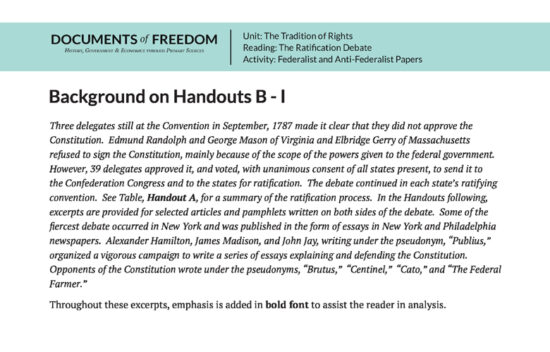
- Background on Handouts B – I
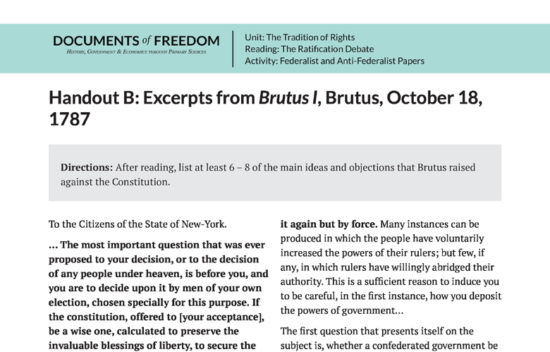
- Handout B: Excerpts from Brutus I
- Handout C: Excerpts from Federalist No. 1
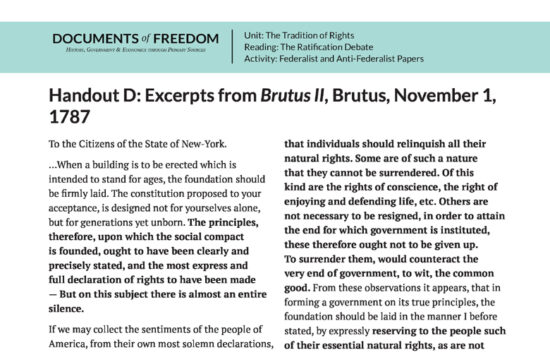
- Handout D: Excerpts from Brutus II
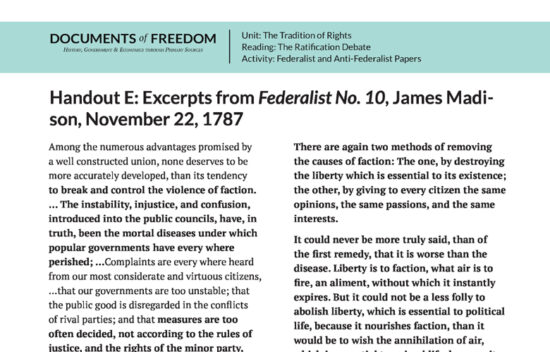
- Handout E: Excerpts from Federalist No. 10
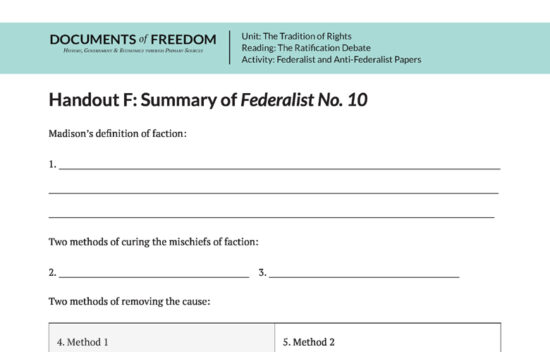
- Handout F: Summary of Federalist No. 10
- Handout G: Excerpts from Federalist No. 44
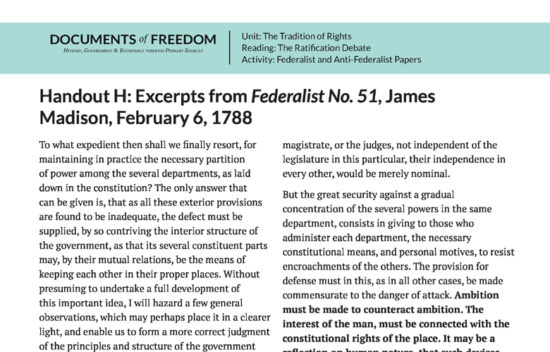
- Handout H: Excerpts from Federalist No. 51
- Handout I: Excerpts from Patrick Henry Speeches, 1788
Lesson Components




After the Constitution was completed and signed by 39 delegates on September 17, 1787, many of the debates from Independence Hall continued in the debate over ratification in the states. For the Constitution to go into effect, nine of them would have to ratify (or agree to adopt) it. A party division arose: Federalists argued in favor of ratification, Anti-Federalists against. Leading Federalists James Madison and Alexander Hamilton made a case for ratification in the Federalist Papers. Leading Anti-Federalists Patrick Henry and George Mason (the latter who had attended the Convention but refused to sign the final document) argued that the central government created by the Constitution would be a threat to liberty.
Lesson plan
Key Terms
- John Jay
- liberty
- Bill of Rights
- Articles of Confederation
- Constitution
