Video
John Quincy Adams In Pursuit of Integrity
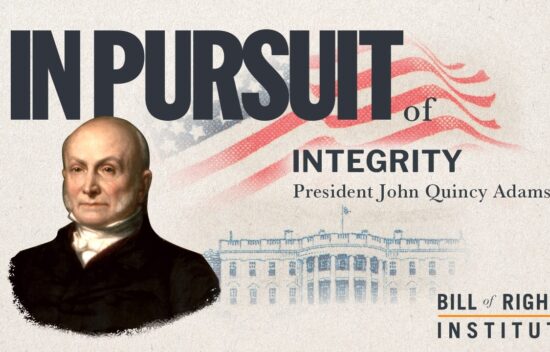
Watch
Founding Principles
Virtues
About this video
In this video, students learn how John Quincy Adams used integrity to shape American foreign policy during the nation's early years. From his diplomatic service in Europe to his role in developing the Monroe Doctrine, Adams balanced American interests with the nation's founding principles. His commitment to prudence, restraint, and self-government helped define America's place in the world.
This video was based on an essay for In Pursuit written by Lindsay Chervinsky
: www.inpursuit.org/lessons/short-term-defeat-does-not-end-long-term-influence
Check out this video and other free teaching resources on BRI or In Pursuit websites at billofrightsinstitute.org/bri-x-in-pursuit/ or inpursuit.org/educators.
This video was made in conjunction with In Pursuit. In Pursuit is a landmark initiative of More Perfect, a bipartisan alliance of 44 Presidential Centers, National Archives Foundation, American Academy of Arts and Sciences, Karsh Institute for Democracy at the University of Virginia, and more than 100 organizations working together to protect and renew our democracy as we approach the 250th anniversary of the Declaration of Independence and beyond.
0:06 As a young man, John Quincy Adams traveled thousands of miles across Europe and spent a great deal of time in foreign capitals. At ten years old, during the American Revolution, he accompanied his father, John Adams, on a diplomatic mission to Paris. A few years later, he traveled to St. Petersburg, Russia, as an interpreter and secretary
0:27 with American envoy Francis Dana, all advantageous experiences for his future career. With his uncommon childhood and diplomatic experience, Adams learned the value of prudence and moderation in negotiation. He sought to advance American power and defend its interests abroad
0:47 while remaining true to the nation’s principles. After graduating from Harvard and practicing law for a few years, Adams acquired more experience as a diplomat in his own right. In 1794, President George Washington appointed him U.S. minister to the Netherlands. He later served as minister to Prussia
1:08 during his father’s presidency. After returning home to serve in the United States Senate, President James Madison appointed him the first U.S. minister to Russia in 1809. While in Europe, he helped negotiate the Treaty of Ghent, which ended the War of 1812 between the United States and Great Britain.
1:30 In 1817, President James Monroe tapped Adams as Secretary of State because of his wisdom and experience in diplomacy. The United States was expanding westward and defining its place in global affairs – and Adams helped navigate relations with European colonial powers.
1:53 To that end, he helped negotiate a treaty with Spain, which gave the U.S. what we now know as Florida, and asserted a US claim on Oregon. In 1821, he delivered a Fourth of July speech in which he promoted restraint in U.S. intervention abroad. Guided by the founding principles of liberty and self-government,
2:14 the country would be the “well-wisher to the freedom and independence of all,” but it must be the “champion and vindicator only of her own.” The United States, he famously said, “goes not abroad, in search of monsters to destroy.” He meant that the country would not force its principles on others or go to war with oppressive governments
2:35 to liberate its people. Adams’s most enduring achievement came from writing President Monroe’s annual address to Congress in 1823. The foreign policy principles outlined in that address became known as the Monroe Doctrine. Although named for President Monroe, the doctrine largely reflected Adams’s vision.
2:57 In the early 1800s, revolutions across Latin America had led to the independence of several former Spanish colonies. The United States faced the question of how to respond to these independent countries and whether to oppose potential European efforts to restore colonial control. Adams and President Monroe asserted
3:17 three main foreign policy principles with the Monroe Doctrine: First, the United States warned that the Western hemisphere was “henceforth not to be considered as subjects for future colonization by any European powers.” Second, the United States would consider any European intervention in the Western hemisphere to be “dangerous
3:37 to our peace and safety,” and they would respond accordingly. Third, in return the United States promised not to interfere in European affairs. The Monroe Doctrine defined American foreign policy for the next two centuries. By the time he became president in 1824,
3:57 John Quincy Adams had spent a lifetime shaping American foreign policy. In every office he held, he paired national purpose and integrity with honor, helping define diplomatic principles that continue to influence discussions of America’s global responsibilities.
Standards
Related Resources

In Pursuit is a landmark initiative of More Perfect, a bipartisan alliance of 44 Presidential Centers, National Archives Foundation, American Academy of Arts and Sciences, Karsh Institute for Democracy at the University of Virginia, and more than 100 organizations working together to protect and renew our democracy as we approach the 250th anniversary of the Declaration of Independence and beyond.
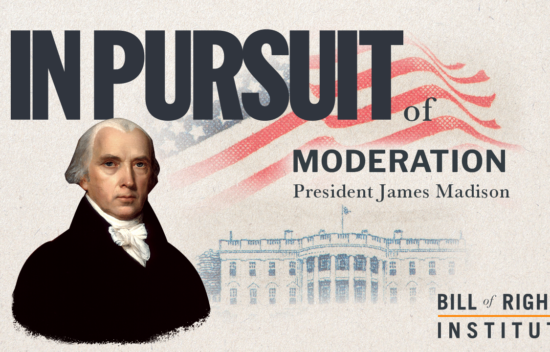
In this video, students learn how James Madison used moderation to build consensus during debates over the Constitution and the Bill of Rights. Although he initially opposed a bill of rights, Madison listened to concerns from Anti-Federalists, constituents, and fellow leaders. By seeking common ground and balancing competing viewpoints, he helped secure the Bill of Rights and strengthen confidence in the new constitutional government. This video was based on an essay for In Pursuit written by Jack Rakove: www.inpursuit.org/lessons/process-over-perfection Check out this video and other free teaching resources on BRI or In Pursuit websites at billofrightsinstitute.org/bri-x-in-pursuit/ or inpursuit.org/educators. This video was made in conjunction with In Pursuit. In Pursuit is a landmark initiative of More Perfect, a bipartisan alliance of 44 Presidential Centers, National Archives Foundation, American Academy of Arts and Sciences, Karsh Institute for Democracy at the University of Virginia, and more than 100 organizations working together to protect and renew our democracy as we approach the 250th anniversary of the Declaration of Independence and beyond.