Lesson
Women in the Gilded Age and Progressive Era

Founding Principles
Federalism, Equality, Liberty, Representative / Republican Government
Objectives
- Students will examine the causes, struggles, and successes of various forms of civic engagement by women, including efforts toward economic, social, and political equality.
- Students will understand the extensive array of reform movements in which women took the lead as part of the broader reform effort of the Progressive Era.
- Students will compare and contrast the goals of the social reformers fighting for protective legislation with the goals of reformers who wanted an Equal Rights Amendment to the United States Constitution.
Materials
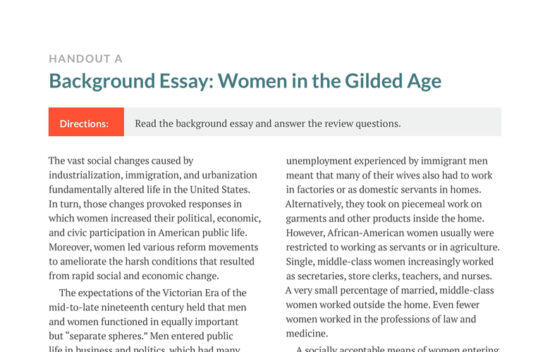
- Handout A: Background Essay: Women in the Gilded Age
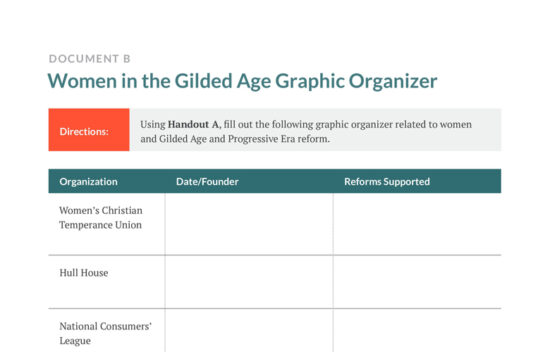
- Handout B: Women in the Gilded Age Graphic Organizer
- Handout C: Timeline of Women’s Suffrage
- Handout D: Images of Women’s Suffrage
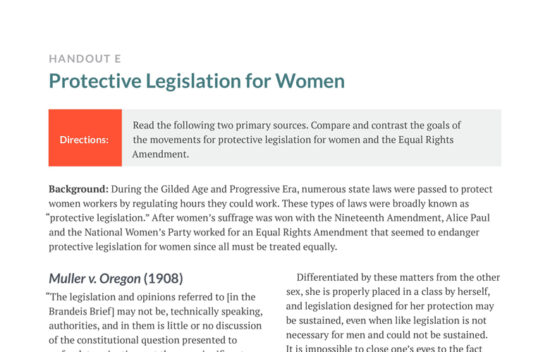
- Handout E: Protective Legislation for Women
- Handout F: Comparing and Contrasting Women’s and African-American Suffrage Movements
Lesson Components



Lesson plan
Key Terms
- “Separate spheres”
- Temperance
- Settlement houses
- Americanization
- Protective legislation
Standards
Advanced Placement
- National
Check whether this resource aligns with your state’s standards →
Related materials

In part two of this two-part Homework Help narrative, learn about the challenges that the women’s suffrage movement overcame in the late nineteenth and early twentieth centuries. What contributions did monumental suffragists like Alice Paul, Lucy Stone, and Carrie Chapman Catt make on the journey to winning the vote for women?

How did Alice Paul fight for equality of the sexes?

The emergence of a true women’s movement for equality and suffrage (the right to vote) developed after the religious revivals of the Second Great Awakening and the rise of several antebellum (before the Civil War) reform movements in the 1830s and 1840s. This lesson explores the birth of the Women’s Rights movement, as well as its goals and the historical context of the movement.

In this lesson, students will learn about the self-sacrifice of Alice Paul and ways in which they can sacrifice their own comfort for what they believe.

How did the suffragists map out a pathway for change to achieve the vote through the Nineteenth Amendment?