Lesson
The Declaration of Independence – Docs of Freedom
Guiding question
What are the revolutionary principles found in the Declaration?

The Declaration of Independence was drafted by Thomas Jefferson in June of 1776. The Declaration announced to the world that the thirteen American colonies regarded themselves independent sovereign states. It articulates the fundamental ideas that form the American Nation: All people are created free and equal and possess the same inherent, unalienable rights.
This lesson plan includes six activities. The activities can be taught in sequence as a comprehensive overview of the Declaration of Independence or individual activities can be taught as stand-alone lessons.
Founding Principles
Virtues
Guiding Questions
- What are the revolutionary principles found in the Declaration?
- What is the relevance of the Declaration of Independence today?
- To what extent was the Declaration of Independence a document of equality?
- What were Thomas Jefferson’s greatest influences in writing the Declaration of Independence?
Objectives
- Students will evaluate the structure of the Declaration of Independence.
- Students will identify the revolutionary principles found in the Declaration of Independence.
- Students will analyze the significance of the Declaration of Independence over time.
- Students will evaluate the statement “all men are created equal.”
- Students will compare the philosophy of the John Locke’s Second Treatise of Civil Government and the Declaration of Independence.
Materials
Educator Resources
- Handout C: The Structure of the Declaration Answer Key
- Handout D: Key Excerpts Answer Key
- Handout G: Comparing the Second Treatise of Civil Government to the Declaration of Independence Answer Key
Student Handouts
- The Declaration of Independence Essay
- Handout A: Declaration of Independence
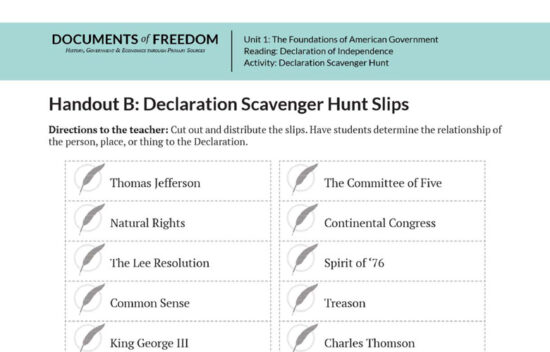
- Handout B: Scavenger Hunt Slips
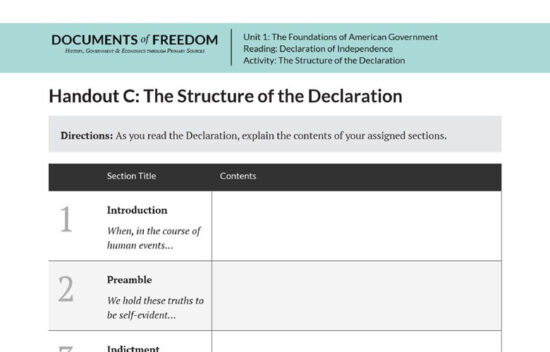
- Handout C: The Structure of the Declaration
- Handout D: Key Excerpts (Declaration of Independence)
- Handout E: The Declaration, The Founders, and Slavery
- Handout F: Slavery Essay
- Handout G: Comparing the Second Treatise of Civil Government to the Declaration of Independence
- Handout H: Response to the Declaration of Independence
Lesson Components


ActivityHandout F: Slavery Essay


EssayEssay: The Declaration of Independence
America's Founders looked to the lessons of human nature and history to determine how best to structure a government that would promote liberty. They started with the principle of consent of the governed: the only legitimate government is one which the people themselves have authorized. But the Founders also guarded against the tendency of those in power to abuse their authority, and structured a government whose power is limited and divided in complex ways to prevent a concentration of power. They counted on citizens to live out virtues like justice, honesty, respect, humility, and responsibility.
Lesson plan
195 minClick a phase to open it
Key Terms
- property
- liberty
- Declaration of Independence
- Founders
- King George III