Lesson
Post Revolutionary War Emancipation and Entrenchment

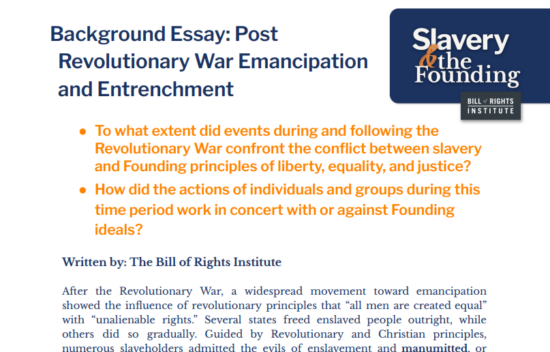
To what extent did events during and following the Revolutionary War confront the conflict between slavery and Founding principles of liberty, equality, and justice? How did the actions of individuals and groups during this time period work in concert with or against Founding ideals?
Founding Principles
Guiding Questions:
- To what extent did events during and following the Revolutionary War confront the conflict between slavery and Founding principles of liberty, equality, and justice?
- How did the actions of individuals and groups during this time period work in concert with or against Founding ideals?
Objectives:
- Students will identify and summarize significant events related to slavery in the Founding era from 1776 to 1808.
- Students will evaluate the extent to which the actions taken during the Revolutionary Era resulted in a fuller realization of Founding principles of liberty, equality, and justice.
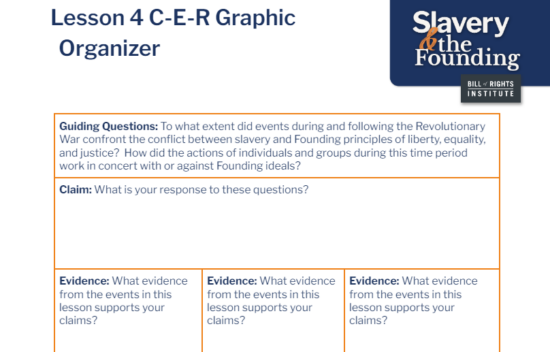
- Students will practice historical argumentation by creating a claim and supporting it with specific evidence.
- Students will analyze continuity and change over time in state constitutions related to the application of Founding principles of liberty, equal rights, and justice. (extension)
Materials
Student Resources:
- Background Essay
- Background Slides (PPTX download)
- Event Cards:
- Full List (25 events)
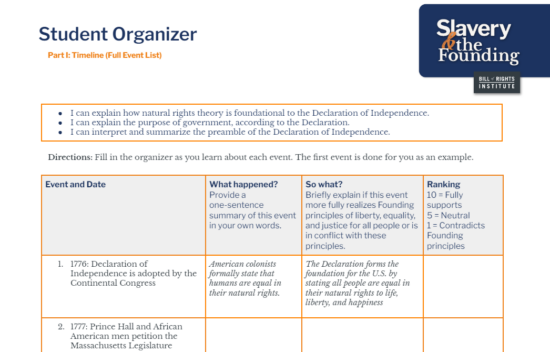
- 1776: Declaration of Independence is adopted by the Continental Congress
- 1777: Prince Hall and African American Men Petition the Massachusetts Legislature
- 1777: Vermont Constitution Bans Slavery
- 1780: Constitution of Massachusetts claims all men are born free and equal
- 1781: Elizabeth (Mumbet) Freeman successfully sues for her freedom
- 1782: Virginia allows manumission by law
- 1783: Quock Walker successfully sues for his freedom
- 1783: Belinda Sutton petitions Massachusetts for an income from her former slaveholder’s estate
- 1783: Virginia passes law emancipating slaves who served as soldiers in Revolutionary War
- 1784: Land Ordinance proposes to outlaw slavery
- 1784: Rhode Island and Connecticut pass gradual emancipation plans
- 1787: US Constitution is signed by 38 of the 41 delegates attending the Constitutional Convention
- 1787: The Northwest Ordinance is passed by the Confederation Congress banning slavery
- 1789-1815: French Revolution grapples with slavery
- 1790: The Southwest Ordinance is passed by the first Congress
- 1791-1804: Haitian Revolution begins as a slave revolt and creates republic that outlaws slavery
- 1793: Invention of the cotton gin
- 1793: The first Fugitive Slave Law is passed by Congress
- 1796: Tennessee enters the Union as a slave state
- 1799: New York passes gradual emancipation plan
- 1800: Gabriel’s Rebellion
- 1801: Georgia outlaws manumission
- 1803: Louisiana Purchase
- 1804: New Jersey passes graduation emancipation plan
- 1808: The international slave trade is abolished by an act of Congress
- Abbreviated List (10 events)
- 1776: Declaration of Independence is adopted by the Continental Congress
- 1777: Prince Hall and African American Men Petition the Massachusetts Legislature
- 1780: Massachusetts Constitution is adopted
- 1781: Elizabeth (Mumbet) Freeman successfully sues for her freedom
- 1787: US Constitution is signed by 38 of the 41 delegates attending the Constitutional Convention
- 1787: The Northwest Ordinance is passed by the Confederation Congress banning slavery
- 1790: The Southwest Ordinance is passed by Congress
- 1793: Invention of the cotton gin
- 1793: The first Fugitive Slave Law is passed by Congress
- 1803: Louisiana Purchase
- Full List (25 events)
- Student Organizer
- Claim, Evidence, Reasoning (CER) graphic organizer
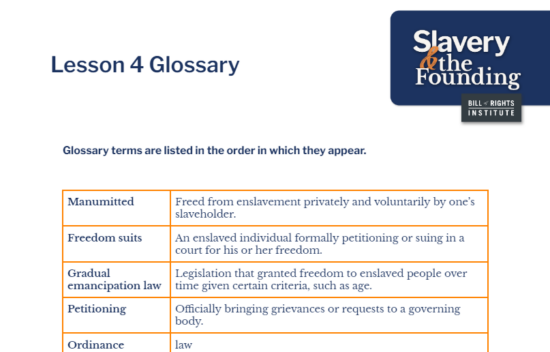
- Glossary
Teacher Resources:
- Answer Key
Lesson Components

Lesson plan
90 minClick a phase to open it
Key Terms
- Manumitted
- Freedom suits
- Gradual emancipation law
- Petitioning
- Ordinance
More Information
Facilitation Notes:
- Glossary terms for this lesson are provided on a separate handout. The terms are also defined when they appear in the sources provided.
- Some components of this lesson contain terminology that is no longer used because the terms are recognized to be offensive or derogatory. These terms have been retained in their original usage in order to present them accurately in their historical context for student learning, including understanding why these are not acceptable today.
Standards
Related materials

LessonSlavery and the Struggle for Abolition from the Colonial Period to the Civil War
How did legislators, courts, and individuals interact with and interpret the principles of liberty and justice in the quest to end slavery from colonial times to the outbreak of the Civil War?

Primary SourceNorthwest Ordinance (1787)
The Northwest Ordinance was the most important piece of legislation enacted by Congress under the Articles of Confederation. The United States claimed the Ohio Territory after the 1783 Treaty of Paris ended the Revolutionary War.

PageA Primary Source Close Reads Video Playlist
Dive into some of the most important speeches and documents from United States history. These videos dissect these documents, define key terms, and explore the lasting impact of the featured documents.