Unit
Unit 4: The President and the Bureaucracy
Guiding question
What is the legitimate exercise of executive powers?

Guiding Question:
- What is the legitimate exercise of executive powers?
Objectives:
- The student will evaluate the actions of the president against the original conception of the presidency in a constitutional republic, applying principles of governance and accountability.
- The student will analyze situations where energy and decisiveness within the executive branch are in tension with the need for restraint, synthesizing historical precedents and contemporary examples.
- The student will assess the evolving nature of the presidency and the executive branch, discerning the impact of societal changes and constitutional principles on their roles and responsibilities.
- The student will analyze the relationship between the executive branch, civil society, and the execution of laws, evaluating the extent of government influence on daily life and societal structures.
- The student will apply principles of prudence in evaluating decision-making within the executive branch, considering the multifaceted factors involved in addressing national issues and their impacts on citizens.
Teacher resource
Unit 4: The President and the Bureaucracy Inquiry Organizer
What is the legitimate exercise of executive powers?
Lessons

Examine the significance of the Presidential Oath of Office.

How does a peaceful transition of power help maintain the Constitution?

What are the constitutional roles of the president? What skills and civic virtues are necessary for the person in this role?

Explore the Presidential roles of Commander-in-Chief, Chief Diplomat, Chief Executive, and Chief Legislator.

How have presidents used communication technologies, such as social media, to shape public views about policy goals?

How have presidents interpreted their role as Commander-in-Chief?

Explore the historical expansion of presidential war powers and analyze the increasing trend of unilateral military decision-making and its impact on the constitutional balance of power.

Explore the mechanisms and impacts of governmental regulations on societal and economic structures.

Study the purpose of executive orders and their historic use. Explore common themes and what constitutes a valid use of executive power.

Does the federal bureaucracy wield too much power in the U.S. constitutional republic?
How can opposing viewpoints be critically evaluated to inform understanding?
Unit resources

Three presidential transition letters left by modern presidents to their predecessors.

The text of Article II, Section 1, Clause 8 that contains the Presidential Oath of Office and corresponding comprehension questions.

The text of Federalist #70 which explore how energy in the executive branch to preserve liberty.
A scaffolded text of Federalist #70 which explores how energy in the executive branch to preserve liberty.

An annotated version of Article II of the U.S. Constitution with key terms defined and comprehension questions.

A scaffolded version of Article II of the U.S. Constitution with key terms defined and comprehension questions.

An activity in which students define the roles of the president and explain the skills and traits required to fulfill these roles.

An activity in which students define the roles of the president and explain the skills and traits required to fulfill these roles.

A narrative activity to help students understand how presidential war powers have expanded over time.

An interactive discovery game that explores virtues.
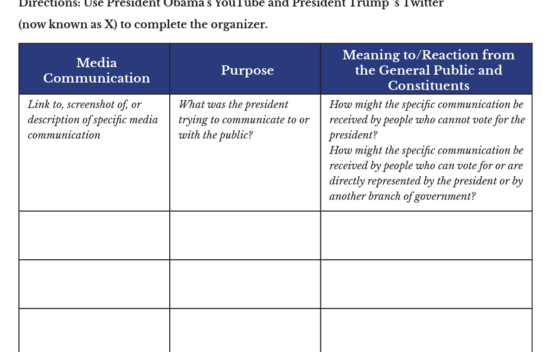
How have advancements in communication technology changed how the president communicates with the people?

The text of Washington's Speech and corresponding comprehension questions.
Standards
Related content

Every four years, the United States demonstrates a remarkable tradition: a peaceful transfer of presidential power. But what exactly are the president’s responsibilities, and how has the role evolved over time? Explore the origins of the presidency in the U.S. Constitution, why the Founders were cautious about executive authority, and the qualifications needed to serve as president. Discover the powers and responsibilities that shape both domestic and foreign policy—from commanding the military and making treaties to signing legislation and appointing Supreme Court justices. Learn how the modern presidency has expanded and why presidential decisions have a direct impact on your life and future.

When you think of the executive branch, the president might come to mind—but behind every decision is a vast network of agencies and civil servants. This is the federal bureaucracy. Explore how the bureaucracy functions, from cabinet officials to over 3 million civil service employees. Learn how these institutions have grown throughout U.S. history, how they affect everything from clean water to transportation safety, and why the balance between accountability and expertise is essential in a constitutional republic. Understand the ongoing debate around bureaucratic power, and why this often-unseen part of government has a very real impact on your everyday life. This video ties into Unit 4 of the Bill of Rights Institute's Government and Politics: Civics for the American Experiment curriculum. Examine the constitutional foundations, evolution, and daily impact of the federal bureaucracy—and why understanding it is vital for informed civic participation.