Lesson · Elementary (BRI Jr)
Colonial Era for 3-5
About this lesson
How this lesson flows
Every stage is laid out below, so you can see the whole lesson at a glance. Nothing is hidden.
Guiding questions
- Lesson Plan PDF Essential Question: How did individuals show courage in the colonial era?
- How did Native Americans and European colonists demonstrate courage during the colonial era?
- How did the reasons for European immigration influence the development of the 13 colonies?
- How did enslaved and free Blacks resist the injustice of slavery during the colonial era?
Learning Objectives
- I can conduct a family interview to determine how I arrived at my current town, home, or school.
- I can use speaking and listening skills to share my family interview and learn from others.
- I can organize new knowledge into a graphic organizer.
- I can engage with my peers to investigate the 13 colonies through an escape game.
- I can investigate primary sources to learn about the lived experiences of enslaved Africans in the colonial era.
Content Objectives
- I can describe the early relationships between European settlers and Native Americans.
- I can explain the reasons why Europeans came to North America, including religious freedom and economic gain.
- I can identify key individuals who founded colonies for various reasons.
- I can identify the introduction of slavery in the colonies and the different experiences of enslaved and free Africans.
Lesson components
Everything you need, in the version that fits your class.
 Activity3-5 Elementary Vocabulary Word Study Handout
A template to help students define key vocabulary words.
Download Activity3-5 Colonial Era Family Interview Homework Worksheet
A homework assignment where students interview a family member to learn more about how their family arrived at their current place.
Download Activity3-5 Elementary Colonial Era Reading
Informational texts to help students understand the earliest British settlements in America.
Download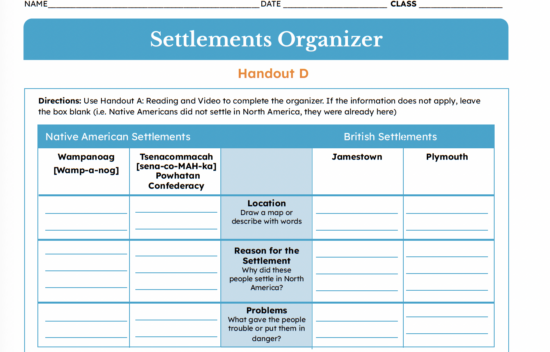 Activity3-5 Elementary Colonial Era Settlements Organizer
An activity to help students understand the differences in Native American and British settlements.
Download Activity3-5 Elementary Colonial Era Illustrating with Details Activity
A drawing activity that asks students to choose a scenario of courage from the stories of Jamestown, Plymouth, or Native tribes.
Download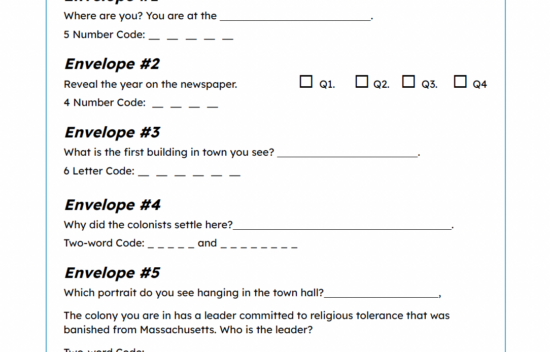 Activity3-5 Colonial Era Escape Room Student Handout
A puzzle game that helps students discover key ideas from the lesson.
Download Activity3-5 Elementary Slavery in the Colonies Illustration Activity
A discovery activity of visual primary sources.
Download Activity3-5 Elementary Slavery in the Colonies Reading
Primary sources documenting the slave trade in the colonial era.
Download Activity3-5 Elementary Colonial Era Art Activity
A labeling activity that encourages students to explore artwork from the time period to gain understanding.
Download Activity3-5 Colonial Era Student Self-Assessment Handout
A self-reflection activity that allows students to internalize their learning.
DownloadMaterials
Teacher Materials
- Vocabulary Cards
- Teacher Slide Deck
- Teacher Resources
- Escape Room Game
- Escape Game Answer Key
- Major Industries of the 13 Colonies Map
- Lesson Rubrics
- Journey to the Colonies Map
- Lesson Video
Student Materials
- Handout A: Vocabulary Word Study
- Handout B: Family Interview Homework
- Handout C: Background Reading
- Handout D: Settlements Graphic Organizer
- Handout E: Illustrating with details
- Handout F: Escape Game Student Answer Sheet
- Handout G: Adding Labels to an Illustration
- Handout H: Explore #3 Reading
- Handout I: Describing an Illustration
- Handout J: Student Self-assessment
The lesson, step by step
Open each stage as you teach it, or expand them all to read straight through.
More Information
This lesson is designed around inquiry questions. There is one essential question, and several guiding questions around which the content is based. The lesson takes place in 5 stages:
- Anticipate- Students build background knowledge needed to be successful in the lesson.
- Engage- Students are ‘hooked” into the lesson.
- Explore- Students grapple with the main content of the unit (usually 2-3 parts).
- Assess- Students demonstrate their knowledge through a performance assessment.
- Reflect- Students reflect on their learning in the lesson.
- The sections below provide a brief overview of the unit’s structure. It offers a snapshot of the organization and flow of the entire unit.
The following detailed sections break down the five stages of the lesson. Each stage is discussed thoroughly with actionable steps to guide you through the teaching process effectively.