Lesson
A Movement Arises (1800-1860)

Founding Principles
Materials
- Background Essay: A Movement Arises (1800–1860)
- Handout A: Declaration of Sentiments and Resolutions: The Seneca Falls Convention
- Handout B: Two Declarations
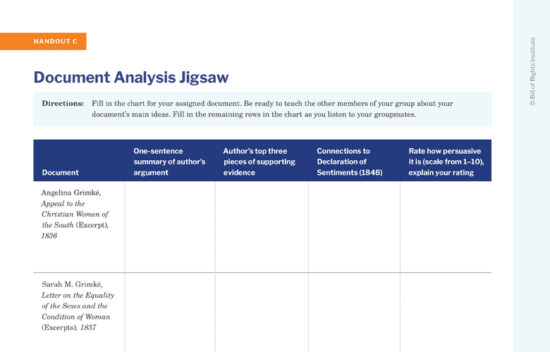
- Handout C: Document Analysis Jigsaw
- Handout D: Voices in the Women’s Movement
- Appendix A: Amending the Constitution
- Appendix B: Timeline and Quotes
- Appendix C: Timeline Cards
- Appendix G: A Pathway for Change
- Answer Key
Lesson Components
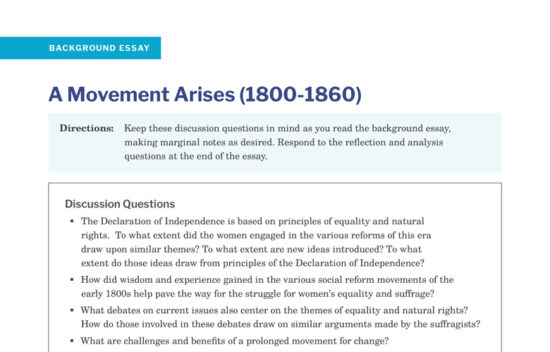



Lesson plan
Key Terms
- Cult of Domesticity
- elective franchise
- republican
More Information
FOR FURTHER READING
- Douglass, Frederick. Narrative of the Life of Frederick Douglass, an American Slave. (Boston, 1845) Bedford/St. Martin’s (2002)
- Flexner, Eleanor and Ellen Fitzpatrick, Century of Struggle: The Women’s Rights Movement in the United States, Belknap Press (1996)
- Lerner, Gerda. The Grimké Sisters from South Carolina, The University of North Carolina Press; Revised and Expanded edition (2004)
- McMillen, Sally. Seneca Falls and the Origins of the Women’s Rights Movement (2009)
- Sklar, Kathryn Kish. Bedford Reader Women’s Rights Emerges within the Anti-Slavery Movement, 1830-1870, New York: Bedford/St. Martin’s (2000)
- The Rights of Women, Married Women’s Property Act of New York 1848-1849, Law Library of Congress
Standards
Advanced Placement
- National
Check whether this resource aligns with your state’s standards →
Related materials

Sarah M. Grimké, Letters on the Equality of the Sexes and the Condition of Women, 1837 Handouts Handout A: Principles and Virtues Glossary Instructions Have your students read the introduction and answer the Sourcing questions.

In this lesson, students will learn about Elizabeth Cady Stanton’s role in the women’s suffrage movement. They will explore how her actions conformed to the ideas of justice and the many obstacles she had to overcome in achieving her purpose. Through her example, they will learn how they can pursue justice in their own lives.

In this Homework Help Narrative, learn about the courage and determination of Elizabeth Cady Stanton and the origins of the Seneca Falls Convention of 1848.

In part one of this two-part Homework Help narrative, learn about the origins of the women’s suffrage movement from Colonial America through the nineteenth century. What challenges did these brave activists need to overcome in the early days of the movement to lay the groundwork for the passage of the 19th Amendment? How did previous protections granted in the Bill of Rights, the 14th Amendment, and incorporation, the responsibility of states to adhere to the Bill of Rights, boost the case for women’s rights.