Video
Road Trip: From the Declaration to the Constitution
Watch
About this video
Welcome back to the Treehouse! In this episode, our friends plan a summer road trip to celebrate America's birthday, six stops from the Declaration of Independence all the way to the Constitution. Join them as they travel from Exit 1776 to Exit 1787, exploring the Declaration of Independence, the Articles of Confederation, the Battle of Yorktown, the Treaty of Paris, the Northwest Ordinance, and the writing of the Constitution.
As part of our Constitution Day Live programming, celebrating "Road to the Constitution," this video takes young learners on a road trip through the key events between 1776 and 1787, showing how America went from declaring independence to establishing the government we still live under today.
0:01
Today our friends are reviewing their plans for summer road trip.
The friends plan six stops to celebrate America’s birthday
Exit 1776: The Declaration of Independence
from the Declaration of Independence to the Constitution.
There are some exciting things to see.
So let’s load up the car and start our road trip from 1776 to 1787.
Here comes our first stop, exit 1776.
This stop is all about the Declaration of Independence.
The declaration was an open letter the American colonies
wrote declaring that they wanted to be independent.
Exit 1777: The Articles of Confederation
It said that all people. Are equal.
And have important rights and freedoms.
That the British had ignored.
They needed to form a new nation that protected these rights.
Next stop is exit 1777.
In order to be its own nation, the United States
needed a way to govern itself.
The first government was under.
The Articles. Of Confederation.
Exit 1781: The Battle of Yorktown
It set up a formal friendship between the states and created
a national government with limited or specific powers.
Our next stop is a few exits down.
Let’s look for exit 1781.
Oh, there it is.
The king was unhappy that the
United States declared independence and created its own government.
Americans fought a long.
War for their freedom.
The final major battle of the war was the Battle of Yorktown.
It was when the King’s.
Army in Virginia surrendered or. Gave up.
It ended the fighting between the United States and Great Britain.
Exit 1783: The Treaty of Paris
The friends are getting hungry.
So let’s stop at exit 1783. For.
Some lunch.
Here we are at the Treaty of Paris picnic station.
The Treaty of Paris officially ended the Revolutionary War.
Exit 1787: The Northwest Ordinance
With this treaty, Great.
Britain officially recognized the United States as a sovereign
or independent nation.
There’s our last stop.
Exit 1787.
After winning. The war.
The United States began to focus on.
Improving and growing.
Congress passed an important law called the Northwest Ordinance.
It banned slavery in the northwest.
Territory.
And explained how new states could join the United States.
Exit 1787: Writing the Constitution
But before we returned to the tree house, there is something else here.
At exit 1787, it became. Clear quickly the.
Articles of Confederation was not working as well as they had hoped.
Citizen leaders, called
delegates, met in Philadelphia in 1787.
To create a new. Constitution.
It says we, the people of the United States, in.
Order to form a more perfect.
Union, establish justice, insure domestic tranquility, provide for the common
defense, promote the general welfare, and secure the blessings.
Of liberty to. Ourselves and our. Posterity.
Do ordain and establish this Constitution
for the United States of America.
This means the Constitution created a new government designed to.
Better protect freedom and.
Help people live and work together.
America is now 250.
250 Years of America
Years.
Old, and the Declaration of Independence and the Constitution
still help guide our country today.
Our journey.
From 1776 to 1787 helps us remember.
Celebrate and carry forward the ideals.
That shaped the United States.
Standards
Related Resources
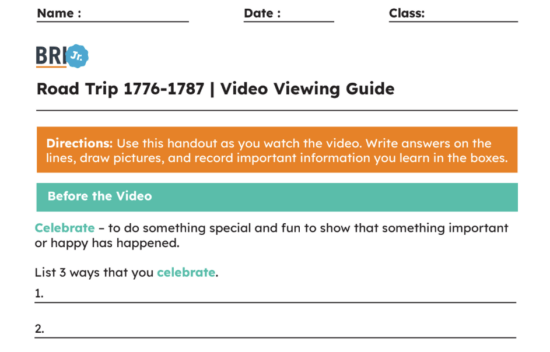
An elementary viewing guide for Road Trip: From the Declaration to the Constitution, designed to help students explore what took place between 1776 and 1787 that shaped the founding of the Constitution.
During the American Revolution, printers like Mary Katharine Goddard and authors like Mercy Otis Warren helped Americans understand the arguments for independence and make informed decisions. This video tells the story of Goddard's courageous decision to print the signers' names, including her own, on the Declaration of Independence, and of Warren's plays, poems, and later histories that brought political ideas into everyday homes. As part of our Constitution Day Live programming, celebrating "Road to the Constitution," this video dives into how printers and authors like Mary Katharine Goddard and Mercy Otis Warren helped everyday Americans access the information they needed to participate in self-government.

Primary sources, videos, essays, lessons, and more about what led to the Declaration of Independence
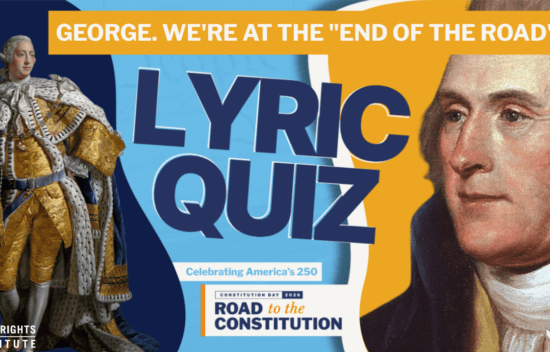
What were the grievances laid out in the Declaration of Independence? Help students define each grievance through modern song lyrics in our interactive quiz leading up to Constitution Day. This Constitution Day, BRI is highlighting the years between the signing of the Declaration of Independence in 1776 and the Constitution in 1787.
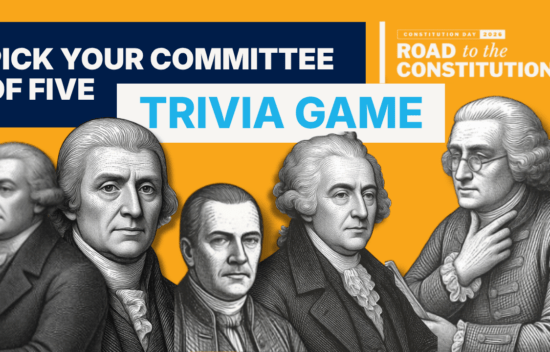
On June 11, 1776, Congress appointed a Committee of Five to draft a Declaration of Independence. Create your own committee with our interactive jeopardy quiz leading up to Constitution Day. This Constitution Day, BRI is highlighting the years between the signing of the Declaration of Independence in 1776 and the Constitution in 1787.