Video
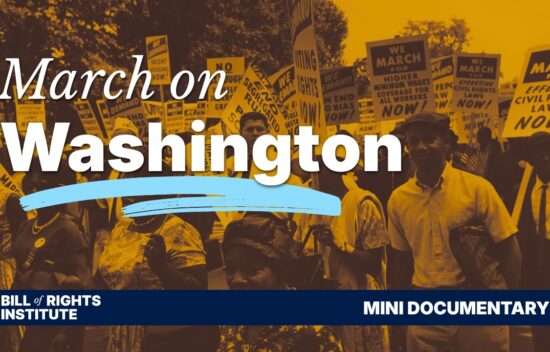
March on Washington Mini Documentary
Watch
About this video
In the summer of 1963, a quarter-million Americans gathered in the heart of the nation’s capital to demand justice, equality, and civil rights.
This mini documentary tells the story of the March on Washington. From the violence in Birmingham that shocked the nation to Martin Luther King Jr.’s "I Have a Dream" speech on the steps of the Lincoln Memorial, discover how ordinary citizens, inspired by the ideals of the Declaration of Independence, united to challenge injustice and fulfill the promise of liberty and equality for all.
0:04 In the spring of 1963, Martin Luther King Jr and other civil rights leaders led courageous demonstrations against segregation and inequality in Birmingham, Alabama. Horrifying images of beatings, fire hoses and police dogs turned against marchers were broadcast on television
0:25 and printed in newspapers across the nation. President John F Kennedy delivered a moving televised speech supporting a civil rights bill in Congress. He stated, the heart of the question is whether all Americans are to be afforded equal rights and equal opportunities. Whether we are going to treat our fellow Americans
0:49 as we want to be treated. As a result, King and the other leaders decide to hold a march on Washington to lobby lawmakers to pass the bill with, as he said, the fierce urgency of now. On August 28th, more than 250,000 Americans black and white,
1:12 male and female, young and old, assembled on the National Mall to march for freedom and equality. They sang freedom songs, prayed together, listened to Joan Baez and Bob Dylan, and heard several speakers, including Freedom Rider, John Lewis, and Martin Luther King.
1:35 King stood on the steps of the Lincoln Memorial, facing the massive audience. He appealed to Lincoln by starting five score years ago, a great American in whose symbolic shadow we stand today signed the Emancipation Proclamation by using the term five score years ago.
1:55 King evokes the wording of Lincoln’s Gettysburg Address, which began with the memorable phrase fourscore and seven years ago in the Gettysburg Address, Lincoln referred back to the ideals of the Declaration of Independence in 1776 that all men are created equal.
2:16 King lays claim to the ideals and the promise of America, whereas the declaration called the principle of equality a self-evident truth, and Lincoln called a proposition. King calls it an uncashed check. He states when the architects of our Republic wrote
2:36 the magnificent words of the Constitution and the Declaration of Independence, they were signing a promissory note to which every American was to fall heir. This note was a promise that all men, yes, black men as well as white men would be guaranteed the unalienable rights of life, liberty and the pursuit of happiness.
3:01 King refused to give up on America and the American Dream. He refused to think that, as he said, the Bank of justice was bankrupt without the vaults of equal opportunity, had insufficient funds. He asserted, I still have a dream. It is a dream deeply rooted in the American dream.
3:24 I have a dream that this nation will rise up and live out the true meaning of its creed. We hold these truths to be self-evident, that all men are created equal. King had a dream that one day his four little children will live in a nation where they will not be judged by the color of their skin,
3:45 but by the content of their character. King built up to a crescendo with his mighty rhetoric and finished when we allow freedom ring, when we let it ring from every village and every hamlet, from every state and every city. We will speed up that day when all God’s children, black men and white men, Jews and Gentiles, Protestants and Catholics
4:10 will be able to join hands and sing, in the words of the old Negro spiritual, free at last, free at last. Thank God Almighty, we are free at last. Inspired by the principles of the Declaration of Independence, King and the others at the March on Washington called on their fellow Americans to live up to them.
4:33 The moral suasion of the March on Washington contributed to the passage of the landmark Civil Rights Act of 1964 that ended segregation. The path through Congress was difficult, but the representatives eventually forged a consensus through negotiation, compromise, and principle.
4:54 It was a culmination of years of struggle and perseverance by the individuals in the civil rights movement, and a great achievement in fulfilling the founding promise of liberty and equality for all.
Standards
Related Resources
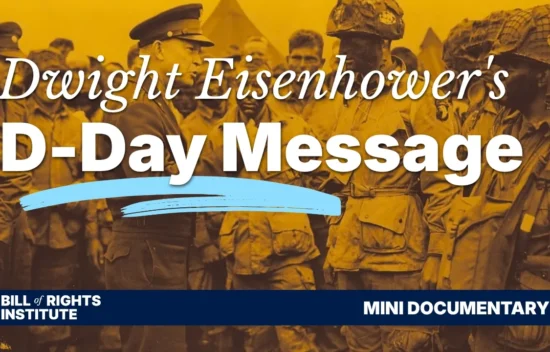
In the stormy days leading up to one of World War II’s most pivotal operations, Allied leaders faced tough decisions, uncertain weather, and the weight of history on their shoulders. On the eve of the D-Day invasion, Supreme Allied Commander Dwight D. Eisenhower carried not only the burden of strategy, but the moral responsibility for thousands of lives. As the fate of Europe hung in the balance, he demonstrated the civic virtues he believed were essential to leadership: humility, moderation, and responsibility. This mini documentary captures the tense hours before Operation Overlord, the words he prepared in case of failure, and the quiet, resolute character that defined his command. From late-night meetings with Churchill and Montgomery to visits with young paratroopers hours before they jumped into enemy territory, witness the story of a leader who rose to the moment and helped shape the course of history.
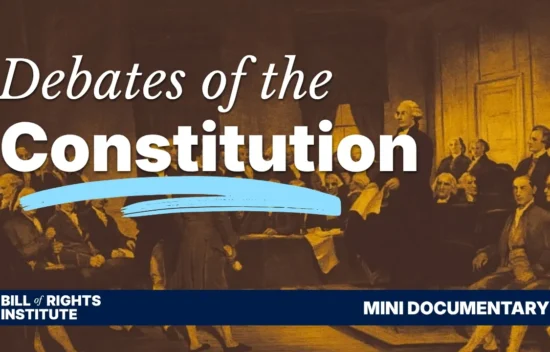
In the uncertain years after the American Revolution, the fate of the new republic hung in the balance. The Constitution—signed in Philadelphia after months of intense debate—was not yet the law of the land. Across the states, fierce battles erupted over its ratification. Would liberty be preserved or lost to centralized power? Federalists and Anti-Federalists clashed in newspapers, statehouses, and convention halls. From the impassioned arguments of Patrick Henry and George Mason to the razor-thin victories in Virginia and New York, this mini documentary captures the intensity and stakes of one of the most consequential debates in American history.

Learn about important dates events that lead up to the ratification of on the Declaration of Independence on July 4th, 1776 in Philadelphia, PA through our interactive timeline!


What significance did the Lincoln Memorial have to the March on Washington? In this episode of BRIdge from the Past, Mary examines images of the 1963 March on Washington for Jobs and Freedom. The massive march of over 250,000 people culminated at the Lincoln Memorial where Martin Luther King Jr delivered his “I Have A Dream” speech. How did King use American Founding documents to highlight the meaning of equality in his speech? How was this event similar and different to others that have taken place at the Lincoln Memorial over American history?