Video
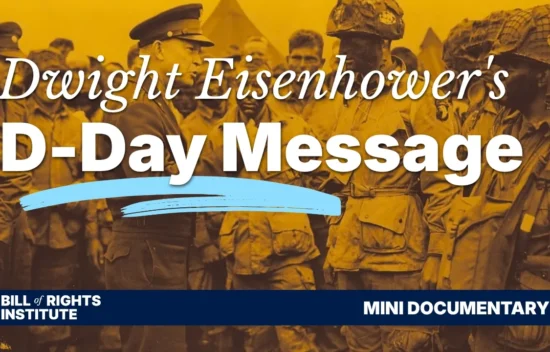
Dwight Eisenhower’s D-Day Statement Mini Documentary
Watch
Virtues
About this video
In the stormy days leading up to one of World War II’s most pivotal operations, Allied leaders faced tough decisions, uncertain weather, and the weight of history on their shoulders.
On the eve of the D-Day invasion, Supreme Allied Commander Dwight D. Eisenhower carried not only the burden of strategy, but the moral responsibility for thousands of lives. As the fate of Europe hung in the balance, he demonstrated the civic virtues he believed were essential to leadership: humility, moderation, and responsibility.
This mini documentary captures the tense hours before Operation Overlord, the words he prepared in case of failure, and the quiet, resolute character that defined his command. From late-night meetings with Churchill and Montgomery to visits with young paratroopers hours before they jumped into enemy territory, witness the story of a leader who rose to the moment and helped shape the course of history.
0:00 Great American leaders, guided by the principles and promises of the Declaration of Independence and the practice of civic virtues, have contributed to the growth of American democracy. Our 250th anniversary is a time to reflect on the people and stories that shaped our common history. One of those leaders who met the moment was Dwight Eisenhower.
0:24 During the evening of June 2nd, 1944, Allied Supreme Commander Dwight Eisenhower met with British Prime Minister Winston Churchill. General Bernard Montgomery and other military commanders in England. They were making final decisions and preparations for Operation Overlord, the Allied invasion of northern France.
0:47 They bore great responsibility for the lives of thousands of young men were in their hands. Eisenhower believed leaders must practice certain civic virtues. A leader must be, as he said, quick to give credit, ready to meet the other fellow more than halfway.
1:09 He must seek to absorb advice when the time comes to make a decision. He must take full blame for anything that goes wrong. Humility. Moderation. Responsibility. These were the virtues of a good leader.
1:30 After dinner, Eisenhower and the generals were put to the test. They received a report forecasting bad weather that might ruin the attempted invasion. They would only get one chance and had to get it right. Additional poor weather forecast delayed the invasion for a few days.
1:50 Tensions mounted. The burdens of command were heavy for the Supreme Commander. During the stormy evening of June 4th, as wind and rain lashed the windows of headquarters, Eisenhower learned that conditions would be clear enough for the invasion to proceed. He sighed.
2:11 I am quite positive we must give the order. I don’t like it, but there it is. The next morning, after conferring with his aides and quietly weighing the options, he decided launching the attack would be prudent. He said simply, okay, we’ll go.
2:34 That day, he wrote out a message, assuming all the responsibility in case the attack failed. He wrote, my decision to attack at this time and place was based upon the best information available. The troops, the air and the Navy did all that bravery and devotion to duty could do.
2:56 If any blame or fault attaches to the attempt, it is mine alone. Eisenhower visited the troops of the 101st airborne that night to boost their morale, shake their hands and look them in the eye. He also sent a message to all the Allied troops, wishing them
3:18 well and encouraging their assault for the defense of the free world. The Allied D-Day invasion on June 6th, 1944, succeeded, and Eisenhower fortunately never had to send his responsibility message. He rose to the occasion with character and greatness
3:41 because he knew that in a democracy, leaders must exercise civic virtues. Dwight Eisenhower led the Allied armies to victory with courage, humility, moderation, and responsibility.
Standards
Related Resources
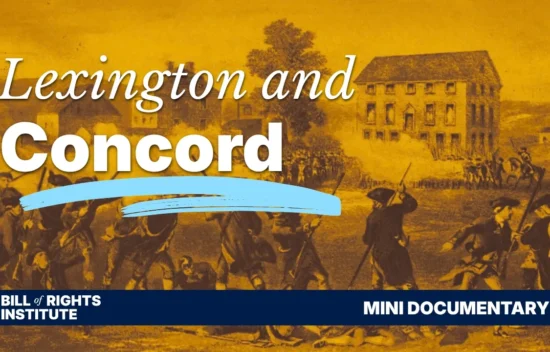
On April 19, 1775, the world changed forever. British troops marched on Lexington and Concord to arrest Patriot leaders and seize hidden munitions—but they were met by a determined militia and the rising spirit of American resistance. From Paul Revere’s midnight ride to the tense standoff on Lexington Green, and the fierce fighting at North Bridge, this mini documentary captures the explosive beginning of the American Revolution.
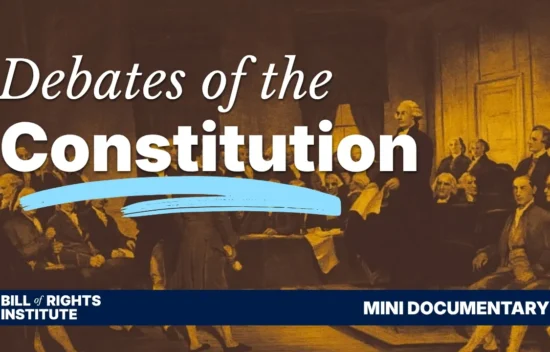
In the uncertain years after the American Revolution, the fate of the new republic hung in the balance. The Constitution—signed in Philadelphia after months of intense debate—was not yet the law of the land. Across the states, fierce battles erupted over its ratification. Would liberty be preserved or lost to centralized power? Federalists and Anti-Federalists clashed in newspapers, statehouses, and convention halls. From the impassioned arguments of Patrick Henry and George Mason to the razor-thin victories in Virginia and New York, this mini documentary captures the intensity and stakes of one of the most consequential debates in American history.

Learn about important dates events that lead up to the ratification of on the Declaration of Independence on July 4th, 1776 in Philadelphia, PA through our interactive timeline!

How can we understand Eisenhower’s leadership through his D-Day statement? In this episode of Primary Source Close Reads Explained, Kirk explores the statement given by General Dwight D. Eisenhower 79 years ago to a group of citizen-soldiers as they prepared for the great undertaking that would be known as ‘D-Day.’ Eisenhower also prepared a statement in case of failure that was never needed but exists for us to examine today as another example of how he demonstrated leadership in the face of hardship. How do these statements show Eisenhower’s commitment to taking full responsibility as a leader?

How can a leader build trust with the people they lead by taking responsibility for their decisions and actions? Explore the story of Dwight D. Eisenhower and the D-Day invasion. In this video determine how he exhibited the virtue of responsibility specifically during the Eisenhower D-Day speech.