Video
Grievance #23 of the Declaration of Independence
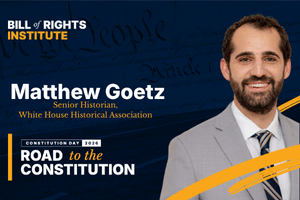
Watch
Founding Principles
About this video
Did the colonists declare independence, or did Britain force their hand?
In Grievance 23 of the Declaration of Independence, Dr. Mathew Goetz of the @WhiteHouseHistoricalAssociation, explains how colonists accused King George III of waging war against them and failing to protect them.
At the center of this grievance is the idea of the social contract. Colonists believed government existed to protect the people. But when Britain passed the Prohibitory Act and withdrew protection from American ships, that agreement was broken.
By this point, fighting had already begun. What started as a conflict over rights was turning into something much bigger.
Some, like John Adams, believed British actions had already made the colonies independent. The Declaration didn’t start independence, it made it official.
This is Part 23 of our 27-part series breaking down every grievance that led to the American Revolution, building toward Independence Day.
0:00 Did the colonists declare independence themselves, or did the British government do it for them? Let’s answer that question by taking a close look at the 23rd grievance in the Declaration of Independence. In the 23rd grievance, the colonists accused King George of waging war against them and refusing to protect them from foreign threats, and thus abdicating government or failing to
0:21 fulfill his duties as king. To understand this grievance, you need to keep two things in mind. The first is that Jefferson and other Americans at the time believed in the idea of the social contract. This was a theory that there was an unwritten agreement between the government and the people. The people should obey the government, but in exchange, the government should protect the people. And if the
0:43 government stopped doing this, then the people were free to rebel and form a new government that would protect them. The second thing to keep in mind is that when the colonists released the Declaration of Independence in July of 1776, the Revolutionary War had already begun almost a year and a half earlier. In April of 1775, the war began with the firing of shots at the Battle of
1:03 Lexington and Concord. Back then, the patriots weren’t fighting for independence, but rather fighting to protect the their rights that they thought they deserved as British subjects. Shortly after the Battle of Lexington and Concord, the British government, with the endorsement of King George, passed what’s called the Prohibitory Act. This said that the powerful British Navy would no longer protect American ships and sailors on
1:25 the high seas as they had previously done up to that point. Now, the king viewed this as just punishment for Americans for disobeying him. But to colonists, the king was violating his half of the social contract. John Adams actually thought that this Prohibitory Act essentially declared independence for the colonists. Within this line of thinking, the Prohibitory Act and other British actions of the
1:46 British government made Americans independent. The Declaration of Independence made it official.
Standards
Related Resources
Why were colonists so alarmed by a law passed in Canada? In Grievance #20 of the Declaration of Independence, Dallas Terry from the Kinder Institute at the University of Missouri explains why the Quebec Act of 1774 deeply worried many Americans. The act expanded Quebec’s territory, replaced English common law with French civil law, and created a government that colonists believed lacked meaningful representation. For many Americans, the biggest issue was proximity. Arbitrary government felt far more dangerous when it existed right next door. Colonial leaders feared that if Parliament could establish this kind of system in Quebec, similar policies could eventually spread into the American colonies themselves. The grievance also reflected anxieties over westward expansion, political power, and the future direction of liberty in North America. This is Part 20 of our 27-part series breaking down every grievance that led to the American Revolution, building toward Independence Day.
What happens when a government rewrites the rules without your consent? In Grievance #21 of the Declaration of Independence, Kelsa Pelletiere, PhD Candidate at the University of Mississippi, explains why colonists were furious when Britain altered colonial governments and revoked key charter rights. Colonial charters acted like agreements between the colonies and the British Crown, helping define how colonial governments operated and what rights colonists expected to have. But in 1774, Parliament passed the Massachusetts Government Act and changed those rules unilaterally, without colonial approval. For colonists, this violated a core principle of self-government: the consent of the governed. If Britain could change colonial governments whenever it wanted, then colonial rights and representation were never truly secure. This grievance reflected a growing fear that Britain was no longer governing with consent, but through direct control. This is Part 21 of our 27-part series breaking down every grievance that led to the American Revolution, building toward Independence Day.
What happens when a government gives itself total power? In Grievance 22 of the Declaration of Independence, Sasha Rickard, Assistant Director at MIT Concourse, explains how Parliament suspended colonial legislatures and claimed the right to make laws for the colonies in all cases whatsoever. For colonists, this crossed a line. Laws were supposed to come from representatives chosen by the people, not imposed by a distant government with no input. Drawing on the ideas of John Locke, this wasn’t just unfair, it was dangerous. Claiming absolute power over the colonies was seen as an act of aggression and a violation of the social contract. By dissolving local governments and taking full control, Britain wasn’t just changing policy. Colonists believed it was destroying their right to self-government and putting them under unchecked authority. This is Part 22 of our 27-part series breaking down every grievance that led to the American Revolution, building toward Independence Day.

Primary sources, videos, essays, lessons, and more about what led to the Declaration of Independence
What were the grievances laid out in the Declaration of Independence? Help students define each grievance through modern song lyrics in our interactive quiz leading up to Constitution Day. This Constitution Day, BRI is highlighting the years between the signing of the Declaration of Independence in 1776 and the Constitution in 1787.