Video
Grievance #18 of the Declaration of Independence
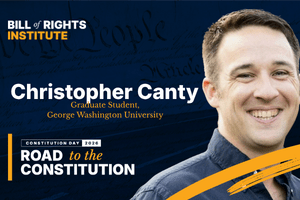
Watch
Founding Principles
About this video
What if you didn’t get a jury at your trial?
In Grievance 18 of the Declaration of Independence, Chris Canty, student at George Washington University, explains how colonists were denied the right to trial by jury in certain cases.
Instead, cases like smuggling were sent to admiralty courts, where a single judge decided the outcome. No jury. No peers. Just a ruling from a magistrate.
For colonists, this was a serious violation of their rights. Trial by jury had been a core part of English law since the Magna Carta, and losing it felt like losing a key protection against government power.
This wasn’t just about one case or one court. It was about a bigger issue: if the government can control the courts, can it also control justice?
0:00 Grievance 18 in the Declaration of Independence states, "For depriving us in many cases of the benefit of trial by jury." It is in direct reference to the British government’s use of an Admiralty court to try offenders accused of avoiding import duties. After the Seven Years’ War, Britain was in tremendous debt and placed several taxes and duties upon the colonists to help raise funds. As the Imperial crisis
0:20 ramped up in the late 1760s, this court’s practice of determining guilt on the sole opinion of a magistrate, rather than a jury of one’s peers, continued to anger colonists. A great example of this process at work is shown through what has come to be known as the Liberty Affair. In Boston in 1768, the owner of the Liberty was accused of smuggling cases of wine and as such had his case heard
0:41 before the Admiralty court. While his case was eventually dismissed, his lawyer identified several violations of his rights, one of the most important being the deprivation of a right to a trial by jury. We know the owner of the Liberty is none other than John Hancock, signer of the Declaration of Independence, and his lawyer, who would eventually be assigned to help draft the Declaration of Independence, is none other than John Adams. To these men, the
1:02 issue at stake did not merely revolve around import duties, but around the British government’s direct refusal to provide colonists with their natural English rights. The right to a trial by jury is so fundamental to English legal tradition that it has its roots dated back to the Magna Carta in 1215. The concept of a jury trial was deemed of such importance by the colonists that it is specifically
1:23 mentioned in both the Sixth and Seventh Amendments to the US Constitution when America was forming its own government over a decade later. But ultimately to the colonists, this deprivation of such a fundamental English right constituted another addition to the long train of abuses and usurpations and led colonists to believe that it is their right, it is their duty to throw off such government and to
1:44 provide new guards for their future security.
Standards
Related Resources
What happens when trials are moved somewhere else? In Grievance 15 of the Declaration of Independence, Hannah Nolan, PhD Candidate at the University of Maryland, explains how British officials allowed soldiers to be tried outside the colonies, raising serious concerns about accountability. After events like the Boston Massacre, colonists had already seen that local courts could deliver fair trials, even in highly emotional situations. But the Administration of Justice Act of 1774 changed that, allowing cases involving British soldiers to be moved elsewhere. For many colonists, this felt like a loophole. If trials weren’t held locally, would justice actually be served? This grievance wasn’t just about one law. It was about a bigger fear: that those in power could avoid consequences, leaving colonists without real protection under the law. This is Part 15 of our 27-part series breaking down every grievance that led to the American Revolution, building toward Independence Day.
What happens when a government controls who you can trade with? In Grievance 16 of the Declaration of Independence, Grace Richter, PhD candidate in history at George Washington University, explains how Britain tightened control over colonial trade through laws like the Navigation Acts. For years, colonists had traded relatively freely, even with countries outside the British Empire. But as tensions grew, Britain began strictly enforcing these laws and restricting trade. The shutdown of the Boston port in 1774 made things even worse, cutting off a major hub of economic activity. For many colonists, this wasn’t just about money. Trade was their livelihood, and controlling it meant controlling their freedom. What once felt like loose oversight turned into something much more serious: direct control over colonial economies and daily life. This is Part 16 of our 27-part series breaking down every grievance that led to the American Revolution, building toward Independence Day.

Everyone knows the phrase “no taxation without representation.” But what did it actually mean? In Grievance 17 of the Declaration of Independence, Zachary Deibel, Assistant Professor at Virginia Military Institute, explains why representation, not just taxes, was the real issue. British officials argued that colonists were “virtually represented” in Parliament, meaning lawmakers acted in the best interest of the entire empire. But for Americans, that wasn’t enough. They were used to having a direct voice through their own colonial legislatures. Colonists didn’t reject all taxes. What they rejected was being taxed by a government where they had no real representation or consent. As thinkers like John Locke argued, legitimate government depends on the consent of the governed. Without that, political power loses its authority.

Primary sources, videos, essays, lessons, and more about what led to the Declaration of Independence
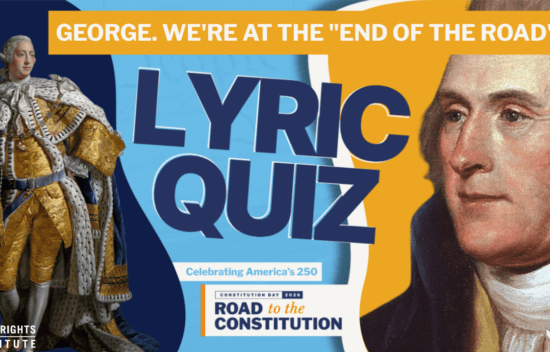
What were the grievances laid out in the Declaration of Independence? Help students define each grievance through modern song lyrics in our interactive quiz leading up to Constitution Day. This Constitution Day, BRI is highlighting the years between the signing of the Declaration of Independence in 1776 and the Constitution in 1787.