Video
Grievance #15 of the Declaration of Independence
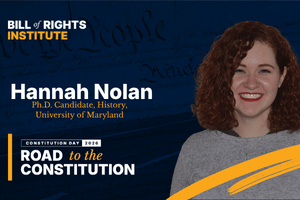
Watch
Founding Principles
Virtues
About this video
What happens when trials are moved somewhere else?
In Grievance 15 of the Declaration of Independence, Hannah Nolan, PhD Candidate at the University of Maryland, explains how British officials allowed soldiers to be tried outside the colonies, raising serious concerns about accountability.
After events like the Boston Massacre, colonists had already seen that local courts could deliver fair trials, even in highly emotional situations. But the Administration of Justice Act of 1774 changed that, allowing cases involving British soldiers to be moved elsewhere.
For many colonists, this felt like a loophole. If trials weren’t held locally, would justice actually be served?
This grievance wasn’t just about one law. It was about a bigger fear: that those in power could avoid consequences, leaving colonists without real protection under the law.
This is Part 15 of our 27-part series breaking down every grievance that led to the American Revolution, building toward Independence Day.
0:00 So, quick question. If I wanted to make
0:02 sure that the Redcoats were given fair
0:04 trials for their conduct in the American
0:06 colonies, where would I put those
0:08 trials? This accusation of mock trials
0:11 was part of a lengthy denunciation
0:13 within the Declaration of Independence
0:15 of standing armies, calling them threats
0:17 to liberty. The Patriots viewed the
0:19 Redcoats as essentially an occupying
0:21 force, a vision deeply rooted in
0:23 Massachusetts experience in the years
0:25 preceding the American Revolution. On
0:27 March 5th, 1770, five men were shot and
0:30 killed by British soldiers during a
0:32 protest. The Boston Massacre incensed
0:34 Patriots, who denounced the soldiers
0:36 involved as {quote} inhuman murderers
0:38 working to bring us into a state of
0:40 bondage and ruin. Now, despite the
0:42 public outrage, the soldiers involved
0:44 were mostly acquitted, and the two men
0:46 found guilty of manslaughter were
0:47 actually given lesser punishments since
0:49 it was their first offense. While this
0:52 decision didn’t provide the emotional
0:53 catharsis a guilty verdict would have
0:55 provided, many Patriots actually
0:57 welcomed the decision because it showed
0:59 that colonial courts were fair, and that
1:01 justice wouldn’t be confused for
1:03 vengeance in Massachusetts.
1:05 This made the Administration of Justice
1:07 Act of 1774 quite the slap in the face.
1:10 So, the Justice Act decreed that all
1:12 cases concerning soldiers would be tried
1:15 outside of Massachusetts if a fair trial
1:17 couldn’t be guaranteed.
1:19 Patriots feared that this simply gave a
1:21 license for British {quote}
1:23 bloodsuckers, as John Hancock put it, to
1:26 act however they wanted without fear of
1:28 punishment. And that was a very
1:30 dangerous precedent set. So, how do you
1:32 ensure that justice is fairly
1:34 administered in the aftermath of a clash
1:36 between law enforcement and citizens,
1:38 especially when it ends in a dead body?
1:40 That question is at the heart of the
1:42 imperial crisis, as evidenced by the
1:44 Declaration’s grievances, and continues
1:46 to be one that the United States
1:48 wrestles with today.
Standards
Related Resources
What happens when military power and government power get combined? In Grievance #12 of the Declaration of Independence, Dr. C.C. Borzilleri explains why colonists were alarmed when British military leaders gained increasing control over colonial government during the imperial crisis. In 1774, Thomas Gage became both royal governor of Massachusetts and Commander in Chief of British forces in North America. To colonists, placing civil and military authority in the hands of one person violated key Enlightenment ideas about limiting power and preventing abuse. The concern wasn’t just about one official. It was about a larger principle: governments need checks and balances so no single authority can dominate the people. Colonists feared that combining military and political power threatened their ability to consent to the laws and systems governing them. This is Part 12 of our 27-part series breaking down every grievance that led to the American Revolution, building toward Independence Day.
What do the Stamp Act, the Intolerable Acts, and Taylor Swift’s favorite number have in common? In Grievance #13 of the Declaration of Independence, Jennifer Seiter from the UVA Democracy and Capitalism Lab breaks down why colonists believed Britain was overstepping its authority and making laws without limits. As Parliament passed laws like the Stamp Act, Sugar Act, and Intolerable Acts, colonists became increasingly frustrated with taxes and restrictions imposed from across the Atlantic. But the real issue wasn’t just money. Colonists believed these laws violated the British constitutional system because they were being imposed by a government where Americans had no real voice. For Britain, Parliament had the authority to act. For colonists, that authority had crossed the line into tyranny. This growing clash over power, representation, and constitutional rights pushed the colonies closer and closer to independence. This is Part 13 of our 27-part series breaking down every grievance that led to the American Revolution, building toward Independence Day.
What if soldiers could show up and expect you to feed and house them? In Grievance #14 of the Declaration of Independence, C. David Carlson from Trinity Academy South Bend explains why colonists were outraged by the British Quartering Acts. Passed in 1765 and again in 1774, these laws required colonists to provide food and shelter for British troops stationed in America. While soldiers weren’t typically placed directly inside private homes, colonists still had to support what many increasingly viewed as an occupying force. At a time when tensions with Britain were already exploding, being forced to house and supply soldiers only made things worse. This grievance became so important that it later inspired the Third Amendment to the U.S. Constitution, which limits the quartering of soldiers in private homes. This is Part 14 of our 27-part series breaking down every grievance that led to the American Revolution, building toward Independence Day.

Primary sources, videos, essays, lessons, and more about what led to the Declaration of Independence
What were the grievances laid out in the Declaration of Independence? Help students define each grievance through modern song lyrics in our interactive quiz leading up to Constitution Day. This Constitution Day, BRI is highlighting the years between the signing of the Declaration of Independence in 1776 and the Constitution in 1787.