Video
Grievance #13 of the Declaration of Independence

Watch
Founding Principles
Virtues
About this video
What do the Stamp Act, the Intolerable Acts, and Taylor Swift’s favorite number have in common?
In Grievance #13 of the Declaration of Independence, Jennifer Seiter from the UVA Democracy and Capitalism Lab breaks down why colonists believed Britain was overstepping its authority and making laws without limits.
As Parliament passed laws like the Stamp Act, Sugar Act, and Intolerable Acts, colonists became increasingly frustrated with taxes and restrictions imposed from across the Atlantic.
But the real issue wasn’t just money. Colonists believed these laws violated the British constitutional system because they were being imposed by a government where Americans had no real voice.
For Britain, Parliament had the authority to act. For colonists, that authority had crossed the line into tyranny.
This growing clash over power, representation, and constitutional rights pushed the colonies closer and closer to independence.
This is Part 13 of our 27-part series breaking down every grievance that led to the American Revolution, building toward Independence Day.
0:00 I’m Jennifer Sider, and today we’re
0:02 talking about another grievance in the
0:03 Declaration of Independence, grievance
0:05 number 13. Now, that’s both Taylor
0:06 Swift’s and my personal favorite number,
0:08 so you know this is going to be a good
0:09 one. This grievance is primarily about
0:11 laws and who has the power to make them.
0:13 The colonists are arguing that the King
0:15 and others, which is Parliament, have
0:18 started enforcing rules that don’t
0:19 really line with the British
0:20 Constitution. But, what rules are they
0:22 talking about exactly?
0:24 Well, let’s set the scene.
0:26 As of this moment, Great Britain has
0:28 passed the Stamp Act, which made people
0:29 pay taxes on paper, so think newspapers,
0:32 playing cards, and legal documents.
0:34 They passed the Sugar Act, which passed
0:35 taxes on a lot of popular goods, such as
0:37 molasses, sugar, coffee, and wine.
0:40 And they passed the Intolerable Acts,
0:42 which closed the Boston Harbor, sent
0:44 additional British troops to America,
0:46 and tightened British control in the
0:47 colonies. The big thing here is not that
0:48 these rules are unfair, which they kind
0:50 of are.
0:51 It’s that they’re costing the colonists
0:52 a lot of money, and they’re being made
0:54 by a governing body from across the
0:56 Atlantic that they think shouldn’t have
0:58 that much authority over them.
1:00 According to the colonists, Parliament
1:01 and the King are overstepping their
1:03 boundaries time and time again. The
1:04 colonists think these actions are
1:06 unconstitutional, but Parliament thinks
1:08 they’re totally within their rights to
1:09 act. The arguments reach an impasse, and
1:12 as long as the colonists are under
1:13 parliamentary power, they’re always
1:15 going to be subjected to their
1:16 authority. And so, as a result, the
1:19 colonists are proudly declaring
1:20 independence from Great Britain, and
1:22 that they are never, ever, ever getting
1:25 back together with the British Empire.
Standards
Related Resources
What happens when the government suddenly floods your town with officials and new rules? In Grievance #10 of the Declaration of Independence, JJ Nattrass from George Washington University explains why colonists were frustrated by the growing number of British offices and officers sent to enforce imperial laws. As Britain passed new measures like the Stamp Act and the Intolerable Acts, enforcement expanded across the colonies. More offices. More officials. More oversight. To colonists, these “swarms of officers” felt intrusive and overwhelming. They collected taxes, enforced regulations, and inserted themselves into everyday life in ways many Americans had never experienced before. This grievance wasn’t just about bureaucracy. Colonists believed British policies were threatening their livelihoods, freedoms, and ability to build lives on their own terms. This is Part 10 of our 27-part series breaking down every grievance that led to the American Revolution, building toward Independence Day.
Why were British troops stationed throughout the colonies during peacetime? In Grievance #11 of the Declaration of Independence, JJ Nattrass from George Washington University explains why colonists grew increasingly suspicious of the British military presence in America. After the Seven Years’ War, Britain kept standing armies in the colonies, claiming the troops were there to maintain stability and prevent further conflict. But many colonists saw something very different. Redcoats appeared not just on the frontier, but in major cities, where their presence began to feel less like protection and more like surveillance and intimidation. Events like the Boston Massacre only deepened those fears. To many Americans, the presence of standing armies without local consent looked like a direct threat to liberty and self-government. This is Part 11 of our 27-part series breaking down every grievance that led to the American Revolution, building toward Independence Day.
What happens when military power and government power get combined? In Grievance #12 of the Declaration of Independence, Dr. C.C. Borzilleri explains why colonists were alarmed when British military leaders gained increasing control over colonial government during the imperial crisis. In 1774, Thomas Gage became both royal governor of Massachusetts and Commander in Chief of British forces in North America. To colonists, placing civil and military authority in the hands of one person violated key Enlightenment ideas about limiting power and preventing abuse. The concern wasn’t just about one official. It was about a larger principle: governments need checks and balances so no single authority can dominate the people. Colonists feared that combining military and political power threatened their ability to consent to the laws and systems governing them. This is Part 12 of our 27-part series breaking down every grievance that led to the American Revolution, building toward Independence Day.

Primary sources, videos, essays, lessons, and more about what led to the Declaration of Independence
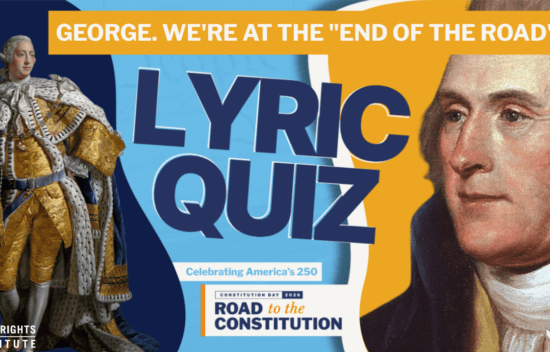
What were the grievances laid out in the Declaration of Independence? Help students define each grievance through modern song lyrics in our interactive quiz leading up to Constitution Day. This Constitution Day, BRI is highlighting the years between the signing of the Declaration of Independence in 1776 and the Constitution in 1787.