Skip to Main Content

Unit

Chapter 12: The Great Depression and WWII 1932-1945

Guiding question

Invite students to explore how Franklin Roosevelt responded to the crises of the Great Depression at home and the war against tyrannical states during World War II abroad.
Grade
9–12
Published
Oct 5, 2021
  • 2 Lessons
  • 17 Activities
  • 14 Essays
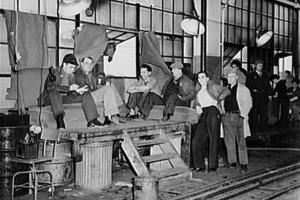
Men sitting and standing in a workshop, engaged in conversation, with industrial equipment and large windows in the background.

Chapter 12 of Life, Liberty, and the Pursuit of Happiness, BRI’s U.S. History Curriculum Resource, invites students to explore how Franklin Roosevelt responded to the crises of the Great Depression at home and the war against tyrannical states during World War II abroad. Discover our suggested sequence for Chapter 12.

Teacher resource

Chapter 12: 1932-1945 Inquiry Organizer

How did Franklin Roosevelt respond to the crises of the Great Depression at home and the war against tyrannical states during World War II abroad?

Download

Lessons

A black and white aerial photograph of a volcanic eruption with smoke and ash clouding the sky.
Was the Use of the Atomic Bomb Justified? DBQ
  • 1 Activity
  • 65 min

Use this lesson with The Manhattan Project Narrative and the Dropping the Atomic Bomb Decision Point to show the development of the United States' nuclear program and subsequent use in the Hiroshima and Nagasaki bombings.

A historical evacuation notice for people of Japanese ancestry during WWII, dated April 1, 1942, in San Francisco.
Korematsu v. United States and Japanese Internment DBQ
  • 2 Activities
  • 80 min

Use this lesson to have students explore the challenges to civil liberties faced by Japanese Americans in internment camps during WWII.

Unit resources

A historical black and white photo of a line of men wearing hats, waiting outside a building.
ActivityDid the New Deal End the Great Depression?

Under the New Deal, federal programs spent huge amounts of money in an attempt to combat the Great Depression. Were these programs an effective way to restore economic prosperity in the country? Glenda Gilmore and Michael Parrish debate this question.

Historical image of a presidential inauguration with a crowd and ornate decorations at the event.
ActivityFranklin D. Roosevelt, First Inaugural Address, March 4, 1933

Use this primary source text to explore key historical events.

Mural depicting a diverse group of people engaged in various traditional activities and crafts.
ActivityArt Analysis: The Art of the New Deal, 1934

Use this primary source imagery to analyze major events in history.

A smiling man in a light suit raises his arms in celebration inside a building.
ActivityHuey Long and the American Liberty League, 1934

Use this primary source text to explore key historical events.

A man and two children walking through a dusty landscape near a dilapidated wooden house.
ActivityPhotographs: The Dust Bowl and Rural Poverty, 1936–1937

Use this primary source imagery to analyze major events in history.

A man in a suit is holding a pipe, seated in an office with wooden furniture in the background.
Activity“Sit Down,” Maurice Sugar, 1936–1937

Use this primary source text to explore key historical events.

Historical black-and-white photo of Franklin D. Roosevelt and Winston Churchill at a military conference.
ActivityThe Atlantic Charter, 1941

Use this primary source text to explore key historical events.

Man in a suit standing in front of the Lincoln Memorial statue, with an inscription in the background.
ActivityA. Philip Randolph, The Call to Negro America to March on Washington, 1941

Use this primary source text to explore key historical events.

Two men working together on an aircraft with an American flag in the background, featuring the text "UNITED WE WIN."
ActivityWorld War II Propaganda Posters, 1941–1945

Use this primary source imagery to analyze major events in history.

Rosie the Riveter, Women Working during WWII
ActivityPhotographs: Women at Work on the Homefront during World War II, 1941–1945

Use this primary source imagery to analyze major events in history.

Franklin D. Roosevelt seated at a desk with multiple microphones during a radio broadcast.
ActivityFranklin Roosevelt, Second Bill of Rights, 1944

Use this primary source text to explore key historical events.

A black and white photo of military personnel listening to a commanding officer in a camp setting.
ActivityDwight Eisenhower, D-Day Statement, 1944

Use this primary source text to explore key historical events.

Load more

Standards