Lesson
War in the Early Republic
Guiding question
How did the country’s first four Presidents exercise their powers as Commander in Chief?

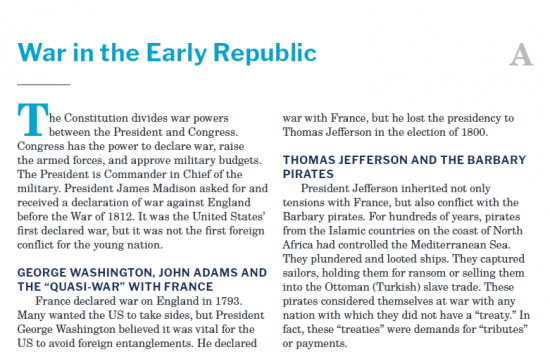
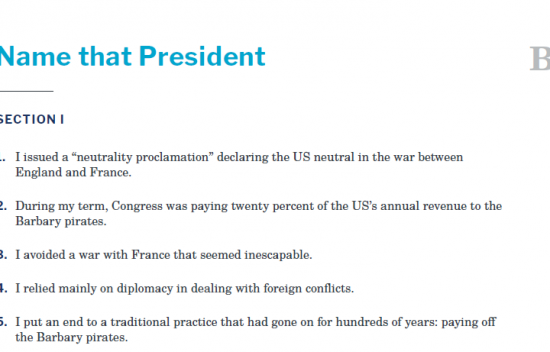
The War of 1812 was the United States of America’s first declared war, but it was far from being the nation’s first foreign conflict. Presidents George Washington, John Adams, Thomas Jefferson, and James Madison all countenanced various adversaries and all took different approaches to exercising the powers vested in the President under the Constitution. Washington, concerned with avoiding foreign entanglements, declared the US would stay neutral when France and England went to war, and set off a firestorm of criticism for doing so. Adams also succeeded in avoiding war after attempting to engage France diplomatically and pursuing domestic policies designed to quiet support for the French. Jefferson, frustrated with his two predecessors for having continued the traditional practice of paying off the Barbary pirates, declared an end to the bribes and sent a naval force to deal with the pirates. Madison sought and received the first-ever congressional declaration of war (against Britain), and also declared victory against the Barbary pirates after a second skirmish in 1815.
Founding Principles
Objectives:
Students will:
- Identify ways the nation’s first four Presidents exercised their constitutional power as Commander in Chief.
- Evaluate their various approaches to foreign enemies.
- Assess what conditions require declarations of war from Congress.
Materials
- Handout A: War in the Early Republic
- Handout B: Name That President
Lesson Components
Lesson plan
50 minClick a phase to open it
More Information
To create a context for this lesson, have students complete Constitutional Connection: War and the Constitution.
Standards
Related materials

EssayThe XYZ Affair and the Quasi-War with France
Explore what the Quasi-War was and its impact on the U.S.
