Skip to Main Content
undefined

Ulysses S. Grant After the Civil War BRI and In Pursuit Lesson

Essential Question

  • How do people evaluate leaders, past or present?

Guiding Questions

  • How do different sources (photographs, video, and political cartoons) shape and challenge our understanding of Ulysses S. Grant’s character and leadership?
  • How can a leader remain principled even when circumstances or public opinion turn against them?
  • How do the habits of a leader shape how they respond when others within an institution act corruptly, irresponsibly, or unfairly?

Objectives

  • Students will be able to…
    • Synthesize information about Ulysses S. Grant from several sources.
    • Analyze visual primary sources (photographs and political cartoons) to identify historical context, symbolism, and perspectives on Ulysses S. Grant’s character and leadership.
    • Evaluate Grant’s actions through the lens of the civic virtues of honor, integrity, and humility, citing specific evidence from a video and primary sources.

Resources

Teacher Resources:

  • Grant Video
  • Grant Political Cartoon
  • Grant Portraits

Facilitation Notes

  • This video and lesson were developed in connection with the In Pursuit project https://www.inpursuit.org/lessons. The essay for Ulysses S. Grant was written by General (Ret.) Stanley McChrystal. It can be read for additional teacher background on this topic, and it might be well-suited to classroom use for higher-level readers. The full essay is available here: https://www.inpursuit.org/lessons.
  • The essay provides an overview of Grant’s role in navigating the Stanton Crisis of 1868, when President Johnson removed Secretary of War Edwin Stanton from his position despite the Tenure of Office Act. The central lesson that the essay imparts is: “Institutions depend on leaders who stay grounded in values and purpose rather than swayed by circumstance.”
  • The essay is one perspective on the life and work of Ulysses S. Grant. The video highlights another aspect of Grant’s legacy: the foundation of Grant’s actions in the practice of civic virtue. This video foregrounds responsibility while revealing how virtues work together in practice. Although the video title names responsibility, the lesson centers on how Grant’s leadership was grounded in honor, humility, and integrity, and how these virtues shaped the way he understood and carried responsibility in moments of national consequence.
  • The Bill of Rights Institute defines these civic virtues in the following way:
    • Honor: Demonstrating good character and being trustworthy.
    • Integrity: To tell the truth, expose untruths, and to keep one’s promises.
    • Humility: A recognition that one’s ignorance is far greater than one’s knowledge. Putting others ahead of ourselves in thought, word, and deed. A willingness to give others credit and to admit when we are wrong.
  • Encourage your students to critically engage with the material in the video, the primary source, and other context you may be providing to come to their own conclusion and assessment.

Anticipate

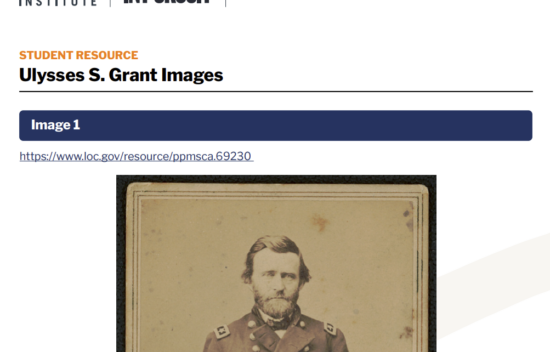
  • Say to students, “Before we hear historians or commentators tell us who Ulysses S. Grant was, we are going to start the way historians often do, by looking closely at visual evidence. Photographs don’t tell us everything, but they do shape first impressions. As we look at these images, keep this in mind: What do these images encourage us to believe about Grant?
  • Students will examine a series of photographs depicting Ulysses S. Grant at different points in his life and public career. As they study each image, they will identify visual elements, objects, technologies, fashions, or social behaviors that would appear out of place in today’s world. Students will also identify aspects of the photos that would still be considered normal or familiar in modern society.

https://www.loc.gov/item/2020635975/

https://www.loc.gov/item/2002736661/

https://www.loc.gov/item/96524441/ https://www.loc.gov/item/96522531/

https://www.loc.gov/item/96522250/

https://www.loc.gov/item/2018650356/


Engage

  • Say to students, “From these photographs alone, we might think we understand who Grant was, or at least what kind of leader he appeared to be. But images can’t show decisions, motives, or consequences. To move beyond appearances, we need to examine his actions and words. You’ll notice how the video title names one civic virtue, but as we watch, we may see others come into play. Our job is to notice which virtues are actually shaping this leader’s decisions. As we watch the video, you’ll begin placing Grant on three character spectrums.”
  • Before playing the video, tell students they will place Ulysses S. Grant on a spectrum for each virtue/vice below, ranging from strongly embodying the virtue to clearly acting in opposition to it.
    • Honor- Dishonor
    • Integrity-Self Deception
    • Humility-Hubris
  • Scaffolding note: To help students think more deeply, consider these questions as they decide where to place him on each spectrum:
    • Honor
      • Does he act in a way that earns respect from others?
      • Does he uphold shared values or responsibilities, even when it is difficult?
      • Are there moments where his actions undermine honor, either personally or toward others?
    • Integrity
      • Do his actions align with his stated beliefs or principles?
      • Does he tell the truth and take responsibility for his choices?
      • Are there signs of hypocrisy, deception, or moral compromise?
    • Humility
      • Does he acknowledge his limitations or mistakes?
      • Does he seek recognition and praise, or does he place others above himself?
  • After the video, Ask students to indicate where they think Grant falls on each spectrum and to explain their reasoning using specific evidence from the video.
    • What actions, words, or decisions support your placement?
    • What mattered most to you in placing Grant on each spectrum?
    • Are there moments that complicate or challenge your judgment
    • Which virtue do you think made the other virtues possible in this story?
    • If Grant had only practiced the primary virtue, what might have gone wrong?

Explore

  • Say to students, “So far, we’ve focused on Grant as an individual, his character, decisions, and leadership. But historical figures don’t exist in isolation. People at the time formed their own opinions, often very different from how leaders saw themselves. One way Americans expressed those opinions was through political cartoons.”
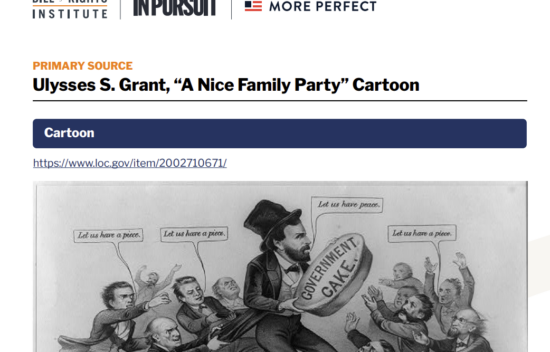
  • Display or distribute the following political cartoon entitled “A Nice Family Party” https://www.loc.gov/item/2002710671/

Say to students, “Ulysses S. Grant was president (1869-1877) during the Reconstruction era (1865-1877). Although widely respected for his leadership during the Civil War, Grant’s presidency became associated with corruption, political favoritism, and scandals involving people close to him. Importantly, historians generally agree that Grant himself was personally honest and not corrupt; however, he often trusted friends and allies who later abused their positions. Many Americans worried that the federal government served insiders rather than the public.

Political cartoons were a popular way to criticize leaders in the nineteenth century, and artists often used humor and exaggeration to express public frustration and influence opinion.

This cartoon is titled “A Nice Family Party.” It depicts a chaotic scene in which many political figures are struggling and reaching toward a large object labeled “Government Cake.” Several figures are pulling, grabbing, and climbing over one another to get a share, while multiple speech bubbles repeat the phrase “Let us have a piece.” The title suggests that the government is being treated like a private family gathering rather than a public institution serving everyone. Through satire, the cartoon criticizes the corruption and greed surrounding Grant’s administration, even though Grant himself is not portrayed as personally dishonest.”

  • Have students complete the following Guided Analysis Questions

1. Observation (What do you see?)

What is happening in the scene?

What words appear in the cartoon, and who is saying them?

What object is at the center of the image?

2. Symbolism (What do things represent?)

What does the “Government Cake” likely symbolize?

Why do you think everyone wants “a piece”?

How does the physical struggle help communicate the cartoonist’s message?

3. Point of View and Message

Is this cartoon supportive or critical of the government? Explain.

What behaviors or problems is the artist criticizing?

How does the title “A Nice Family Party” add to the meaning?

4. Historical Connection

How does this cartoon reflect concerns about corruption during Grant’s presidency?

Why might Americans in 1872 have found this cartoon reflective of the world around them?


Assess & Reflect

  • Say to students, “Earlier, you placed Ulysses S. Grant on three character spectrums based on the video. You’ve now analyzed a political cartoon that criticizes corruption during his presidency. Political cartoons exaggerate problems and often blur the line between a leader and the people around him. Let’s quickly revisit our judgments.”
  • Ask students to look at their original spectrum placements for:

Honor – Dishonor

Integrity – Self‑Deception

Humility – Hubris

  • Have them answer (in writing or discussion):
  1. Would you place Grant in the same spot, a different spot, or the same spot for different reasons?
  2. Does the cartoon change your view of Grant himself, or mainly of his administration?
  3. Does the cartoon suggest Grant is personally corrupt, or that corruption existed around him?
  4. What evidence from the video still supports your original placement?
  • Say to students, “Good historical thinking means holding two ideas at once: corruption existed during Grant’s presidency, but that does not automatically mean Grant himself lacked honor or integrity. Different sources emphasize different aspects of the past.”

Extend

  • Present a choice that Grant faced during the video (e.g. whether to accept the role as Secretary of War) and offer a sentence stem for accepting the role “I will do this because…” or rejecting it “I will not accept the job because…”
    • Students write a paragraph with clear reasoning to back up their choices.