Lesson
Separation of Powers with Checks and Balances
Guiding question
Why was the separation of powers included in the US government?

Founding Principles
Guiding Questions
- Why was the separation of powers included in the US government?
- What are the three branches of government?
- How does the checks and balances process work?
- What are some examples of how separation of powers works in our government today?
Objectives
- Students will understand how and why separation of powers was included in the US Constitution.
- Student will describe the three branches of government and explain how the checks and balances process works.
- Students will explain real life examples of checks and balances in action.
Materials
Educator Resources
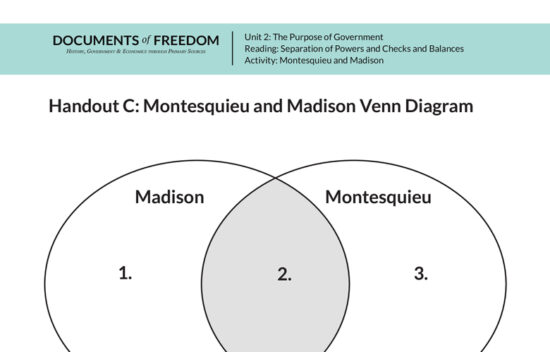
- Handout C: Montesquieu and Madison Venn Diagram Answer Key
- Handout D: Separation of Powers Video Viewing Guide Answer Key
Student Handouts
Lesson Components



The Founders understood the principle expressed by the British historian, Lord Acton, “All power tends to corrupt; absolute power corrupts absolutely.” Through the complex system of checks and balances developed in the U.S. Constitution, they sought to assure that no person or branch of government could exercise unrestrained power. As James Madison advocated in Federalist No. 51, ambition should counteract ambition in a fashion that advances the public good.
Lesson plan
Key Terms
- Founders
- liberty
- limited government
- Framers
- John Locke
Standards
Related materials

What is separation of powers? The US Constitution describes separation of powers throughout the first 10 amendments. Do you understand why separation of powers is important for protecting our freedom? This short, engaging video focuses on the constitutional principle of separation of powers. Clear definitions and graphics, an engaging historical narrative, brief scholar interviews, and memorable quotes will make this 6-minute video perfect for use any time of the year!

How do the executive and legislature balance each others powers?