(K-3) Social Studies Skill Mini-Lesson – Cause-and-Effect and Neil Armstrong’s Amazing Courage
Lesson Components
Guiding Questions:
- How do different events lead to specific outcomes?
- How did Neil Armstrong demonstrate courage?
- What is the civic virtue of courage?
Objectives
- Students will…
- Identify cause and effect relationships.
- Explain how Neil Armstrong demonstrated courage.
- Define and identify the civic virtue of courage
Facilitation Notes
- This lesson is intended to follow Franklin’s Fantastic Civic Virtues lesson. It can follow or precede any version of Eckford’s Epic Courage.
- Eckford’s Epic Courage also focuses on the civic virtue of courage. This is intentional to allow comparison of how two different people manifested courage in different situations. Scaffolding notes are included throughout the lesson to help you create these connections for students.
- This lesson is intended for younger learners, from kindergarten to 3rd grade. Several modifications, such as different levels of texts and scaffolding notes, are available to span this large range of ages and developments.
- This lesson requires advance preparation, including collecting and printing materials. See the Teacher and Student Materials list.
Resources
Teacher Materials
- Courage Song – Armstrong’s Amazing Courage
- 1 copy of the K-1 mini-book deconstructed (not stapled, pages randomized)
- Optional: Modes of Reading Teacher Support Document
- Teacher sourced – picture or video of Neil Armstrong stepping on the moon
Student Materials
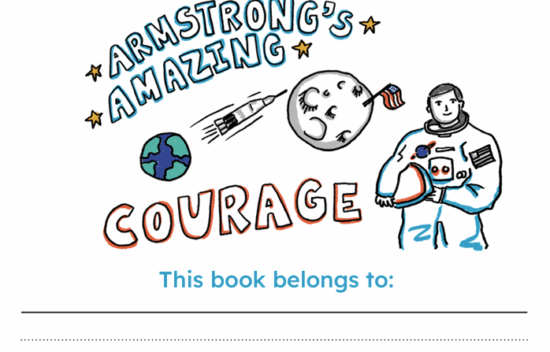
- Armstrong’s Amazing Courage Mini-book
- Two versions of the mini-book are available based on the lexile level of your learners. Option A features clear, simple sentences, large easy‑to-read print, and a dedicated reflective writing page. With fewer total pages, it’s an ideal choice for younger learners or those who benefit from a streamlined, accessible format. Option B features more complex sentence structures and a longer page format. Skills boxes appear throughout to reinforce key literacy concepts including phonic spelling patterns (sounds), Fluency and Vocabulary practice words, and targeted phonemic awareness skills. This option offers a more robust challenge for developing readers who are ready for increased rigor.
- Option A (K-1)
- Print double-sided, along the short edge. Fold along center line and staple to create a book.
- Print-Ready Option B (2-3)
- Print single-sided, staple on left side where indicated, then cut on the dotted line to create books.
- Digital Option B (2-3) – meant to be accessed via a device
- Option A (K-1)
- Two versions of the mini-book are available based on the lexile level of your learners. Option A features clear, simple sentences, large easy‑to-read print, and a dedicated reflective writing page. With fewer total pages, it’s an ideal choice for younger learners or those who benefit from a streamlined, accessible format. Option B features more complex sentence structures and a longer page format. Skills boxes appear throughout to reinforce key literacy concepts including phonic spelling patterns (sounds), Fluency and Vocabulary practice words, and targeted phonemic awareness skills. This option offers a more robust challenge for developing readers who are ready for increased rigor.
- Group Assessment
- Two options of the assessment are available to choose from based on the needs of your learners.
Anticipate
Civic Virtue Song
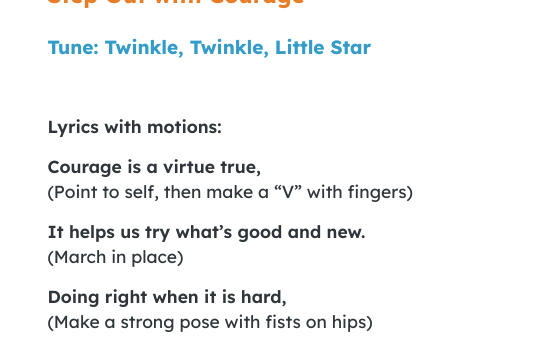
- Tell students: “Today I am going to teach you a song called Step Out with Courage. It is going to help us remember some important ideas that we will be learning about.”
- Teach students the words and motions for the song, one line at a time.
- Sing the full song at least two times with students.
- Repeat the song throughout the day, singing with students during transitions, play time, or during periods of waiting.
Scaffolding note: This song complements the song about Courage from Eckford’s Epic Courage. If students already know that song, discuss the differences between the songs and how courage can look different in different situations.
- For instance, it can be courageous to jump from a tall rock and it can be courageous to speak in front of a large crowd.
Engage
Reading the Mini-book
- Transition: Distribute copies of the mini-book to students.
- Tell students: “We are going to read a book called Neil Armstrong’s Amazing Courage. Based on our courage song and what you know, what do you think courage is? Based on the title and the book cover, what do you think this book will be about?”
- Guide students to the idea that courage is when you do good things, even if it is hard or scary.
- Brainstorm with students: “Who are some people or characters that you think are courageous?”
- Student-friendly examples could include superheroes, community helpers, or sports players.
- Tell students: “Next, we will read a story about a man named Neil Armstrong. He was the first person to step on the Moon and that took a lot of courage!”
- Read the book with students twice.
- First, read the book aloud to students as they follow along, pointing to each word with a finger as you read. Model appropriate speed and expression as you read to your students.
- Next, read the book in a teacher think-aloud reading style.
- In a think-aloud, you will pause at strategic points to highlight important information, summarize, and model skilled thinking about reading for your students.
- Prepare these pause points before the lesson based on your students grade and skill level. You can also utilize the skills boxes in Mini-book Option B to inspire your pause points.
- For example, on page 9 of the mini-book Option B the text says: “No one knew if the Moon’s surface could hold a spacecraft.”
- A teacher could say: What do you think that means? How do you think he felt? Armstrong believed that taking the risk of going to the moon to learn more about space was valuable. Even if he did not know what was going to happen, he still was willing to travel to the Moon.
- Send student mini-books home at the conclusion of the lesson to encourage family engagement. Families and students will benefit from a shared understanding around classroom activities.
Scaffolding note: If reading with more advanced or older students, additional reading styles are available to choose from in our Modes of Reading Teacher Support Document. Check out “Choral Reading” or “Echo Reading” to support fluency.
Explore
Cause and Effect Book Page Sequencing
- Explain Cause and Effect:
- Cause= why something happened
- Effect= what happened because of it
- All events have causes and effects, they are like a chain.
- There can also be many causes or many effects for one event.
- Some examples of student accessible examples include:
- Because it rained (cause), we used umbrellas (effect)
- Because the sun was very bright (cause), we wore our sunglasses (effect).
- Because we were hungry (cause), we ate our snacks (effect).
- Because the classroom was messy (cause), we cleaned up together (effect).
- Because the bell rang (cause), we lined up to go outside (effect).
Scaffolding note: If your students need additional practice with this concept, consider turning it into a quick, game‑like activity. Use examples pulled from their daily lives so the cause‑and‑effect relationships feel familiar and accessible. Start by giving students a cause and asking them to suggest a possible effect. For an added challenge, reverse the task by providing an effect and having students generate a plausible cause.
- Bring out the deconstructed pages of the K-1 mini-book and distribute a page to each student or pair of students, depending on your class size.
- Instruct students to use their understanding of cause and effect to place the pieces on the book in order and defend their reasoning.
- Invite them to consider text-dependent questions such as:
- What choices did Neil make in her early life that led to being chosen for the Apollo 11 mission?
- What caused the president to announce America would go to the Moon?
- What did Neil and Buzz bring back from the Moon? What might be the effect of this?
- Millions of people watched Neil Armstrong land on the Moon on TV or read about it in the paper. What effect might the words “One small step for man, one giant leap for mankind” might have had on them?
- Show a picture or video of Neil Armstrong stepping on the Moon. Ask “Why do you think this moment was important?”
Whole Group Discussion Wrap Up
- Write “Neil Armstrong walked on the Moon (1969) on the board. Ask students for the effects of this event. For example:
- People were proud of them
- They learned new things about space.
- We (Americans) won the space race.
- People were inspired to become astronauts.
- Optional: Extend student thinking by introducing the idea of short-term and long-term effects. Short-term= we won the space race, Long-term=new information, inspiration.
Apply
Personal Cause and Effect Relationship Sentences
- Tell students “There were cause and effect relationships when Neil Armstrong walked on the Moon, but there are also cause and effect relationships in our own lives. Let’s come up with some.”
- Have students come up with cause-and-effect happenings in their own lives.
- An example could be “Because I study math, I can do addition.” or “Because I went to school, I met my friend Sam.”
- List several sentence starters on the board if students are not sure where to begin, such as:
- Because I study_____, I know_____
- Because I went to school, I _____.
- Because I play _____, I _____.
Assess
There are two assessment options. You can use them together or individually, depending on your needs.
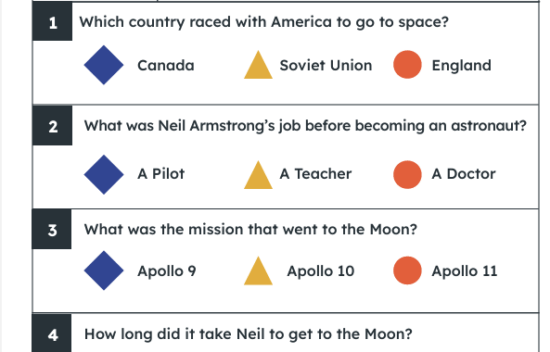
- Option 1: For K-1
- 5 multiple choice questions, shapes distinguish options
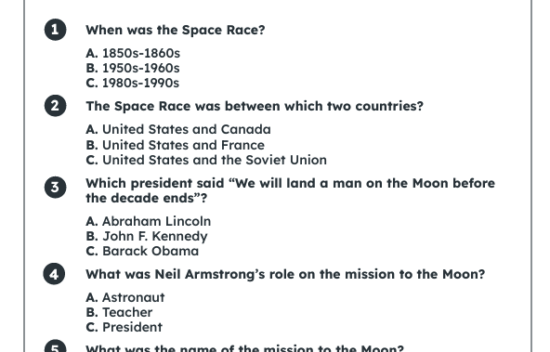
- Option 2: For 2-3
- 10 multiple choice questions, letters distinguish options
- To facilitate a whole-group assessment:
- Print a copy of your chosen assessment option for each student in the class and project a copy of the assessment if possible.
- Ask students to point to the number 1 on their page, then follow along as you read aloud. You may point to each word as you read.
- Read the question, pointing to each word.
- Read each answer choice, pointing to the choice indicator (letter or shape)
- Repeat the question-and-answer choices if needed.
- Prompt students to choose their answer by circling their choice.
- Repeat for the remaining questions to complete the assessment.
