Lesson
John Quincy Adams and Foreign Affairs In Pursuit Lesson Plan
Founding Principles
Virtues
Guiding questions
Essential Questions
- How do experiences, values, principles, and civic virtues shape the way people make consequential decisions?
- How did these guide Adams in shaping American foreign policy?
Guiding Questions
- How did Adams’s diplomatic experiences shape his thinking about America’s role in the world?
- What principles did he believe should guide American foreign policy?
- How did virtues like prudence and moderation influence the Monroe Doctrine?
- What dilemmas did Adams identify when deciding whether America should intervene abroad?
Learning Objectives
Students will:
- Synthesize information from three different sources and media types to build an idea of the life and career of John Quincy Adams.
- Assess the role of the United States in the world based upon John Quincy Adams’s political career.
Materials
Lesson resources
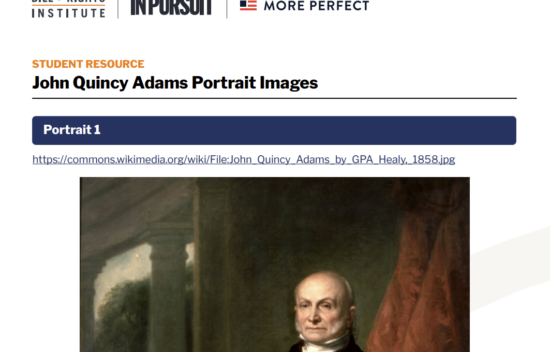
Analyze three artistic portraits of John Quincy Adams to evaluate his presentation in history and culture.
Analyze a speech from John Quincy Adams to see his application of civic virtue to foreign policy decisions
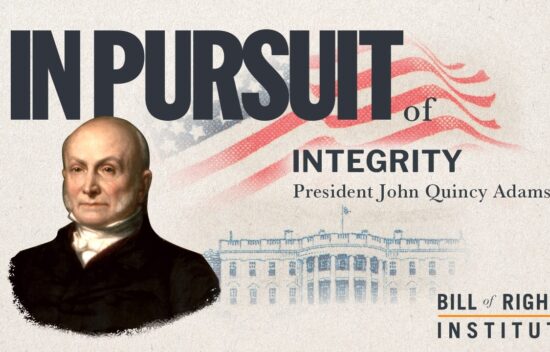
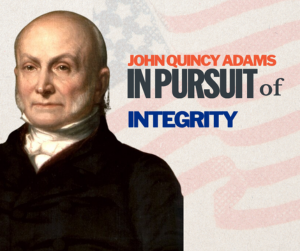
In this video, students learn how John Quincy Adams used integrity to shape American foreign policy during the nation's early years. From his diplomatic service in Europe to his role in developing the Monroe Doctrine, Adams balanced American interests with the nation's founding principles. His commitment to prudence, restraint, and self-government helped define America's place in the world. This video was based on an essay for In Pursuit written by Lindsay Chervinsky : www.inpursuit.org/lessons/short-term-defeat-does-not-end-long-term-influence Check out this video and other free teaching resources on BRI or In Pursuit websites at billofrightsinstitute.org/bri-x-in-pursuit/ or inpursuit.org/educators. This video was made in conjunction with In Pursuit. In Pursuit is a landmark initiative of More Perfect, a bipartisan alliance of 44 Presidential Centers, National Archives Foundation, American Academy of Arts and Sciences, Karsh Institute for Democracy at the University of Virginia, and more than 100 organizations working together to protect and renew our democracy as we approach the 250th anniversary of the Declaration of Independence and beyond.
Lesson plan
More Information
Teacher/Facilitation Background:
This video and lesson were developed in connection with the In Pursuit project https://www.inpursuit.org/lessons. The essay for John Quincy Adams was written by historian Lindsay Chervinsky. It can be read for additional teacher background on this topic, and it might be well-suited to classroom use for higher-level readers. The full essay is available here: https://www.inpursuit.org/lessons.
The essay provides an overview of Adams’s long and varied career in public service, including roles in government at home and abroad. The central lesson that the essay imparts is: “Presidents can provide vision and wisdom for the future, even if the American people are not willing to embrace it in that moment.”
This is one perspective on the life and work of John Quincy Adams. The video highlights another aspect of his legacy: focusing in particular on his role in the development of the Monroe Doctrine. While the video highlights integrity, the lesson focuses on how John Quincy Adams practiced prudence and moderation, carefully weighing consequences, exercising restraint, and making decisions shaped by long-term judgment rather than impulse. The Bill of Rights Institute defines these virtues in the following way:
- Integrity: To tell the truth, expose truths, and keep one’s promises.
- Prudence: Practical wisdom that applies reason and other virtues to discern right courses of action in specific situations.
- Moderation: The avoidance of excess or extremes.
Encourage your students to critically engage with the material in the video, the primary source, and other context you may be providing to come to their own conclusion and assessment.