Lesson
The Civil War to 1910: The Golden Age of Parties

Founding Principles
Objectives
- Students will examine the major events that shaped the methods and acts of Congress as they responded to a rapidly-changing political and economic landscape.
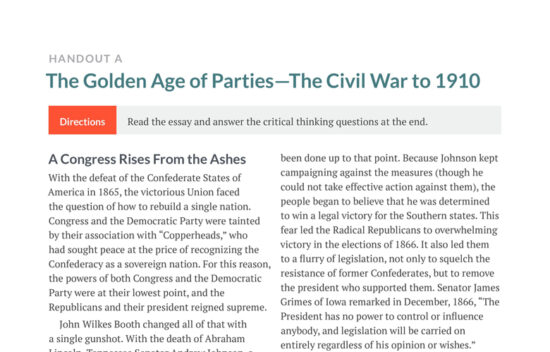
- Students will take an in-depth look at the impeachment of President Andrew Johnson, and analyze Congress’s power of impeachment.
- Students will analyze the separation of powers among the three branches, and understand how that balance is maintained in the Constitution.
Materials
Lesson Components


Lesson plan
Key Terms
- Speaker of the House
- Political party
- Caucus
- Disappearing quorum
- Thomas B. Reed
Standards
Related materials

What is separation of powers? The US Constitution describes separation of powers throughout the first 10 amendments. Do you understand why separation of powers is important for protecting our freedom? This short, engaging video focuses on the constitutional principle of separation of powers. Clear definitions and graphics, an engaging historical narrative, brief scholar interviews, and memorable quotes will make this 6-minute video perfect for use any time of the year!

The Founders understood the principle expressed by the British historian, Lord Acton, “All power tends to corrupt; absolute power corrupts absolutely.” Through the complex system of checks and balances developed in the U.S. Constitution, they sought to assure that no person or branch of government could exercise unrestrained power. As James Madison advocated in Federalist No. 51, ambition should counteract ambition in a fashion that advances the public good.

In 1787 the Constitution granted significant new powers to the central government, including those traditionally held by sovereign nations. In response to Anti-Federalist concerns about a too-powerful central government, James Madison explained that the new system of government was designed to work with human nature.

The U.S. Constitution divides war powers between the president and Congress. The delegates to the Constitutional Convention were focused on creating a government powerful enough to protect liberty, but not so powerful that it would threaten liberty. They worked carefully to craft the war powers of the new government, knowing that history was full of examples of war, so that war powers were necessary, but also of rulers who had abused the power and endangered liberty in order to make war.

Congress, the House of Representatives, the Senate, and the U.S. Constitution. What does the Constitution not do? How did the Founders intend the legislative branch of government to operate? Through primary source analysis students will examine the purpose of a legislature, the design of the U.S Congress, its powers, its history and the reality of how Congress works today in relation to the American Constitution.