(K-3) Social Studies Mini Lesson – Benjamin Franklin’s Own Words
Lesson Components
Guiding Questions:
- What are civic virtues?
- How did Benjamin Franklin practice civic virtues to improve himself and his community?
Objective
- Students will understand that we can learn about historical figures by reading their own words and thinking about what they mean.
Student Materials
- Franklin’s Fantastic Civic Virtues Mini-book
- Two versions of the mini-book are available based on the lexile level of your learners.
- Option A (K-1)
- Print double-sided, along short edge. Fold along center line and staple to create a book.
- Print-Ready Option B (2-3)
- Print single-sided, staple on left side where indicated, then cut on the dotted line to create books.
- Digital Option B (2-3) – meant to be accessed via a device
- Option A (K-1)
- Two versions of the mini-book are available based on the lexile level of your learners.
- Group Assessment
- Two options of the assessment are available to choose from based on the needs of your learners.
Teacher Materials
Anticipate
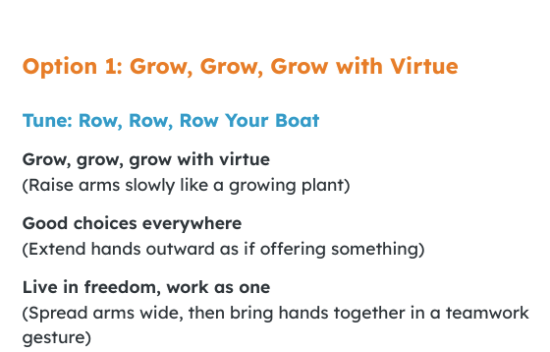
Civic Virtue Song
- Tell students: “Today I am going to teach you a song called the Civic Virtue Song. It is going to help us remember some important ideas that we will be learning about.”
- Teach students the words and motions for the Civic Virtue Song, one line at a time.
- Sing the full song at least two times with students.
- Repeat the song throughout the day, singing with students during transitions, play time, or during periods of waiting.
Teacher note: There are two civic virtue songs available in the teacher resource. Choose the one that works best for your classroom.
Engage
Reading the Mini-book
- Transition: Distribute copies of the mini-book to students.
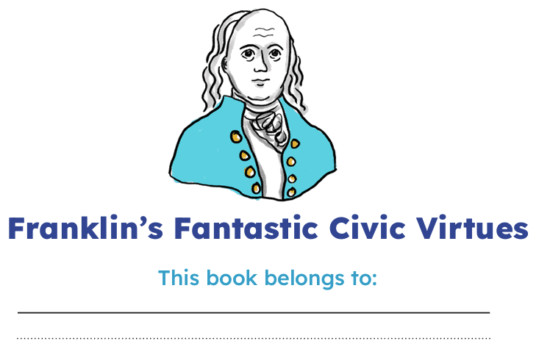
- Tell students: “We are going to read a book called Franklin’s Fantastic Civic Virtues. Based on our Civic Virtue Song, what do you think civic virtue is? Based on the title and the book cover, what do you think this book will be about?”
- Guide students to the idea that Civic Virtue is a good quality—like kindness, honesty, or courage. It’s something you choose to do to be a better person. Practicing civic virtue builds to character which is when you do good things again and again—until it becomes part of who you are.
- Deepen understanding by connecting concepts to real-world examples and modeling reflective thinking. After modeling, invite students to share their own observations. For instance, highlight civic or personal virtues demonstrated by characters in texts they have read or examples observed in the classroom. Prompt discussion with questions such as:
- When have you seen someone show kindness?
- When have you noticed honesty or courage in action?
- Read the book with students twice.
- First, read the book aloud to students as they follow along with pointing to each word with a finger as you read. Model appropriate speed and expression as you read to your students.
- Next, read the book in a teacher think-aloud reading style.
- In a think-aloud, you will pause at strategic points to highlight important information, summarize, and model skilled thinking about reading for your students.
- For example, on page 15 of mini-book Option A the text says: “He also thought that practicing civic virtue was important for the new American colonies. He knew Americans would need to have good character to govern themselves.”
- A teacher could say: What do you think it means when it says govern themselves? How do we govern ourselves at school? Franklin believed that people needed to have good character to help their country. That makes me think about how today, we also need to be kind, honest, and responsible to make our communities better. For example, when people follow rules, or help others, they’re showing good character—just like Franklin wanted. I wonder what I can do to help my community today. Maybe I can pick up litter at the park or help a friend who needs something. That’s how I can show civic virtue, too! When have you seen someone be kind or honest?
- This kind of connection helps students see how the ideas in the story relate to the real world and their own lives.
- For success in the next part of the lesson, the students will need to discuss a few key details during this part of the lesson.
- Create an anchor chart with students that will hang in the classroom during the rest of the lesson. The anchor chart should include:
- Civic virtue is a good quality—like kindness, honesty, or courage. It’s something you choose to do to be a better person.
- Practicing civic virtue builds character which is when you do good things again and again—until it becomes part of who you are.
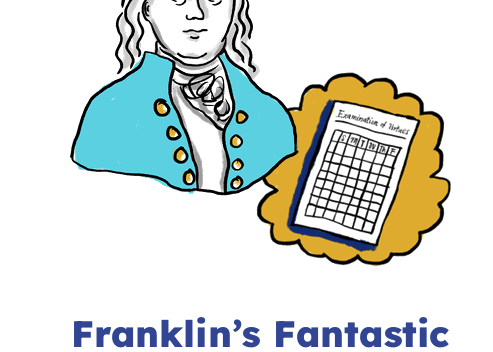
- Benjamin Franklin practiced civic virtue by making a list and working to use one virtue a week.
- Examples of Civic Virtues:
- Respect- Hands Shaking – treating all people equally, knowing that all humans deserve kindness no matter what
- Responsibility – Two hands on top of each other – making good decisions about what is right and wrong.
- Courage – a lion – upholding what is fair and right.
- Justice – scales – the ability to take helpful action in the face of fear or danger.
- Examples of civic virtue in action. This will vary based on your class. You could include helping in the community, listening, being kind, volunteering
- Students will have the opportunity to read the book again on their own and/or with a partner during the stations activity in the Explore section of the lesson.
- Send student mini-books home at the conclusion of the lesson to encourage family engagement. Families and students will benefit from a shared understanding around classroom activities.
Scaffolding note: If reading with more advanced or older students, additional reading styles are available to choose from in our Modes of Reading Teacher Support Document. Check out “Choral Reading” or “Echo Reading” to support fluency.
Scaffolding note: You could also extend this by choosing civic virtues students could practice at home and work each week. Students create their own civic virtue table modeled after Franklin’s, record their efforts daily, and compare their experiences at morning meeting or circle time.
Explore
- Ask students: “What do you do before you go to bed? What time do you usually go to bed?”
- Tell students: “A long time ago, Benjamin Franklin wrote little sayings that people remembered. In one, he gave advice about sleeping and waking up.”
- Write Franklin’s proverb on the board:
- Early to bed, early to rise, makes a man healthy, wealthy, and wise.
- Read it aloud once, then together with the class.
- Ask: “What do you think he means?” (Let students share, expect answers like: going to bed early is good for you, you’ll be smarter, you’ll feel better.)
- Guide them to see Franklin was giving advice for living well.
- Ask:
- “Why do you think he wanted people to go to bed early?”
- “Do you think this saying is still true today? Why or why not?”
- “What does this tell us about what Franklin thought was important?”
Optional: More Words from Franklin
- Share with students three more proverbs from Benjamin Franklin and ask students to translate them into their own words. A few are listed below, there are many more here.
- “No gains without pains.”
- “When you’re good to others, you’re best to yourself.”
- “A true Friend is the best Possession.”
Assess
Group Assessment
- Facilitate a whole group assessment. There are two options available based on the needs of your classroom.
- Option 1: For K-1
- 5 multiple choice questions, shapes distinguish options
- Option 2: For 2-3
- 10 multiple choice questions, letters distinguish options
- Option 1: For K-1
- To facilitate a whole-group assessment:
- Print a copy of your chosen assessment option for each student in the class and project a copy of the assessment if possible.
- Ask students to point to the number 1 on their page, then follow along as you read aloud. Perhaps pointing to each word as you read.
- Read the question, pointing to each word.
- Read each answer choice, pointing to the choice indicator (letter or shape)
- Repeat the question-and-answer choices if needed.
- Prompt students to choose their answer by circling their choice.
- Repeat for the following questions to complete the assessment.
Extend
- Tell students: “Franklin wrote sayings to help people live better. Let’s try writing our own class sayings.”
- Have students identify class civic virtues and list them on the board. You can use a sentence starter like “In this class we . . .” (are kind, take turns, tell the truth, help each other, try our best).
- Then, brainstorm one or two examples of sayings together. Examples:
- “Be kind, and a friend you’ll find.”
- “Try your best, forget the rest.”
- Say to students: “We just read Benjamin Franklin’s own words. By thinking about what they mean, we learned what was important to him. That’s how historians use old words and writings to learn about people from the past.”
- Optional Extensions:
- Write the class created sayings on the board and let students illustrate one if time allows.
- Create printed strips with the class sayings for students to glue in their notebooks or journals and illustrate.
- Create a class book with the sayings and their illustrations that can be checked out of the classroom library or shared with families.
