Lesson
Aaron Burr and Hubris

Founding Principles
Guiding questions
Essential Question
- How do you know when ambition is self-sacrificing and when it is self-serving?
Guiding Questions
- Why is noble ambition directed toward self-sacrifice and public service a civic virtue, whereas self-serving ambition is a vice?
- What are the differences between a healthy ambition to serve the public as a leader and an unhealthy ambition to serve only one’s own interests?
Learning Objectives
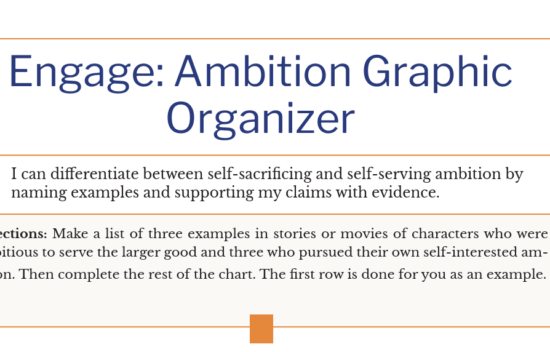
- Students will differentiate between self-sacrificing and self-serving ambition by naming examples of each and supporting their claims with evidence.
- Students will use the story of Aaron Burr to understand the dangers of hubris and how serving the republic is a noble virtue, while pursuing one’s self-interest is a lowly vice.
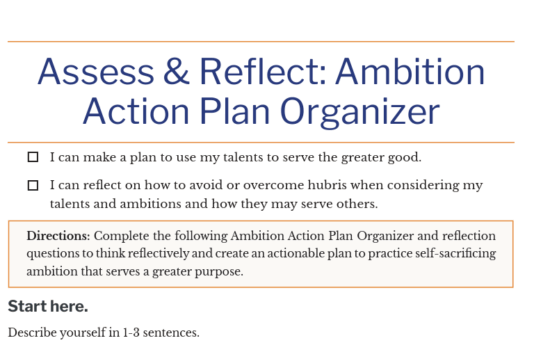
- Students will reflect on using their talents and ambition to serve others while avoiding hubris.
Materials
Student Resources
- Engage: Ambition Graphic Organizer
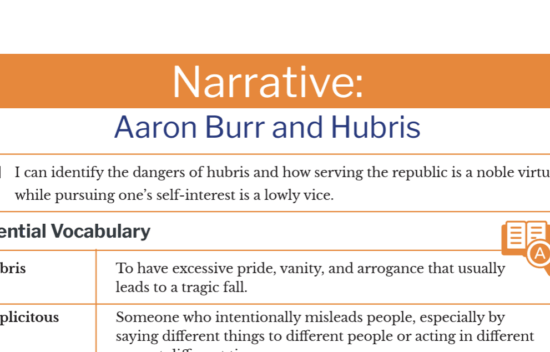
- Aaron Burr & Hubris Narrative
- Assess & Reflect: Ambition Action Plan Organizer
Teacher Resources
- Analysis Questions
- Virtue in Action
- Journal Activity
- Sources for Further Reading
- Virtue Across the Curriculum
Lesson Components
Lesson plan
Key Terms
- Hubris
- To have excessive pride, vanity, and arrogance that leads to a tragic fall.
- Self-serving
- Using one’s talents and ambition to only serve oneself.
- Self-sacrificing
- Using one’s talents and ambition for the greater good.
More Information
Procedures:
- The following lesson asks students to consider the vice of hubris to understand the differences between self-sacrificing and self-serving ambition. A self-sacrificing, or noble, ambition, can drive one to serve the public as a lawgiver, a military hero, a builder of art and culture, an inventor, or a business leader. On the other hand, hubris and self-serving ambition for power and glory can lead one to put their ambitions above those of the public and can sometimes lead to destruction and a tragic fall.
- Students will engage with the story of Aaron Burr as a warning against self-serving ambition and hubris as they consider the question: How do you know when ambition is self-sacrificing and when it is self-serving?
- The main activity in this lesson requires students to read and analyze a narrative that explores how Aaron Burr chose self-serving ambition over self-sacrificing ambition. Students may work individually, in pairs, or in small groups as best fits your classroom. The analysis questions provided can be used to help students comprehend and think critically about the content. As the teacher, you can decide which questions best fit your students’ needs and time restraints.
- Lastly, the lesson includes sources used in this lesson for further reading and suggestions for cross-curricular connections.
Standards
Related materials

How do you know when ambition is self-sacrificing and when it is self-serving? Explore the story of Aaron Burr in this video feature of BRI's Heroes and Villains Curriculum to help determine how he exhibited the vice of hubris. Heroes and Villains uses narratives to discuss the concepts of civic virtue in all classrooms. Each virtue narrative includes corresponding discussion guides, journal templates, a toolbox with additional activities, and suggestions for further reading on each topic or virtue.

You may know him as the man who killed Alexander Hamilton, but do you know the full story of one of American History's most notorious characters? Our latest Homework Help Institute of History video brings you the story of Aaron Burr, his rise to the position of governor of New York and vice president of the United States, and his spectacular downfall.