Primary sources
The Third Voyage of Master Henrie Hudson: http://www.americanjourneys.org/aj-133/summary
Essay
Objective
Why did Henry Hudson want to find the Northwest Passage?
Suggested sequencing
This narrative should be assigned to students after the First Contact Narrative. Students can make comparisons between concepts in this narrative and the motives for exploration discussed in the following Primary Sources: Columbus’s Letter to Ferdinand and Isabella of Spain, 1494 and Richard Hakluyt and the Case for Undertaking Sea Voyages.
In early April 1609, the 80-ton Halve Maen (the “Half Moon”) sailed from the Dutch commercial capital of Amsterdam toward the frozen seas of the Arctic Ocean. The ship’s captain was seeking a quicker northeast passage around Russia for access to the valuable spices and other riches of the East Indies. The great powers of Europe were locked in a worldwide struggle for empire that included competing for the vast wealth associated with the Asian trade. The intrepid captain of the ship, Henry Hudson, was determined to be the first to chart a path through the Arctic ice – or perhaps he had other discoveries in mind.
Hudson was an Englishman who found employment as a ship captain for the Dutch. He was sailing familiar waters with his Dutch and English crew. In the previous two years, he had twice tried to discover a northeast passage for the English East India Company. Merchants in several countries were looking for an alternative to sailing around Africa, because the long journey increased the dangers posed by weather, piracy, and diseases like scurvy. Hudson’s voyage was sponsored by Dutch merchants who would soon form the Dutch East India Company. Although the monarchs of some European nations used government funds to sponsor voyages, these entrepreneurial merchants, acting with the permission of their governments, formed and invested in privately owned joint-stock companies that launched voyages of exploration in search of profit. The investors split the profit and paid a share to the crown.
Hudson sailed into the Barents Sea north of Scandinavia but soon found the ice impassable. After some bickering among the officers and crew about their next destination, the captain persuaded them to sail across the Atlantic and search for the fabled Northwest Passage that had captured the imaginations of so many mariners, investors, and monarchs of Europe. Over the past century, several Spanish, English, and French explorers had probed just about every broad river they encountered along North America’s Atlantic coast in hopes that it would provide a water route through the continent. Hudson was drawn to North America by the same ambition of being the first to sail directly to the East Indies, although not by the path his investors had directed.

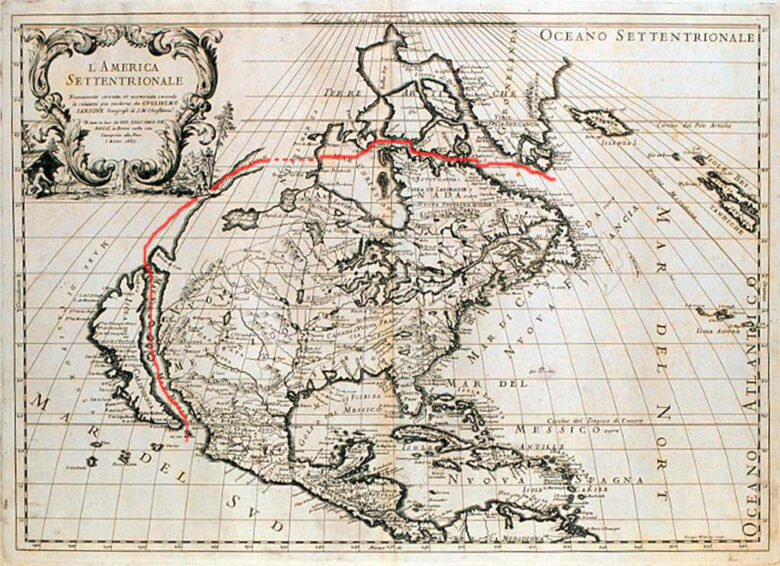
This 1687 Dutch map illustrates the widely held belief that a northwest passage to the riches of China and the East Indies existed. For centuries, European explorers like Henry Hudson hoped to be the first to chart this route.
In early July, the Halve Maen reached Newfoundland, where Hudson and his crew encountered a French fishing fleet hauling in cod. The sailors aboard the Dutch ship caught and salted dozens of cod for their journey, and Hudson eventually plied the officers of another French vessel for information about the coast. The Halve Maen also made contact with Native Americans in or near Nova Scotia; Hudson traded knives, kettles, clothing, and beads for beaver skins and other furs. He heard tales of gold and silver, and possibly the Northwest Passage. However, because his men feared the Native Americans had stolen items from the ship, they went ashore and raided the native village. It was an ominous start to Hudson’s relationship with the indigenous people of North America.
By early August, the Halve Maen had spotted Cape Cod and traded with more Native Americans for tobacco and meat. A few weeks later, the ship arrived at the eastern shore of Virginia, but Hudson quickly sailed away rather than exploring the Chesapeake Bay and risking trouble with the new English colony at Jamestown. After repairing damage the ship had suffered in storms, the Halve Maen’s crew sailed to New York in early September. Hudson then traveled what is now the Upper New York Bay for a couple of weeks and had many trading encounters with different local Native American tribes.
On these occasions, the Native Americans generally paddled over to the ship in several large canoes with items for trade. Some came aboard, invited and not, to trade tobacco, oysters, furs, wheat, and corn for knives, hatchets, and beads. After the crew grew suspicious of some Natives Americans and chased them from the ship, however, a group of Munsees attacked one night. Three sailors were injured, one of whom was shot through the throat with an arrow and died. The Europeans were even more wary and cautious after this violent exchange and were prepared to use their muskets and cannons should further violence ensue. They may also have abducted a few Native Americans, who later escaped.
Hudson was pleased at the prospect that one of the rivers – the Hudson that would later be named for him – was the Northwest Passage. The Halve Maen sailed up this river, passing the Peekskills and the Hudson Highlands. The crew traded cautiously with Native Americans along the way, especially the Mahicans at Catskill Creek. They sailed all the way to modern-day Albany and went ashore to trade with Native Americans, who sought wampum (strings or belts of purple and white shells used as currency). The crew also introduced the Native Americans to alcohol.
The ship finally reached shallows and was forced to turn around. As Hudson sailed back down the Hudson, a trading encounter with the Indians turned violent when a Native American climbed aboard the ship and stole some items. A sailor shot him in the chest and killed him, after which the other Native Americans on the ship jumped into the water and were chased by sailors in a small boat. When the Indians in the river tried to overturn the boat, a sailor cut off the hand of one, causing the Indian to drown. Two canoes assaulted the ship, and word spread quickly for additional warriors to join the attack. As more than one hundred Native Americans shot arrows from canoes and the nearby shore, the sailors opened up with a cannon and killed three. A few other Native Americans were cut down by cannon and musket fire while a hail of arrows flew ineffectively against the crew.
The Halve Maen reached what is now Manhattan by early October, and Hudson and his crew again faced a decision. Hudson wanted to continue searching for the Northwest Passage and winter in North America, but the crew was strongly opposed. So Hudson reluctantly sailed into the Atlantic bound for Europe. The ship reached Dartmouth, England, in early November, and, curiously, Hudson went to London to report on his voyage rather than returning to his employers in Amsterdam. Perhaps the English detained him and prevented him from going to Amsterdam because they were trying to gain a competitive advantage in the struggle for empire. Whatever the case, Hudson sailed to North America for the English the following year on the Discovery, but he was stranded with his son and some other crew members in a mutiny and was never seen again.
The Dutch established their first permanent fur-trading post near modern-day Albany, New York, in 1614. For a decade, the post had fewer than 50 inhabitants. In 1625, the Dutch West India Company established New Amsterdam on Manhattan Island as a fortified town to guard the Hudson River and the fur trade against any competing European powers. The company selected a governor, Pieter Stuyvesant, who presided over the settlement. New Amsterdam’s policy of religious toleration invited the growth of a religiously and ethnically diverse group of settlers. Eventually, the Dutch colony was caught up in the Anglo-Dutch wars in the mid-seventeenth century and was lost in 1664 when English warships forced its surrender. The Netherlands ceded “New York,” as it came to be known, to England a few years later.
A quick set for review, discussion, or exam practice. Answers aren’t collected or graded here.
Why were European empires locked in a competition to discover the Northwest Passage?
Which of the following best describes a joint-stock company?
Why did the Dutch establish a settlement at Albany?
Why did the Dutch establish a settlement at New Amsterdam?
How did Henry Hudson and his crew interact with Native Americans during their voyage?
Why did the Dutch settlement at New Amsterdam attract a diverse group of settlers?
Explain why Henry Hudson sought both a northeast and a northwest passage.
Explain the entrepreneurial basis of Hudson’s expedition for the Dutch.
Describe the nature of Hudson’s relations with Native Americans.

A 1687 Dutch map of North America.
Refer to the map provided.
This 1687 Dutch map illustrates the widely held belief at the time that there existed
At the time this 1687 Dutch map was created, which empire controlled the most territory in the New World?
Charter of the Dutch West India Company, 1621“The States-General of the United Netherlands, to all who shall see these Presents, or hear them read, Greeting.
Be it known, that we knowing the prosperity of these countries, and the welfare of their inhabitants depends principally on navigation and trade, which in all former times by the said Countries were carried on happily, and with a great blessing to all countries and kingdoms; and desiring that the aforesaid inhabitants should not only be preserved in their former navigation, traffic, and trade, but also that their trade may be encreased as much as possible in special conformity to the treaties, alliances, leagues and covenants for traffic and navigation formerly made with other princes, republics and people, which we give them to understand must be in . . .
The aforesaid Company may, in our name and authority . . . make contracts, engagements and alliances with the limits herein before prescribed, make contracts, engagements and alliances with the princes and natives of the countries comprehended therein, and also build any forts and fortifications there, to appoint and discharge Governors, people for war, and officers of justice, and other public officers, for the preservation of the places, keeping good order, police and justice, and in like manner for the promoting of trade.”
Refer to the excerpt provided.
This document was created primarily to
How did join-stock companies contribute to the European race for empire in the seventeenth-century?
The Third Voyage of Master Henrie Hudson: http://www.americanjourneys.org/aj-133/summary
Hunter, Douglas. Half Moon: Henry Hudson and the Voyage that Redrew the Map of the New World. New York: Bloomsbury Press, 2009.
Kammen, Michael. Colonial New York. Oxford: Oxford University Press, 1996.
Mancall, Peter. Fatal Journey: The Final Expedition of Henry Hudson. New York: Basic, 2009.
Taylor, Alan. American Colonies: The Settling of North America. New York: Penguin, 2001.
Advanced Placement
Check whether this resource aligns with your state’s standards →

In our resource history is presented through a series of narratives, primary sources, and point-counterpoint debates that invites students to participate in the ongoing conversation about the American experiment.