Video
“War News from Mexico;” Richard Caton Woodville and the Mexican-American War | BRIdge From The Past
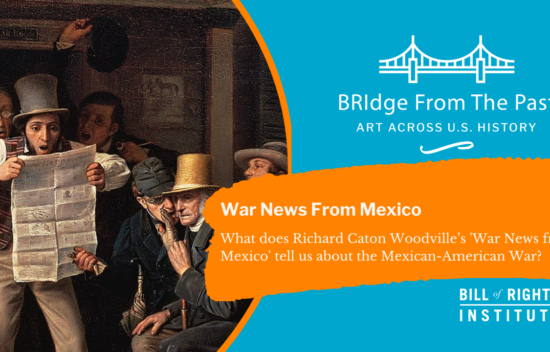
Watch
Founding Principles
Natural/Inalienable Rights, Liberty, Majority Rule/Minority Rights
About this video
What does Richard Caton Woodville’s War News from Mexico tell us about the Mexican-American War? In this episode of BRIdge from the Past, Mary explores the 1848 painting depicting a reaction to the signing of the Treaty of Guadalupe Hidalgo which would give the United States half of Mexico’s territory. It was also a major source of conflict amongst abolitionists and anti-abolitionists as they fought about whether these new states should allow slavery. What different groups of people are represented in this painting, and how does Woodville use them to convey different feelings surrounding the end of the war?
0:00 Welcome to another episode of Bridge from the Past. I’m your host Mary, and this series is all about using primary source images as a starting point to think about important topics in American history. Today we’re looking at Richard Caton Woodville’s War News from Mexico. What does this painting tell us about the Mexican American War? Let’s jump in and see.
0:24 Here is our image. This is Richard Caton Woodville’s painting War News from Mexico. It was done in 1848, and it’s currently on display at the Crystal Bridges Museum of American Art in Bentonville, Arkansas. Whenever you have an image, it’s important to just make some observations before you do anything else. If you have the handout that goes with this video, go ahead and pause here and make some observations of your own.
0:47 My eye is immediately drawn to this man in the center of the painting. So I’m definitely noticing that there’s other people around him, but he is front and center. He’s holding this white newspaper, and it’s light. It’s right in the center. That’s where my eye goes. And most of the other people in the painting, it looks like their eye is going to that newspaper as well.
1:09 So a question that I have is, what’s he reading? What’s the deal with this expression? He clearly looks to be really like his mouth is wide open. He can’t believe it. So what’s he reacting to? And then what are all these other reactions that I see here in the painting? A big thing for the context for this image is the date 1848.
1:30 The news from Mexico concerning a war in 1848 is that the Mexican-American War is over. So what was the Mexican-American War? What was it all about? And why would there be all of these various reactions that the war is over? Well, the Mexican American War starts in 1846. President James K. Polk asked Congress to declare war
1:51 on Mexico, saying that Mexico had invaded us. Territory and shed American blood. The reality was a little bit more complicated than that. In 1848 this idea of manifest destiny is prevalent on a lot of Americans minds. This idea that the United States should control the entire continent from the Atlantic to the Pacific Ocean. If we go to war with Mexico and we win
2:13 territory from Mexico, that’s one more chunk of the continent. Another thing that’s going on in 1848 is that slavery is still around in the United States. If Americans win territory from Mexico, that’s land that’s south of the 36-30 parallel. That 36-30 parallel was the border set by the Missouri Compromise of 1820.
2:35 Below that line, slavery was allowed. So a war with Mexico that was a victory would lead to more land and more land where slavery could expand. The war with Mexico ends in 1848. The treaty of Guadalupe Hidalgo is signed, and the United States gets a huge chunk of territory from Mexico. So this is the news that these people are reacting to in this painting.
2:58 So we can see there’s sort of a disbelief. This man right here seems to be pretty excited. He’s got his cap up in the air. You have an older gentleman here. It looks like someone is whispering in his ear. Perhaps he’s a little hard of hearing. He’s dressed in sort of the garb of the revolutionary generation. So there’s this generational gap between younger Americans and older Americans.
3:21 He doesn’t look too pleased, but maybe he just can’t hear. It’s a little unclear from the picture. Interestingly, kind of in the shadows. Here you have a woman. So it’s interesting that she’s in the shadows because women can’t vote, right? They’re kind of in the shadows of public light, but they’re going to have a reaction to this news as well. And very tellingly.
3:41 Down here in the corner, you have an African American man and a child. And the child especially is in sort of this tattered clothing, and their reactions look a little bit more apprehensive. And again, because of the Missouri Compromise, slavery will be allowed in most of the land that has been now is now part of the United States because of the Treaty of Guadalupe Hidalgo.
4:03 So this war is going to be hotly contested even when war is declared in 1846. And when it’s over in 1848, many still saw it in the north and abolitionists especially as a war of conquest and a war to expand slavery. We started by asking what Richard Caton Woodville’s War News from Mexico could tell us about the Mexican-American War.
4:27 We learned about the seemingly simple start to the war, but how it really had a lot of bigger issues at play. But as always, there’s so much more to the story. So now I’m going to turn it over to you. What questions do you still have? What would you like to know more about? I’d love to know your thoughts in the comments below. If you learned something, be sure to like this video and subscribe to our channel to learn about other
4:49 resources to help you throughout the school year and beyond. I’ll be back soon with another image to help us think about important topics in American history. Until then, everybody take care. Oh, no. The video is over. Oh, come on. Don’t be so sad. Don’t you know that the Bill of Rights Institute has tons of videos on American history, government and civics.
5:09 From primary source document breakdowns, to historical image analysis, whether you’re studying for a test or just interested in learning more, they’ve got something for you. Oh, well, in that case, I better check out this video. And don’t forget to subscribe. So you aren’t so sad again.
Standards
Related Resources

Use this primary source text to explore key historical events.
By the end of this section, you will explain the causes and effects of westward expansion from 1844 to 1877.

Did the positives outweigh the negatives as the concept of Manifest Destiny drove western expansion during the nineteenth century? A. James Fuller and Andrew Fisher debate this question.