Video
The Constitution | BRI’s Homework Help
Watch
Founding Principles
Natural/Inalienable Rights, Due Process, Federalism, Separation of Powers, Limited Government
Virtues
About this video
Why did the Articles of Confederation fail? In our eighth episode, we tackle the Articles of Confederation and the need for a Constitution at the Constitutional Convention. Learn how the US Constitution made provisions for a stronger federal government, state rights and powers, and personal rights formally known as the Bill of Rights.
Have you ever looked at your teacher with a puzzled face when they explain history? I know we have. In our new Homework Help Series we break down history into easy to understand 5 minute videos to support a better understanding of American History.
0:01 Welcome to Homework Help. Whether you’re studying for the AP US history exam or any other exam that your teacher is inflicting upon you, we’ve got you covered. Last week, we discussed the problems with the Articles of Confederation and the need for a new governing document. Today, it’s all about the Constitution. At the Constitutional Convention in 1787, the first critical question was to figure
0:26 out how the new national government could better represent the people and the state. Large states pushed for a new national Congress based on population, and smaller states wanted to preserve the confederation system, where each state received equal representation regardless of how many people lived in their states. Oliver Ellsworth from Connecticut had an idea.
0:49 He suggested that Congress should be made up of two parts the House of Representatives, which would grant state’s representation based on their population, and the Senate, which would grant states equal representation no matter their size. After much contentious debate, each side compromised and a bicameral legislative branch was born.
1:10 Popular representation was complicated because of slavery. Northern states did not want slaves to be counted when evaluating the total population for each state, as there were far fewer slaves in the north than in the south. Slave states, on the other hand, argued that plantation owners represented multitudes of slaves, and therefore slaves deserve to be counted.
1:33 As we can see, self interest can play a major role in history. States were trying to give themselves the ability to have the most votes as possible, which would create a greater advantage in creating laws. Eventually, both sides compromised and slaves would be counted as three fifths of a person for purpose of both representation and taxation.
1:56 The next major question was how much power should the executive branch have? This was very controversial because many were worried about the executive having too much power because of their experience under the British monarch. Nevertheless, the Constitution created a strong presidency with broad powers, especially over foreign policy.
2:16 However, the different branches of government had checks and balances over each other. For example, Congress has the power to declare war, but the President is the commander in chief of the military. Congress has the power to create laws, but the President has the power to veto those laws which the Congress can in turn override. Also, an independent judiciary was created
2:39 as the third branch of government to determine whether laws and executive actions are consistent with the Constitution. This complex system of checks and balances is intended to prevent abuse of power by any branch of government. Another important part of the Constitution was the idea of federalism, which divided powers between the federal and state governments.
3:01 Under the principles of federalism and the Supremacy Clause, the central government had power over items such as regulating trade, coining money, raising armies, and conducting foreign affairs, while the states retain all other powers not granted to the federal government. Eventually, the Framers drafted and signed the new federal constitution.
3:22 It was then sent to popular ratifying conventions of the people’s representatives in each state. Nine out of 13 states had to ratify the Constitution to make it the law of the land, which was an expression of federalism. Public debates raged between those known as the Federalists and Anti-Federalists. There was much hesitation to adopt this new constitution from Anti-Federalist
3:45 leaders such as Patrick Henry and George Mason because they felt the constitution lacked protections for the rights of individual citizens. Federalists such as James Madison, Alexander Hamilton and John Jay worked hard to ease the fears of the Anti-Federalist through a series of letters known as the Federalist Papers.
4:06 In several state conventions, the Federalists agreed to include the protection of individual rights and liberties in a bill of rights as soon as the constitution was adopted if the anti federalist would agree to ratify the document. These became known as the Bill of Rights, and they explicitly protected individual freedoms and limited government.
4:26 Some of the freedoms included the right to free speech, religion, due process and the right to bear arms, as well as protection against unreasonable search and seizures and against cruel and unusual punishment. The constitution was finally ratified in the summer of 1788. The first presidential election was held in November 1788 and the first ten amendments were passed in 1789.
4:52 Thanks for watching and check us out next week for more Homework Help.
Standards
Related Resources
Has the American nation lived up to the ideals of its experiment in liberty? Invite your students to explore the rich tapestry of American history and actively participate in the ongoing experiment that defines our nation's identity. Help your students gain insights into the nature of the American experiment - the ongoing quest for a more perfect union.

What are the powers delegated to the Executive Branch and how have constitutional principles have applied throughout U.S. History? Examine these questions with your students and equip them to be more informed citizens and critical students of history and current events. The curriculum is made possible by The National Endowment for the Humanities and Dr. John M. Templeton, Jr.

The Constitution was written in the summer of 1787 in Philadelphia, Pennsylvania, by delegates from 12 states, in order to replace the Articles of Confederation with a new form of government. It created a federal system with a national government composed of 3 separated powers, and included both reserved and concurrent powers of states.
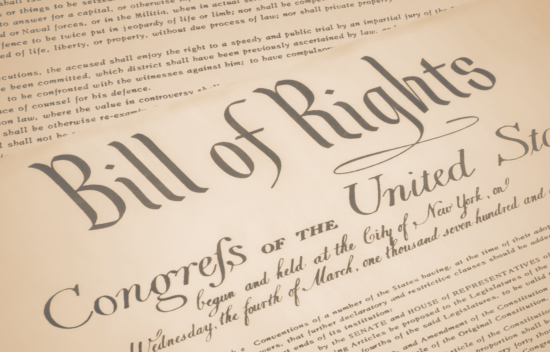
The first 10 amendments to the Constitution make up the Bill of Rights. James Madison wrote the amendments, which list specific prohibitions on governmental power, in response to calls from several states for greater constitutional protection for individual liberties.