Video
The Battle of Bunker Hill Mini Documentary
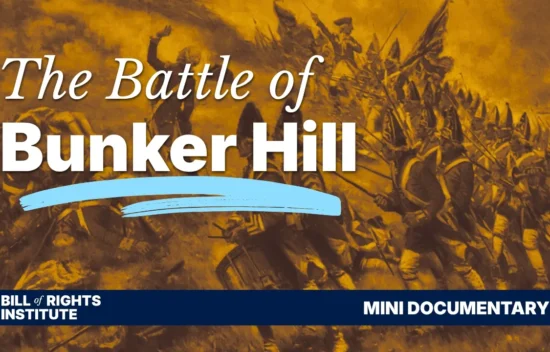
Watch
Founding Principles
About this video
In the tense early months of the American Revolution, before independence was declared, British and American forces clashed in one of the war’s most brutal and revealing early battles.
On June 17, 1775, thousands of British troops stormed a hilltop fortification hastily constructed by colonial militia overnight. Though the British would ultimately claim the ground, their victory came at a staggering cost. Through grit, missteps, heroism, and sacrifice, the Battle of Bunker Hill proved that the colonial resistance would not be easily crushed—and that the road to American liberty would be long and bloody.
From secret intelligence networks to last-minute reinforcements, and from smoldering Charlestown to the rise of George Washington as commander of a newly formed Continental Army, this mini documentary traces the events of that fateful day and its place in the broader struggle for American independence.
0:04 On the night of June 16th, 1775, Colonel William Prescott led 1200 American militia as silently as possible through the darkness, so that the watch aboard the British warships in the surrounding waters would not learn of their movements. Prescott’s objective was Bunker Hill, but by some mistake the colonists climbed up Breed’s Hill and began digging.
0:27 Almost two months after Lexington and Concord, the American army under General Artemus Ward had learned from its network of spies that British General Thomas Gage, recently joined by Generals William Howe, Henry Clinton, and John Burgoyne, had planned to take the high ground at Bunker Hill on June 18th and they were there to take it first.
0:51 When dawn arrived, the sweat soaked and exhausted Americans looked over their handiwork a relatively formidable redoubt with a six foot high breastwork extending on its left flank. When the British spy the American fortress erected overnight, Gage immediately called a war council and ordered how to attack. Howe assembled his units and prepared transports across the Charles River
1:15 and to trips. They sat down to tea and a bite to eat as they waited for the crossing to be completed, and awaited the order to attack. Meanwhile, British warships ineffectually bombarded the sturdy American redoubt, causing only a few casualties. The ships fired heated ordnance into nearby Charlestown
1:35 to burn the town and root out American snipers. The colonists used the delay to fortify their defenses. Captain Thomas Knowlton and his Connecticut troops extended the left flank and reinforced the rail fence. John Stark led hundreds of New Hampshire militia to guard the far left flank on the beachy shore of the mystic River,
1:57 and built a small wall at around 3:00 in the afternoon. Howe ordered the redcoats to attack the main attack aimed at the Connecticut and New Hampshire troops, as Howe hoped to hit the American flank and surround the redoubt, marching shoulder to shoulder in the heat of the day. They had a difficult climb uphill over obstacles,
2:19 including several rail fences and stone walls, but they were a disciplined, professional army and held their lines tight. The Americans did not have a lot of gunpowder ammunition and held their fire until the British were frightfully close. Finally they fired, tearing into the British ranks.
2:40 The battlefield was littered with dead and bleeding redcoats. The survivors withdrew and reorganized their ranks. After several minutes, the British attacked again and were bloodily repulsed a second time. Many officers were killed, including Major John Pitcairn, who was mortally wounded
3:00 one quarter of all the British officers killed in the Revolutionary War died that day. How was desperately reinforced with 500 fresh reserve troops. He directed them to assault the redoubt and columns. The Americans were very low on ammunition.
3:20 The British withstood a bloody American volley and fought their way into the redoubt with bayonets fixed. They slaughtered many Americans, including Patriot leader Doctor Joseph Warren, who became a martyr to the cause of liberty. The Americans retreated pell mell from the redoubt, and several were cut down by the pursuing redcoats.
3:43 Finally covered by the Connecticut New Hampshire troops, the exhausted Americans safely withdrew across the neck. The British took Breeds Hill, but suffered 40% casualties. One general remarked another such victory would ruin us
4:04 in the wake of the battle. The Siege of Boston began. While the battle raged, the Second Continental Congress created the Continental Army and appointed Virginian George Washington its commander in chief. Washington would soon arrive in Boston and truly mold the army there into a professional continental one,
4:25 animated by a passion for liberty.
Standards
Related Resources
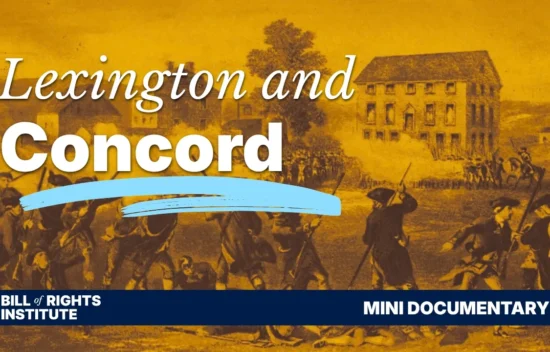
On April 19, 1775, the world changed forever. British troops marched on Lexington and Concord to arrest Patriot leaders and seize hidden munitions—but they were met by a determined militia and the rising spirit of American resistance. From Paul Revere’s midnight ride to the tense standoff on Lexington Green, and the fierce fighting at North Bridge, this mini documentary captures the explosive beginning of the American Revolution.
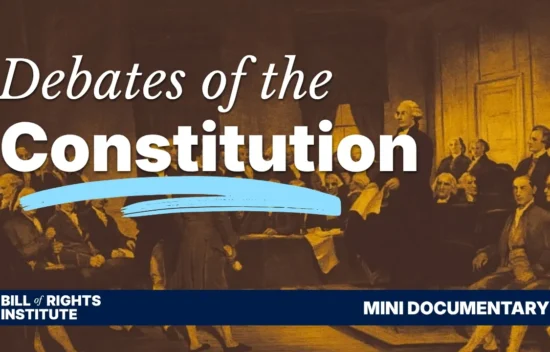
In the uncertain years after the American Revolution, the fate of the new republic hung in the balance. The Constitution—signed in Philadelphia after months of intense debate—was not yet the law of the land. Across the states, fierce battles erupted over its ratification. Would liberty be preserved or lost to centralized power? Federalists and Anti-Federalists clashed in newspapers, statehouses, and convention halls. From the impassioned arguments of Patrick Henry and George Mason to the razor-thin victories in Virginia and New York, this mini documentary captures the intensity and stakes of one of the most consequential debates in American history.

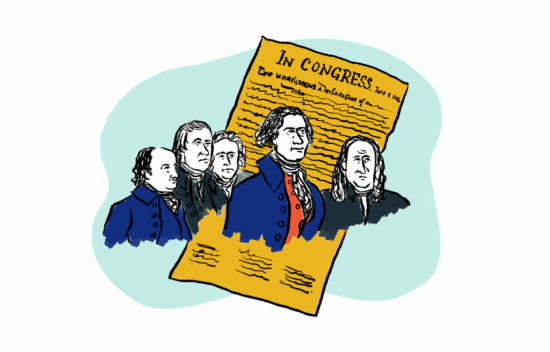
Learn about important dates events that lead up to the ratification of on the Declaration of Independence on July 4th, 1776 in Philadelphia, PA through our interactive timeline!

How did the American colonies gain independence from Britain?
Get ready to travel back in time to the early days of America and discover the thrilling events that led to the American Revolution! In this elementary lesson, we explore the key moments that paved the road to independence—from the end of the French and Indian War to the fiery debates over "taxation without representation." Our elementary lessons are primary source-based that focus on content-area literacy instruction and performance-based assessments. Designed for grades 3-5, these lessons use a modular approach for all learners and are ideal for helping elementary students explore American history and citizenship.
How did the ideals of natural rights and justice inspire a revolution for independence in the colonies?