Video
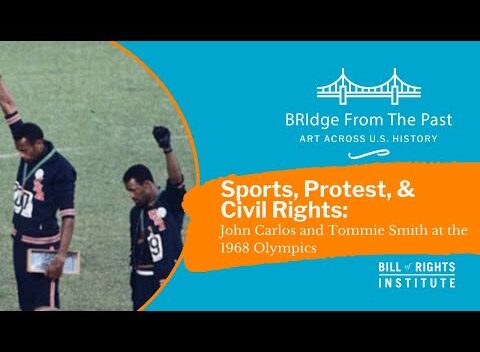
Sports, Protest, and Civil Rights: John Carlos and Tommie Smith at the 1968 Olympics
Watch
Founding Principles
About this video
What controversy arose around this image from the 1968 Olympics? In this episode of BRIdge from the Past, Mary explores the image of John Carlos and Tommie Smith and the statement they made during the Mexico City Olympics. What historical events occurred around this time that led to their protest? What lessons can we learn about protests today from examining this image?
0:00 Hi everybody. Welcome to another episode of Bridge from the Past art across US history. I’m your host, Mary, and today we’re looking at an iconic image of protest from the 1968 Olympics. What was the context surrounding this protest? Why was it considered controversial? And what lessons can we learn from this act of protest into the present day?
0:22 Let’s jump in and see. Here is our image again, this is the 1968 Olympics, which was held in Mexico City. And here is this act of protest. Whenever we’re looking at an image as a historical source, it’s important to just make some observations and then start thinking of questions.
0:44 So some initial observations I have are that it looks like this is a metal ceremony. I can see down here a podium. I can see the numbers two and three. And I can see three men here. And I see these two men are raising a gloved fist and they have a bowed head. So is this the act of protest?
1:07 What are they protesting? Is this a medal ceremony? What was the event? Who saw this? How many people saw this? What was their reaction? These are a lot of questions are coming to mind even just from these initial impressions of this image. As with any primary source, before I can really jump into the analysis, I need some more historical context.
1:28 So here is what we need to know. This took place in 1968, and 1968 was a really eventful year in US history. I’m going to try to be as brief as possible in explaining a few reasons why this was so, starting with January. So in January, a major escalation in the fighting of the Vietnam War occurred, called the Tet Offensive.
1:50 So criticism of the Vietnam War had been building over time. The United States became involved in Vietnam in the 1950s, and it was only escalating throughout the 1960s. Television is there, media coverage of the war of the fighting in Vietnam in a way that hadn’t been possible in prior conflicts. So when Americans see this coverage, particularly the Tet Offensive,
2:11 it really starts them questioning, why are we in Vietnam to begin with? In March of 1968, the President, Lyndon Baines Johnson, or LBJ, announces that he won’t run for reelection. This has a lot to do with the criticism he’s getting for being involved in the Vietnam War. To announce for a President to announce
2:33 they’re not going to seek a second term is really unusual, and that sort of adds to the unrest that’s building in the country. In April of 1968, martin Luther King, Jr. Is assassinated. Even before Martin Luther King, Jr. Was assassinated, the Civil Rights movement, of which he was such an iconic leader, was starting to fracture.
2:54 So even though key victories had been secured in the fight for liberty inequality for African Americans, with the passage of the Civil Rights Act in 1964 and the Voting Rights Act in 1965, this didn’t alter the fact that many African Americans still experienced discrimination and racism. They still lived in segregated areas, and many of these areas were often poor.
3:17 So frustration, especially among younger black Americans, had been building and frustration with Martin Luther King’s nonviolent approach and his goal of integration, of bringing black and whites together. And what you’re going to see is, in particular, younger black Americans. They’re frustrated with the slowness of change and they’re starting to call for new tactics.
3:40 So in 1966, Stokely Carmichael, who was the leader of the Student Nonviolent Coordinating Committee, so again, a young leader coins the phrase black Power. Black power was all about black was not all about but black power believed in black separatism. So not blacks and whites coming together, but living apart.
4:00 So it advocated cultural pride excuse me, black leadership, but also black separatism. So you’re already starting to see these cracks in the civil rights movement. And then with the assassination of Martin Luther King, riots erupt in many cities across the country that last for days and lead to thousands of dollars in destruction and lives lost.
4:20 So people are seeing again, we’re seeing this on TV, and people are really starting to ask, what’s the future of the civil rights movement? In June, you have another assassination. Robert F. Kennedy, who was seen as a hopeful to be the next president, was assassinated, which adds to this unrest. In August at the national or the Democratic National Convention
4:41 in Chicago, you have thousands of people coming to protest. So this is protest about Vietnam, about civil rights. Other protest movements are taking shape in the 60s, women’s rights, environmental rights, lots of groups that are coming together. You have thousands of protesters descending on the city, thousands of police officers, thousands of National Guardmen confrontations become violent.
5:05 It’s all on TV. And people are asking, what’s going on in the United States? Why is there so much unrest into the fray of all of this? You’re going to have the Olympics being held in October of that year in Mexico City. So usually, as we know today, the Olympics are seen as a time of healthy competition. Again. The cold war is going on. So this is kind of seen as a bright spot, good competition, athleticism.
5:30 And into this we have our image of protest. So now I’m going to give you a little bit more information. So from left to right, the people in this photograph are the silver medalist Peter Norman, a gold medalist. Peter Norman is representing Australia. And this is Tommy Smith winning the gold medal and John Carlos winning the bronze medal in the 200 meters dash.
5:54 So this is in fact a medal ceremony. And these two men representing USA, kind of the USA written on their tracksuits, are raising a gloved fist during the playing of the national anthem. So Tommy Smith as the gold medalist, his national anthem, united States national anthem is going to be playing.
6:16 So this is the first time that the Olympics were fully broadcast on network TV. Before, you would just see highlights, but you’re seeing all of this. So the world is watching. The stadium goes silent. There’s some booing. So if you can imagine a stadium, an Olympic stadium that goes silent, how eerie that must have been.
6:37 It’s kind of hard to see, but over here you can see that John Carlos is his shoe. So both Smith and Carlos removed their shoes and stood in black socks to symbolize black poverty. And this raised fist is the black power salute. So this was a deliberate act to bring attention to the fact that discrimination
6:59 and racism against African Americans is still going on. And again, the world is going to see this. What I love about this story and what you don’t often hear about this story, is that Peter Norman, the civil medalist from Australia, he knew they were going to do this. Again, this was a planned act. These athletes knew they were going to have this platform and they chose to do this.
7:21 Ask them how he could support their cause. So all three of them wear this badge. My circles aren’t very good here. All three of them wear a badge on their uniform. And that is the Olympic Project for human Rights badge. So in essence, it’s alluding to the fact that this discrimination experienced by African Americans is a violation of this idea of human rights.
7:45 So this act was condemned by the International Olympic Committee. Carlos and Smith are suspended from the Olympic team. They’re kicked out of the Olympic village. And when they come home, many of them receive death threats. Many saw this act as unpatriotic at best, and at worst, they were considered traitors.
8:07 Smith, Tommy Smith, again, he is the gold medalist. He described the raised fist as, quote, a cry for freedom and for human rights, adding, quote, we had to be seen because we couldn’t be heard, end quote. So as time goes on, their action, this raising of the fist, this black power suit starts to be re examined.
8:30 So again, at the time, black power, it frightened many white Americans because of this idea of black separatism. So I’m going to read you a really quick quote from Stokely Carmichael on what black power was. So it was, quote, a call for black people in this country to unite, to recognize their own heritage, to build a sense of community.
8:51 It is a call for black people to begin to define their own goals, to lead their own organizations and to support those organizations. It is a call to reject the racist institutions and values of this society, end quote. I think it’s that final sentence that people will make some people uncomfortable rejecting racist institutions and values of this society.
9:14 So this association with the concept of black power brands this act by Tommy Carlos and John Smith as unpatriotic or as being a traitor. Again. Time passes. Their actions are seen in a new light. In 2008, they’re given the Arthur Ash Award for Courage by ESPN, and some historians have started to say
9:36 this is just a call for America to be better and to be better for all people. We started by asking what happened at the 1968 Olympics and what lessons we could take from studying this event into the present day. As always, there’s so much more to the story, and now I turn it over to you.
9:58 What can we learn about this act of protest? What lessons can we carry into the present day? What do you want to know more about? There’s so much more to explore in all of these topics, and this is really just the tip of the iceberg. If you learn something, please be sure to like this video and subscribe to our channel. You’ll be in the Know about contests,
10:19 resources, and other things to help you through the school year. I’ll be back soon with another image to help us think about the complex stories that make up American history. But until then, always keep your eyes open, always look at the pictures and keep asking questions. Take care, everybody.
Standards
Related Resources

BRIdge from the Past: Art Across U.S. History is a new YouTube series for students that explores an important historic image every episode to gain insights into the culture, politics, and society of a particular time in U.S. history. Host Mary Patterson will explain how each primary source is its own “window to the past,” revealing new areas for contemplation and discussion.

