Video
Philosophy Behind the Constitution | BRI’s Homework Help

Watch
Founding Principles
Virtues
About this video
Have you ever looked at your teacher with a puzzled face when they explain history? I know we have. In our new Homework Help Series we break down history into easy to understand 5 minute videos to support a better understanding of American History.
What happened at the Constitutional Convention? In our seventh episode, we tackle the philosophical ideas behind the United States Constitution during the Constitutional Convention. Deep dive into the mindset of The Founders and learn different ways to interpret the US Constitution.
0:00 Welcome to Homework Help. Whether you’re studying for the AP US history exam or any other exam that your teacher is inflicting upon you, we’ve got you covered. Today we will be looking at the United States Constitution. The United States has been referred to as the child of the Enlightenment because our constitution embodies principles of limited power, protection of individual
0:24 freedom, and guarantees of participatory democracy. So to understand the Constitution, we must jump back a few hundred years. The Enlightenment was a philosophical movement that began in Scotland, England, and France by writers who used scientific methods to understand social problems.
0:45 Just as physics or chemistry are subject to laws of nature, so too are the fields of politics and economics subject to certain laws. Unlike the law of gravity, which cannot be broken, our free will often causes us to break natural laws of politics and society, resulting in an unjust government. The age of enlightenment was fueled
1:07 by dozens of political philosophers, including Baron de Montesquieu, Jean-Jacques Rousseau, Voltaire, and many others. These ideas led to uprisings against unjust governments who broke these natural laws. For example, aristocratic rebels in England believed that King Charles misused his powers to corrupt the Church of England.
1:31 They claimed that Charles violated their rights by seizing their goods, arbitrarily arresting them, and punishing them without cause or due process. These same ideas and issues with authority eventually led to the American Revolution. The mission statement of the United States found in the Declaration of Independence
1:52 is a prime example of Enlightenment theory. We see phrases such as that all men are created equal and endowed by their Creator with certain unalienable rights, including life, liberty, and the pursuit of happiness. These words presume that rights are not given by the government, but belong to everyone.
2:13 Like a law of nature, these rights cannot be taken away without due cause. They also highlight that legitimate governments exist only to protect those rights. If governments fail to protect them, then they lose their legitimacy, and the people have a duty to replace the government with one that better reflects natural law.
2:35 Thomas Jefferson wrote these words in 1776, but he took them almost directly from John Locke, who had written them nearly 100 years earlier. Jefferson used them to argue that the American colonies were equally justified in breaking the connection between themselves and the British Parliament because
2:56 the king and Parliament violated their natural rights. So what was it about American society that gave rise to such a strong sense individual liberty? The short answer is that Americans were made up of people who shared most of the same basic priorities. While colonists came from many different countries, most Americans shared common
3:19 convictions about the importance of independence and freedom. Immigrants came to America because they believed the colonies would provide them with opportunities that did not exist in Europe. Most of the immigrants were from middle classes because the poorest classes could not afford the price of transport, and the wealthiest had few reasons to leave.
3:41 Therefore, on average, Americans were literate. They also valued the importance of education as a tool for self development. American cultural priorities originated with the earliest settlers, especially the Puritans of New England, who created social standards that later immigrants imitated and embraced. The Puritans originated as dissenters against the king,
4:04 and that dissent developed into a tradition of independent thinking and a willingness to oppose rules that seem to violate natural law. The Puritans emphasized the importance of work, and later generations inherited a strong work ethic that emphasized the importance of individual accomplishments.
4:24 Lastly, American colonists were forced to become self-reliant as many lived in the frontier of the British Empire. Colonial towns were built along seaports and waterways to ensure access to supplies and provide outlets for trade. This encouraged private enterprise and individual initiative through commerce.
4:45 The physical geography of the American colonies also opened new opportunities for those willing to take risks and apply initiative. After the American Revolution ended, the framers of the Constitution set out to create a new government that would not undermine or disturb all those unique advantages that American culture had created.
5:07 As a result, the new American Constitution represented a new democratic republic that was unique in the world for its protection of individual rights and promotion of individual liberty as a cultural priority.
Standards
Related Resources
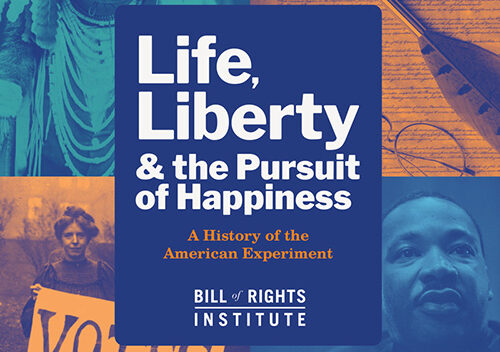
Has the American nation lived up to the ideals of its experiment in liberty? Invite your students to explore the rich tapestry of American history and actively participate in the ongoing experiment that defines our nation's identity. Help your students gain insights into the nature of the American experiment - the ongoing quest for a more perfect union.

What are the powers delegated to the Executive Branch and how have constitutional principles have applied throughout U.S. History? Examine these questions with your students and equip them to be more informed citizens and critical students of history and current events. The curriculum is made possible by The National Endowment for the Humanities and Dr. John M. Templeton, Jr.

The Constitution was written in the summer of 1787 in Philadelphia, Pennsylvania, by delegates from 12 states, in order to replace the Articles of Confederation with a new form of government. It created a federal system with a national government composed of 3 separated powers, and included both reserved and concurrent powers of states.