Video
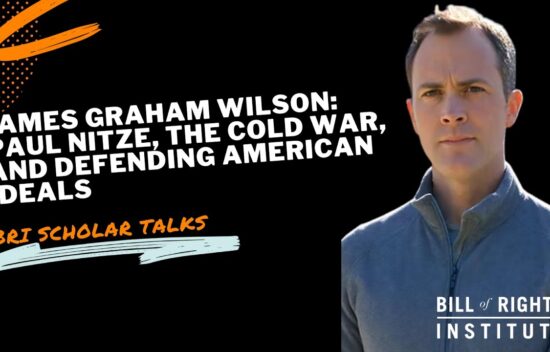
Paul Nitze, the Cold War, and Defending American Ideals with James Graham Wilson | BRI Scholar Talks
Watch
Founding Principles
About this video
In this episode of BRI Scholar Talks, historian and author James Graham Wilson joins host Tony Williams to examine the life and legacy of Paul Nitze, a key architect of Cold War national security policy.
Drawing from his book America’s Cold Warrior: Paul Nitze and National Security from Roosevelt to Reagan, Wilson explores how Nitze’s decades-long public service reflected a deep commitment to American ideals and the defense of liberty in the nuclear age. The conversation traces Nitze’s role in shaping NSC 68, the strategic response to Soviet aggression, and his enduring influence on arms control and diplomacy during the Reagan administration. Wilson and Williams also discuss the Cuban Missile Crisis, the broader Cold War context, and how Nitze's work underscores the importance of perseverance, principle, and strategic clarity in U.S. foreign policy.
0:06 For this episode of Scholar Talks, the guiding question is how did Paul Nitze ‘s work on Cold War national security policy support American ideals and aspirations? Our guest, James Graham Wilson, is an historian with the US State Department. Editing volumes on arms control, national security and foreign policy.
0:30 He is the author of The Triumph of Improvization Gorbachev’s Adaptability, Reagan’s Engagement, and the end of the Cold War, and Today’s Topic. His most recent book, America’s Cold Warrior Paul Nitze and National Security firm Reagan from Roosevelt to Reagan.
0:50 I am Tony Williams, and I am pleased to bring you another episode of Scholar Talks in the America 250 series. James, I want to thank you very much for joining us. Thank you so much for having me, Tony. Sure. You know, I just I love this book, for a couple of reasons. One is, you know, he’s such a compelling and interesting figure.
1:11 Paul knits, and, you know, his his public service just spans the entire history of the Cold War all the way from his very beginning, sort of at the end of World War Two, all the way through the Reagan administration and fall of the Berlin Wall and fall of the Soviet Union. So he’s just so interesting. But also, I love the fact that, you know, you you tie it to the idea
1:34 that that his public career was, was tied to, was in the service of something. In other words, that it was supportive of American ideals, American aspirations, American principles, as were many of the other policymakers, during the Cold War in the, in the postwar period.
1:55 Oh yes. Thank you so much. Yes. I suppose that’s, just to kind of give a brief overview of of the person he, as you say, is there until the end of the Cold War. Even before that, he had started out as an investment banker on Wall Street in the 1930s. And one of his mentors was a man named
2:17 James Forrestal, whom, President Roosevelt, in Europe to leading up to the U.S. entry into World War two, had summoned to Washington, DC in a way to kind of make nice with Wall Street and to kind of prepare for the possibility that the U.S. would enter the into the war. And one of the first things that Forrestal did was to call on Paul Nitze.
2:42 To come down to Washington. It was sort of be there be here on Monday morning and Pulitzer showed up. And from that moment onward, throughout the 40s to, you know, the 1990s, Pulitzer really tackled hard national security challenges. And he, he just never stopped doing that.
3:04 And, you know, toward the end of his life, he was interviewed in the early 90s. They said, well, you’ve made all this money on On Wall Street. You’ve also been at the Reykjavik summit all night with, with, you know, when Reagan and Gorbachev had their famous encounter and they said, which one was more exciting? He said. Well, there’s no question. Was this visible? There’s no question that it was exciting to make money on Wall Street.
3:26 But even more exciting was, you know, to be in these negotiations, working on matters of, of, war and peace, trying to reduce, the prospect of, of a nuclear war. And I think that to your point about, the service of ideals, the document that Paul notes will always be, you know,
3:48 remembered for his, his stewardship and authorship of parts of but overall stewardship of, something called NSC 68 and, the first few months of 1950 and NSC 68, you know, recommend for everyone to just to kind of Google it and, and read through. It’s a beautiful articulation of fundamental American ideals and values,
4:08 kind of going looking back at the founding documents of the Declaration of Independence, the Bill of rights and the Constitution. And then, you know, kind of framing those in terms of the, the, the some called, you know, 30 year crisis, whatever you want to call it, the kind of World War One and the war and World War two and looking at the world, in 1950 and
4:31 looking at the threats to these ideals and, you know, what do we need to do about it? You know, there are many Cold War. Well, it’s it is remains a kind of Cold War foundational document. But I think that, you know, going forward, if you look at national security strategies, more recently, you don’t get the same kind of, exploration and articulation of of what are the fundamental values
4:53 that we’re trying to protect. Right. Interesting. Well, thank you for that sketch of of his, his, life. So so how does his work. And that leads me to my next question. How does his work on NSC 68 reflect his thinking? And and how does it help to alter Cold War national strategy policy?
5:15 Well, so he. Yes. That he knits, had been, involved with a previous project which was the strategic two iterations of the strategic bombing Survey. During World War two as it was happening first, in the European theater, looking at,
5:35 the kind of, U.S. strategic bombing of German industries. But then, very interestingly, he and I think very important to him, as the war ends in the Pacific in 1945, he remains on the team, so to speak, for this second iteration of the strategic bombing survey,
5:57 to look at, the U.S. response or US strategic bombing of Japan. But looking at it from the frame as sort of after it happened. Right. So the Japan is surrendered. And almost as an aside, President Truman says to Nitze, on his way over, you know, while you’re at it, try to figure out, well, why they attacked us in the first place.
6:19 And, you know, necessarily ran with that. And it you know, it built it out in his final, his final report, which came out in 1946, and he was very, I think very clear in, in his line that the reason why Imperial Japan attacked the United States in December of 1941
6:40 at Pearl Harbor, was because of a fundamental U.S. weakness. The thought was that that we had let down our strength. And, you know, the Americans people, the president would basically accept some form of surrender. And that kind of the the lesson from that was that, you know, weakness was provocative.
7:01 Never again can we allow this to happen. And, you know, it’s it’s interesting. It could offer, you know, history wonks. It’s kind of it’s a little bit funny. In 1946, the Nixon tries to he’s kind of looking out at what’s going on with the Soviet Union and the collapse of the wartime alliance against, against Nazi Germany. And and he’s he’s trying to make these points and, you know, people,
7:24 Dean Acheson, among others, tell him, no, no, you’re just seeing things as he he wasn’t really the the world’s best writer. And so he’s kind of writing this in a, in a stilted manner. And then, you know, around the same time, a little bit afterwards, George Kennan writes his, his long telegram, which the same people say mentors and to like James Forrestal, tell everybody they need to read.
7:46 And it’s essentially saying a number of the same things, but it’s far better written and, you know, easier to read. And then so if you fast forward a few years to Tennessee 68, I think what what he’s, you know, the the experience and the memories are quite similar. And what he’s trying to do specifically,
8:08 the specific charge in NSC 68 is to think about, like, how to protect American values in the world where a the Soviets now have the atomic bomb, which we know from the fall of 1949. Indisputably, they they now possess the bomb and then be in a world where there is the potential of each side, achieving,
8:34 a hydrogen bomb or pursuing or achieving a hydrogen bomb, which, you know, is it may seem like a subtle distinction, but it’s it’s the difference between the atomic bomb and hydrogen bomb is, is is quite profound. And the prospect of, you know, something that would, I suppose, even though, you know,
8:55 we think of the atomic bombings in the cities and, Hiroshima and Nagasaki and we’re approaching the anniversary of it. You know, I think by that point, in, in the mid mid 40s, the year or two afterwards, it’s still considered to be a kind of a military to military thing. Whereas a hydrogen bomb would, you know, be a city destroying a type of weapon.
9:17 And so, you know, thinking about in, in, in that type of world, what are the things that we, the United States need to do to protect itself and the free world? Very good. And a follow up to that. I guess there’s some sense maybe out there that, that, you know, some of the early Cold War was a little bit more focused maybe on, on an economic aid specifically like the Marshall Plan.
9:39 But then NSC 68, I think some people are that it seems to sort of militarize, Cold War, policy. Is that is that accurate or. Let me say a few things about that. So the, the, the Marshall Plan, so first of all, this is very much involved in the Marshall Plan.
10:00 He, he worked in the in the early Cold War. Just jump around a little bit here in 1946, 47. I think one of the points I try to make in the book is that a lot of other people sort of go back to their pre time employment, whether that’s on Wall Street as a, you know, banker or, or lawyer and, and it’s the himself was given the opportunity
10:22 to go back to be an investment banker again and probably make a lot more money on Wall Street. He turns it down in 46. He wants to work on postwar issues, and it’s primarily rebuilding the European, Europe and the European economy. The Marshall Plan. But I think very importantly, you know, in, in this kind of distinction between Nixon and Kennan,
10:45 Kennan self avowedly thought that we needed to focus on, 4 or 5 specific core areas in the world. And, you know, Nitze, had who had had a kind of different experience during World War Two. And I laid it out on the book that he’s, you know, writing through the jungles in South America, trying to find, I guess, what we would call strategic,
11:08 you know, critical minerals today, which I guess they were back then, too. But his, his kind of he had a very sort of sense of, of the Cold War as a global thing from the start. And so this there’s kind of two axes, you know, I guess people rightly consider, you know, NSC 68 one, it’s it’s, you know, going to be a global conflict, not just something that’s limited to,
11:33 you know, Central Europe and, and Germany and the two. Yes. I mean, militarily, right after the war ends in 1945, there’s an intense effort to draw down U.S. military spending to demobilize. And whereas the Soviets really never, never, never demobilized.
11:56 And, you know, the the then secretary of defense, Louis Johnson, this is part of the kind of the 1950 the framework here. He had promised Harry Truman that he would limit defense spending to like something like $13 billion. And you know, what Nixon was trying to do,
12:16 and he skillfully co-opted a number of, key figures in the defense establishment was to kind of make the case that we needed a dramatic increase, in U.S. military spending. And originally, you know, in the spring of 1950, President Truman didn’t want to deal with this. He didn’t want to think about it because he had his own domestic, you know, priorities. He wanted,
12:37 you know, to his own version of the kind of FDR New Deal. He wanted health care, you know, some kind of system like that. And it wasn’t until June of 1950 with the, beginning of the of the Korean War, North Korea’s invasion of South South Korea. That, you know, it really seemed at the time. And this is, I think, kind of hard.
12:58 It’s even hard. It’s hard for me to fathom. Well, a lot of a lot of things are hard for me to fathom, but, I mean, like trying to kind of get into the mindset of of what it was like to be in in Washington, D.C., in June of 1950. It seemed like the start of the Third World War. I mean, we know now today that the war would ultimately be the a limited thing and would not involve, the use of atomic weapons.
13:21 But but, you know, that was certainly something on the table at the time. And it really seemed like the start of a third World war. And it was only after that that, that, that Truman signed off on it in the C 68. Right. Okay. Well, speaking of that, you know, my next question is about the the Cuban Missile crisis. So what is and it’s his role in that, crisis.
13:42 And and how does it alter the, the Cold War in the arms race? I think you see it as sort of a watershed moment. Yeah. So the October of 19, 62 Nixon at this point is the assistant secretary of defense for international security affairs. He’s the equivalent of what would today be
14:04 the undersecretary, of defense for for policy. And, that man actually, at the moment is Elbridge Colby, who’s, sort of the top policy advisor, to to the secretary. And it’s a, you know, just to kind of a little piece of, of flavor here. You know, one of the things that’s very interesting to me.
14:25 And when he’s meeting with McNamara and the president and this is all in our foreign relations volumes, you know, McNamara will say something to President Kennedy, and Nixon will then say that he disagrees with that. And it’s it’s always amusing to me. I mean, was this man who works as secretary of defense is disagreeing with him, but I say that because it’s a good kind of,
14:47 you know, you have to think about that, the sort of personal dynamics in terms of, you know, what becomes then the most dangerous crisis the world has ever seen, which is the that the 13 days in October. Nit’s. You know, it’s this is a also a kind of fun thing as a historian because he, he writes about the Cuban Missile Crisis as to be expected
15:09 in, in his memoir in the early 1990s, from Hiroshima to Glasnost. This is his memoir. And he’s, you know, he’s, broadly speaking, he’s favorable of President Kennedy’s, handling of the crisis. And it’s important, you know, data point that I I’ll say this personally, you know, I first really got into interested in the Cold War in college,
15:34 through a class on Cold War history in which we did a simulation of the Cuban Missile Crisis, and we read all of the transcripts of of, the audio recorded transcripts. And I came away thinking, you know, goodness, this is best when crisis, you know, these people knew exactly what they were doing. And, you know.
15:55 Ultimately. So this is a very long winded way of getting to your question, but Nazis, Nazis actual sense of things being in the room, being on this executive committee was that the Kennedy administration, the Kennedy and his brother, waffled from the start, and
16:18 that it took the insertion of, Nazis former boss Dean Acheson, who a few days into it comes into the room and where few people had been willing to make any decisions. He just kind of sat down and was this figure of command.
16:38 I mean, there’s an incredible moment when they’re talking about like, you know, the meaning of of an embargo versus a quarantine embargo has a kind of it’s a associated with it legally is a declaration of war. And the then, State Department legal advisor is, is going on about this. And Dean Acheson apparently just slams his fist down and says, you know,
17:02 American, the law is what American says it is, or something like that. And this is the Nazis. That’s his notes. And then there’s his own, like, interviews when he’s working with his coauthors in the book, he’s he’s being much more candid and much more critical of the Kennedy folks than, than then ultimately, he wrote about at the time. But
17:23 anyway, this there’s a universe of things to explore here. And, you know, it also is is amusing to me. And I think one of the things that just remarkable about JFK during this time period, even though I had become sort of more critical about a lot of the feeling, more critical about a lot of the decisions, first of the decision, starting with the fact that that that the Republican senator,
17:46 Senator Keating, you know, a few months earlier had said there was proof that the Soviets were putting missiles in the Cuban and they sort of the administration somehow got away with just dismissing that out of hand. It’s on, you know, it’s kind of unbelievable. But I mean, the thing remarkable and, and amazing thing about, about JFK is that throughout the entire crisis, he stays polite, calm, you know,
18:10 with a few exceptions. And that is, you know, one person, he’s not polite to his policy, and it’s, you know, it’s one of courage, you know, folks interested in this to kind of, you know, narrow in on the Kennedy tapes, the exchanges with, with Kennedy and Paul. And it’s very clear that, you know, it’s it was not in the inner circle. But to your question, I mean, it’s a defining moment to Paul
18:33 that’s in his worldview and his his sense of priorities, again, to this theme of protecting American values and an American homeland, which was that at the end of the day, Nixon, who had been railing throughout the 1950s against the prospect of the Soviets getting strategic and conventional superiority, at the end of the day, the Soviet Union
18:57 backed down because of American strength and October of 1962. And there’s an incredible line from a Soviet diplomat who says to an American, I think it was to Bob Lovett. Shortly afterwards he said, you will never do this to us again, meaning that, you know, never again with the Soviet Union allow itself
19:18 to be in this position of strategic and conventional inferiority. And when we see that play out, I mean, there’s a fundamental. So by the end of the 1960s, you have, in terms of the striking power number of missiles, all all of these metrics, you have a rough equivalence. And in some cases, the Soviet Union, pulls ahead
19:40 and I try to make the point in the book that there’s kind of two, two different ways of interpreting why the Cuban Missile Crisis ended peacefully. And what it meant going forward. And the one that kind of wins out is, Bob McNamara’s view that, you know, the two sides got to the point where they were looking down over a cliff, and they and then they said, well,
20:03 we know what’s down there. We’re going to pull ourselves back, and we’re never going to go up to that point again. And from his perspective, this was exactly the wrong approach. I mean, the approach was that that ultimately the Soviets backed down because if you work strength, that this was a stabilizing factor. And that we needed to kind of sustain that strength. Whereas ultimately what happened was that, McNamara,
20:25 sort of unilaterally limited the number of, U.S. Minutemen to to a thousand. And, you know, obviously, the Vietnam, experienced through a hole is a key part of the of the narrative. And, but, I mean, I think just that that’s where I try to make the case that from that point onward, Nixon becomes
20:47 singularly focused on, on the, you know, the strategic balance. And, and in wake of the Cuban Missile Crisis. Right right. I agree. And so, and then there’s, you know, obviously a huge Soviet massive buildup, as you mentioned, and of course, the Salt treaty. But then, you know, what was, you know,
21:08 in his thinking about the Cold War and the arms race in light of those, events, during the Reagan administration. And how was he involved in crafting, that arms control policy especially, you know, we talked earlier about, SDI, Star Wars and all of that. So this is, this is a, I think to for folks who are interested in,
21:33 careers in public service as, as I hope folks are, there’s an overriding theme here in the book, which is that George Kennan gets has gotten a lot more attention. As I said earlier, he was a better writer than Paul Nixon.
21:54 But George kind of left in a snit in, at the end of 1949. And for about 40 years, he wrote very critically about policy, U.S. policy, much of it on the theme of that. He had gotten everything right, and people then messed it up after he left.
22:15 He wrote wonderful books, wonderful history books is just a wonderful, wonderful writer. But he really never commanded the attention of U.S. presidents from that moment on. In terms of like, what should we do? Or what are the big terms of the debates? And that’s where Panetta stayed in the game throughout this entire period. And I actually think that, you know, while he’ll always
22:37 probably be remembered for NSC 68, it was his greatest moment, I think was, those years during the Reagan administration when he was fundamentally, you know, important, both in negotiating what became the 1987 INF agreement, but also creating, this strategic framework,
23:01 excuse me, in 1985, which is basically a 3 or 4 sentence or 3 or 4 paragraphs about like, how do you reconcile the president’s aspirations for a world without nuclear weapons, for building strategic defenses, or making sure that, you know, NATO remains together,
23:22 making sure that the American people support the national security objectives and making sure that the Soviets kind of stay at the table. You said, first of all, you have to kind of frame it and it becomes this, this three phased approach of of, you know, how you also stay within the 1972 Anti-Ballistic Missile Treaty?
23:42 And, you know, he’s staying close then to George, Secretary of State George Shultz. And he also commanded the respect of President Reagan, who really, you know, regarded him as kind of a throwback to the Truman, big Democrats and their kind of this moment at the start of the Cold War, when there was kind of more of a sense of moral clarity and the sense of what,
24:06 you know, the United States needed to do. And, you know, over time that that this is all a whole blurred a bit. But there was a kind of mutual attraction that the late 70s between Reagan and its, and and what did it mean? Well, it’s one thing. I mean, is it it’s a could get away with stuff, right? I mean, he partly because of his financial independence,
24:29 but also because he had this kind of status with the president that there’s this famous moment in the summer of 1982, this walk in the woods, episode where where Panetta is in Geneva and he meets, kind of secretively, with his Soviet counterpart, they go out into the woods. I other in the French cross the French border, I forget, but the point is that he
24:51 he goes rogue, so to speak, that he’s given a set of instructions and he comes up with his own proposal, and he broaches it with the Soviets, and he sends it back, you know, back to D.C. and there’s there’s quite a bit of harrumphing about it, you know, because he hasn’t followed his instructions. But I kind of make the point. I try to make the point that the President Reagan,
25:12 first of all, is not going to fire him because, you know, he’s just somebody who knows he regards him as an expert, somebody who has his credentials. But but I also try to make the pick the point of the book that he, Reagan, considers this. I mean, he said, well, what about what about this idea that it’s not a, you know, it’s not what I’m asking for, but it’s not a bad idea. And so that’s where I think that, you know,
25:32 there’s a lot that has to go in to kind of putting yourself into the position where somebody say, well, well, that person, if they think it’s a good idea, I know it’s not just motivated by their kind of Partizan politics. I know that they’re they’re not just out there on, you know, Twitter writing this, that, that the other thing that there’s somebody who really they thought hard about the issue and they thought, thought, well,
25:54 this is something that might work and they’re willing to, but they’re willing to take the risk. And so I really kind of admire about that. But it’s, you know, it’s it’s difficult, it’s hard to kind of get into that, into that position. But it’s I mean, to me, it’s you can tell I it’s exciting to know that you can, you can kind of stay at this and that your, you know, your legacy,
26:15 your record of achievement, can, can accrue over time. Excellent. So, going back to the guiding question, something we’ve touched upon, how did Paul Nixon’s work on Cold War, a national security policy support, American founding ideals and aspirations? I think that, you know,
26:36 there was a fundamentally for him, especially in the second half of of of his career, it, when it came to the nuclear balance, it came it it was about preserving the United States freedom of action. And that was a kind of prerequisite for preserving,
26:57 individual freedoms at home. And, you know, it’s he’s somebody who I don’t find a lot of him sort of on the record about what’s going on domestically in the 60s and 70s. But his singular focus really was on, you know, this, this broader, I guess, sort of two pillars.
27:21 I would put it and this these are thematically they unite that’s and and Kennan and many others who at the dawn of the Cold War and the first was if you if you had a successful strategy to contain reverse whatever, communism which was fundamentally antithetical to human freedom,
27:43 if you had a, a strategy to do these things, then ultimately you could win without war, right? NSC 68 was not a document about how to fight a war, was how to prevent a war that was the aspiration. And then the second one was that in terms of the what becomes the this it’s a scenario.
28:05 It’s this the sense that the in the 70s, you know, that the Soviet Soviet leader would be able to kind of blackmail, an American president and America more broadly by saying, well, we have the ability to take out your land based nuclear missiles, sparing your cities.
28:26 This is a very grisly thing to consider, and that then we would, you know, say to you, okay, here’s the deal. You either if you retaliate, we will take out your cities. So the best thing to do is surrender. And I think that it’s a, it’s it’s kind of hard to kind of find all the fine grain evidence, but this is a kind of a, some my extrapolation of everything that’s us thinking was that,
28:49 that he believed that, you know, no American president would back would sorry. All American presidents would back down in that situation because I mean, the American people elected somebody. And the very people don’t elect somebody who’s going to make the decision, okay, I’m just going to flip the switch. And, you know, there goes to New York City. And that the so the more importantly, the sort of the Soviets knew
29:12 that about America, the fundamental nature, fundamental ideals and the kind of the ideals that that instill us to vote people to protect them and that that would allow them to take all sorts of risks. Now that they had nuclear equivalency or in some, some categories, superiority. I mean, that’s kind of hovers all the over all of Nixon’s ideas in the 70s
29:37 and 80s to the point where he becomes he’s very gloomy and he can’t really, you know, comprehend that Gorbachev is somebody different than the, you know, 1 or 2 weeks before the Berlin Wall comes down, he’s still railing against Gorbachev, is never gonna let this happen. So, you know, there’s a there’s a sense of complexity here, and I don’t I went into this project thinking, I’m either going to fall in love or grow to despise this man.
29:59 You know? And that’s the kind of dilemma of anybody writing a biography. And I, I don’t I feel like I got through it without that. But I do think that there’s kind of the downsides and upsides to this person, as with anybody. But the upside is the perseverance, the just continual sense of of hacking away at these very hard hearted problems.
30:21 Unfortunately, some of them I’ve kind of pop that back up on the scene and during our lifetime. Right. That that’s a great lesson for all of us. Very perseverance in the face of adversity. And, and that the world is a very complex place. So, James, I want to thank you very much for joining us to share, insights on your book and this very important topic.
30:43 Thank you so much, Tony. All right. And thank you all for joining us for this episode of Scholar Talks. Check out the other videos in our America 250 series on the very channel.
Standards
Related Resources

Which country, the United States or its previous ally, the Soviet Union, was responsible for the escalating tensions that led to the Cold War that would go on to last for decades? Two scholars debate this question.

How did President Reagan help win the Cold War?