Video
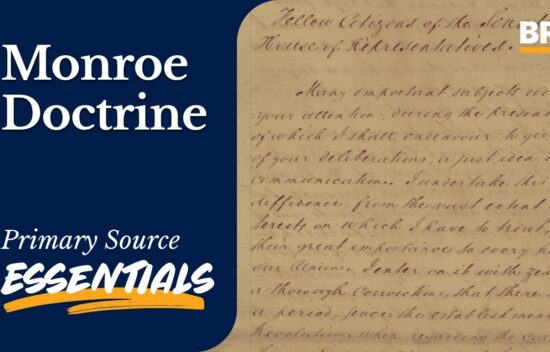
Monroe Doctrine | Primary Source Essentials
Watch
Virtues
About this video
In this episode of Primary Source Essentials, explore President James Monroe’s 1823 message to Congress that became known as the Monroe Doctrine. Learn how this defining statement of early U.S. foreign policy warned European powers against new colonization in the Western Hemisphere and declared any intervention “dangerous to our peace and safety.” Discover how Monroe and his administration balanced American security with a promise of noninterference in European affairs. Understand how the doctrine reflected the nation’s growing confidence, its belief in republican ideals over monarchy, and its emergence as a continental power with influence in the Americas.
0:00 Welcome to Primary Source Essentials. In this episode, we are going to briefly examine the foreign policy principles of the Monroe Doctrine. During the early Republic, the new nation was expanding across the continent. According to the idea of Manifest Destiny, especially in the wake of the Louisiana Purchase, this led the United States
0:22 to contend with many different empires on North American soil. Spain in Florida, Great Britain in Canada in the Oregon Territory, and Russia in the Pacific Northwest. In the early 1800s. Revolutionaries rebelled against the Spanish Empire and formed new countries in Latin America. The United States had to formulate a diplomatic policy towards those newly
0:46 independent countries, and how to handle any further European presence there. When rumors spread, this theme was forming an alliance to restore its crumbling empire in the new World. President Monroe issued a declaration of American national security with his Monroe Doctrine in his annual message to Congress in 1823.
1:07 He asserted three main foreign policy principles. One, he warned that the Western Hemisphere was henceforth not to be considered as subjects for future colonization by any European power. Two. The United States would consider any European intervention in the Western Hemisphere to be dangerous to our peace and safety,
1:31 and decide to respond accordingly, depending on the circumstances. Three. The United States, in turn, promised not to interfere in European wars or in its internal concerns. The Monroe Doctrine was a ringing affirmation of American continental aspirations and hemispheric preeminence.
1:54 It also contrasted American Republican ideals with Old World monarchy and aristocracy. Finally, the doctrine established a nonintervention policy with Europe and created an American sphere of influence for American trade. National security. Military intervention. And some would argue, American empire in Latin America.
2:17 Thanks for watching and check out the other videos in Primary Source Essentials.
Standards
Related Resources
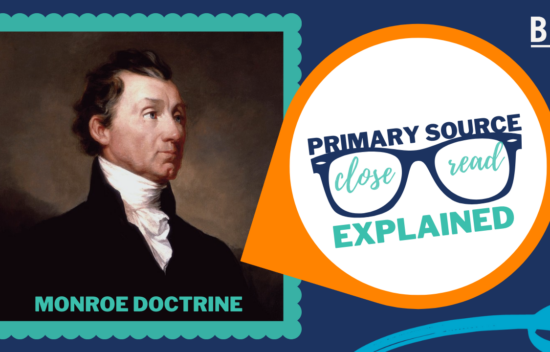
How did James Monroe establish his unique approach to American foreign policy? In this episode of Primary Source Close Reads Explained, Kirk investigates the 1823 Monroe Doctrine in which James Monroe dictated his stance on continued European colonization in the Western Hemisphere. What is James Monroe saying and not saying about America’s position in the world in his 1823 doctrine? How does the Monroe Doctrine compare and contrast to previous administrations’ declarations of neutrality? How can words, written and spoken, change history? “Primary Source Close Reading: Explained,” dives even deeper into some of the most pivotal pieces that shaped the America we know today. Join BRI’s Director of Content, Kirk Higgins, as he takes a detailed look at the language contained in the most formative documents, speeches, and court cases throughout the history of the United States. Learn the true meaning and story behind the writing that fashioned the country in a way you can easily digest!

Use this primary source text to explore key historical events related to the Monroe Doctrine.