Video
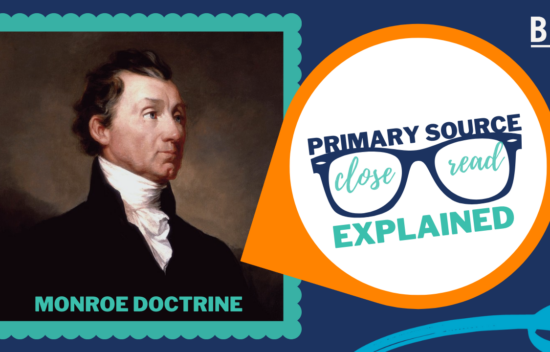
Examining The Monroe Doctrine | Primary Source Close Reads Explained
Watch
Founding Principles
Natural/Inalienable Rights, Liberty, Majority Rule/Minority Rights
Virtues
About this video
How did James Monroe establish his unique approach to American foreign policy? In this episode of Primary Source Close Reads Explained, Kirk investigates the 1823 Monroe Doctrine in which James Monroe dictated his stance on continued European colonization in the Western Hemisphere. What is James Monroe saying and not saying about America’s position in the world in his 1823 doctrine? How does the Monroe Doctrine compare and contrast to previous administrations’ declarations of neutrality?
How can words, written and spoken, change history? “Primary Source Close Reading: Explained,” dives even deeper into some of the most pivotal pieces that shaped the America we know today. Join BRI’s Director of Content, Kirk Higgins, as he takes a detailed look at the language contained in the most formative documents, speeches, and court cases throughout the history of the United States. Learn the true meaning and story behind the writing that fashioned the country in a way you can easily digest!
0:04 So I have an older sister, and when I was growing up, we used to have what I’ll call territorial disputes. Now, it’s kind of funny thinking about it now because it wasn’t even my house and I didn’t really have any authority to assert. But it doesn’t mean I didn’t make statements about what was mine and what she couldn’t touch. That’s not dissimilar to the United States in the 1820s.
0:26 Now, I won’t compare the disputes between the United States and other world powers as though they’re even on the same consequential level, but that kind of analogy helps us understand the weak position that the United States was in when it made the Monroe Doctrine. The doctrine itself is actually a part of President Monroe’s State of the Union address that was given on December 2, 1823.
0:47 And in it, he made a statement that we’ll think about as a principle rather than a doctrine, because when he made it, the United States wasn’t really in a position to enforce what he was talking about. Sure, the United States had won its own independence in 1783. It had survived the Quasi War with France, it had defeated Barbary pirates, and it had even survived the War of 1812 with Britain ending in 1815.
1:11 But we weren’t exactly a world power. So making a statement where we’re telling everyone to stay out of our hemisphere was pretty bold. But I think it’s important to discuss whether or not that’s actually what Monroe was talking about. But before we get to the document, it’s probably important that we know a little bit about world history that’s going on at this point. Why?
1:31 Well, when talking about foreign policy, we’re going outside of just the United States, and we’re thinking about the entire globe, because everything that happens in the world at this point is interconnected and has international ramifications. In the American context, in 1789, we were busy electing our first president. But in Europe, France was in the early stages of its revolution.
1:51 And in fact, beginning in 1792, a conflict would essentially consume the entire continent. At the core of some of those conflicts was an ideological position pitting what people were arguing was sort of republican or democratic ideals against monarchies in the entire continent. These conflicts would go on from 1792, really up until 1815, with the final defeat of Napoleon at Waterloo.
2:15 Now, ideology was only a part of what many of those wars were about, but the idea that monarchies were under threat was something that was seen as being very real for the governments in Europe at this time. And in fact, a holy alliance would be formed between Prussia, which is in Germany, Austria, and Russia,
2:35 that would be explicitly made to defend the ideas of monarchy. Now, understanding all these conflicts and all these ideological tensions that were going on in Europe helps us better understand what Monroe is talking about in the document. So with that, let’s take a look at what Monroe had to say in the State of the Union address. So, as always, it’s important to keep in mind that we’re only looking at a segment of what is a much longer address in the State of the Union address.
2:58 And so the section that we’re looking at is what would later become known as the Monroe Doctrine, but is really just a statement of foreign policy ideas that Monroe was laying out. So again, thinking about the context that he’s giving us in, he’s giving it to a domestic audience, meaning he is addressing this to Congress, but he knows that there are international implications for what he’s about to say.
3:19 So he’s saying it domestically to his own government, but he’s also saying it internationally because he knows that other countries around the world are going to be paying attention to what is in this address. So let’s take a look. So the first section we’re going to look at here speaks directly about this ideological sense that I was talking about earlier. Monroe says the political system of the allied powers is essentially
3:40 different in this respect from that of America. The difference proceeds from that which exists in their respective governments and to the defense of our own, which has been achieved by the loss of so much blood and treasure and matured by the wisdom of the most enlightened citizens and under which we have enjoyed unexampled felicity this nation is devoted.
4:01 So when talking about the ideological difference here, he says in a couple of different places, he says that this difference proceeds from that which exists in their respective governments. So he’s talking about the nature of those governments and in one of them, one of the types of governments he says has been matured by their most enlightened citizens, meaning individuals are voting, individuals have a voice, individuals are participating in their government, and that is doing something
4:24 differently than what’s happening in the monarchy in Europe. Now, we’re going on in the next section. He says we owe it therefore to Candor and to the amicable relations existing between the United States and those powers to declare that we should consider any attempt on their part to extend their system to any portion of this hemisphere as dangerous to our peace and safety. All right, so this is a key part of what
4:44 later becomes known as the Monroe Doctrine. But here is just President James Monroe making a statement about what he sees as important for the United States. He says that we should consider we, the United States should consider any attempt on their part to extend their system to any portion of this hemisphere as dangerous to our peace and safety
5:06 with the existing colonies or dependencies of any European power we have not interfered and shall not interfere. OK, so we’re saying we should consider any attempt to extend their systems as a threat, but with the existing colonies that they have over here. We have not interfered and shall not interfere. All right, why is this important?
5:26 Well remember what the Monroe Doctrine becomes known as is line the sand saying that the Western Hemisphere is sort of the backyard of the United States. It’s an area where we are seeing our sphere of influence, right? This is an area where any action that takes place here is directly relevant to the interests of the United States.
5:47 However, many European powers already had colonies here in the Western Hemisphere. So you’d think on its surface that’s kind of silly that the United States is saying, don’t come over here, but they’re already here. But what Monroe is actually saying in this document here is that we’re not going to interfere with anything you have going on, but don’t start new colonial efforts
6:08 and don’t try to bring what are your governments or don’t try to bring new colonies or new military adventures into this hemisphere. Now, also going on in this period are a lot of revolutions in Latin America and a lot of governments are changing hands. The Spanish, there’s been a Haitian revolution, there’s been a lot of change that’s been happening.
6:30 And so all of that background is going on. There’s sort of an unraveling of what was the old order in Europe, in these colonies that were throughout South America and Central America. And that’s all changing. And so what Monroe is saying is, look, we have not interfered and become involved in those different conflicts, but don’t come over and try to conquer the new countries that are trying to establish themselves either.
6:50 Again, this is getting to that point of monarchies and nascent republics. So a lot of these Latin American countries were attempting to become republics or elected leaders, and they were making an attempt to sort of follow in the footsteps of free, self governing peoples. And so Monroe was saying, look, leave them alone. Don’t come and recolonize those people.
7:11 But also we’re not going to interfere in whatever it is you already have going on here. So it’s complicated. But it’s good to keep in mind because we’re thinking about what was happening in 1823, not what later the Monroe Doctrine becomes known as, which is this hardline? The Western Hemisphere is in the United States because again, the United States is not the world power that it becomes. In 1923,
7:34 the United States is a very young, a very immature, if you will, power that doesn’t have a lot of naval might, it doesn’t have a lot of military might. The might that it does have, it’s enough to defend itself, but it’s certainly not pushing its powers out beyond itself. And not only is it not doing that, it hasn’t wanted to. Up to this point, the United States has
7:54 been neutral as Washington’s declaration of neutrality. And the Adams administration did something similar where they’re saying, look, we’re neutral in all of these conflicts around the world. We don’t keep a standing army for reasons related to liberty and to reasons at home, that we think that a standing army is sort of opposed to those democratic principles. So what Monroe is standing here is very carefully put.
8:17 He’s saying, look, new ventures, not acceptable. Things you already got going on, all right, we’re staying out of it, but don’t come over here and try to push your ideology or your monarchy onto us in the Western Hemisphere. So he goes on to kind of state what I just said. But with the governments who have declared their independence and maintained it and whose independence we have on great
8:39 consideration and unjust principles acknowledged, we could not view any interposition for those for the purpose of oppressing them or controlling in any other manner their destiny by any European power in any other way than as a manifestation of an unfriendly disposition toward the United States. So these new countries that are here, that have chosen their governments and we
9:04 have recognized we, the United States, have recognized we’re going to stand behind them, and if you threaten them, you’re threatening the United States. All right. So he goes on to say, in the war between those new governments in Spain, we declare our neutrality. So again, Spain, these new countries, these are former colonies of Spain who are rebelling against the Spanish government. These colonies, we’re declaring our neutrality.
9:25 We’re not getting involved. And at the time of their recognition into this, we have adhered. So we declared neutrality when it first started, and we have adhered, meaning we have stuck to it. We’ve held firm to our agreements and shall continue to adhere, provided no change shall occur, which, in the judgment of the competent authorities of this government, shall make a corresponding change on the part of the United States indispensable to their security.
9:48 All right? So this is what we would call diplomatic language. Essentially, what this is saying is, look, we’re neutral. We been neutral. We’re staying neutral unless something occurs that we think is a direct threat to us. So what does that mean? Well, to the Spanish, it’s kind of a firm warning to be paying attention to the United States as you’re moving forward to this.
10:09 So he goes on our policy in regard to Europe, which was adopted at an early stage of the wars, which have so long agitated that core of the globe. So here he’s talking about sort of those Revolutionary Wars between 1792 and 1815, revolutionary wars, and then later the Napoleonic Wars, which ended in something called the Congress of Vienna, where all of the heads of Europe then got together to sort of sort out what the continent was going to look like.
10:32 So they’ve been at war with each other for that entire time, a really long time. But the United States was neutral in those wars and tried to stay out of them. Nevertheless remains the same, which is to not interfere in the internal concerns of any of its powers, to consider the government de facto as the legitimate government for us to cultivate from the relations with it and to preserve those relations by a frank, firm and manly policy,
10:54 meeting, in all instances, the just claims of every power submitting to injuries from none. So don’t come at us. We’re going to recognize the power that is in charge, and that’s what we’re going to deal with. There’s a lot of complex history that goes in behind us, but we’re essentially saying is, look, our policy of neutrality in terms of Europe and the internal concerns of that continent are remaining the same.
11:15 But again, we’re saying that this the Western Hemisphere, this is directly in the interests of the United States. But in regard to those continents, circumstances are eminently and conspicuously different. It is impossible that the Allied powers so, again, this is the holy alliance that I was talking about earlier between Prussia, what would become Germany, Austria, Russia should extend a political
11:38 system, so their political system is monarchy, remember, to any portion of either continent without endangering our peace and happiness. Nor can anyone believe that our southern brethren, if left to themselves, would adopt it of their own accord. So here we’re talking about the idea that these individual countries should have a choice in the kind of government they’re getting. It is equally impossible, therefore,
11:59 that we should behold such interposition in any form with indifference. Meaning, if you come over clearly, if you’re going to force your type of government on these countries, which we don’t think they would choose anyway, it’s not only a threat to those countries, it’s a threat to the United States. So, again, drawing this line, the Western Hemisphere is where the United States has direct interest.
12:20 We looked at the comparative strengths and resources of Spain and those new governments and their distance from each other it must be obvious that she could never subdue them. Meaning, look, Spain is not a strong nation. It’s also far away from these colonies. It’s basically time to let these countries live on their own and allow them to determine their own fate.
12:41 It is still the true policy, the United States, to lead the parties to themselves in hopes that other powers will pursue the same course. Meaning the United States is going to stay neutral. Spain, if you think about it, you don’t really want to do this, so please stay neutral. The United States will take any move that you’re making that is a new colonial effort in the New World or opposed to these new countries as a threat to our interests.
13:04 So, a quick recap. What is Monroe’s message again, given in his State of the Union address to Congress? He’s saying, look, the United States is looking at the Western Hemisphere as an area of its direct interest. That any action that takes place in the Western Hemisphere is something that the United States is going to have a lot of interest in not only knowing what’s going on. But in paying attention to. And that we may see it as a threat to our security depending on where it is.
13:29 Particularly ideological beliefs. So if monarchies are coming over and impressing themselves into this hemisphere or into these new countries, that’s going to be something that we’re not looking kindly upon. But what is Monroe not saying? Monroe is not saying that we’re going to go get involved in everything, and he’s not saying that we’re going to be interested in trying to help overthrow
13:50 colonial governments that are already existing in the Western Hemisphere. And he’s not really saying that we’re going to necessarily go to war over all of these things. But he is making a line in the sand saying that the United States has an interest in this, and so it may be the case that we determine that we will become involved if someone comes over. So why is that important?
14:10 It’s all really kind of vague and foggy, as foreign policy often is. But again, keeping in mind, the United States is not a strong country at this point, militarily or even from in terms of international reputation. It’s 1823. We’re a very young country. We’re still trying to figure out what it even means to have a military.
14:32 US military is not strong, and we’re not sort of the country that we’ll become. But as time goes on, this Monroe, what becomes known as the Monroe Doctrine in 1850 becomes something that we lean on and interpret in different ways. So how is this the same or different from the declaration of neutrality of earlier administration? Well, as we talked about,
14:52 this declaration of neutrality is still kind of a part of this. We’re not going to go get involved in foreign conflicts if we can help it, and we’re going to even stay neutral in conflicts that are happening in Latin America unless those conflicts seem to directly affect the interest of the United States or threaten the United States in some way, to put it in another way. And so how is it different?
15:13 Well, it’s a little bit stronger, but it’s still not strong enough to say that we’re going to go and start fighting on behalf of our brethren and liberty in every corner of the globe that we can find it’s more restrained than that. However, over time, as I mentioned, this doctrine, what becomes a doctrine sort of becomes adapted to the different periods that it kind of goes through.
15:35 By the time Theodore Roosevelt is President of the United States, this Monroe Doctrine is seen as a way for us to be more forceful in the Western Hemisphere. That has to do with a lot of other historical context that’s going on. The United States military has grown in strength. The desire that the United States has expressed towards what is essentially imperialism or trying to expand our
15:56 holdings around the world is something that people are actually advocating for. And so the Monroe Doctrine begins to reflect that a little bit more. We end up helping lead the formation of something called the Organization of American States, also somewhat related to the Monroe Doctrine, but again, not with the United States being the sole leader and defender of the Western Hemisphere, but us as a member of several different
16:17 parties who are working to find solutions within the Western Hemisphere. So the Monroe Doctrine continues to have significance in the United States that it still continues to hold to this idea, but it has certainly changed over time. So thank you so much for taking a look at our video today. I hope you learned a little bit more about the Monroe Doctrine, about the language that’s contained within it, about what it says and what it doesn’t say, and the complexities of what was
16:40 going on in foreign policy for the United States at this time. We also have a link to the primary source that we have on our page that can help. You can go back through and annotate and check it out as you like. But I also encourage you to check out the other videos that we have. My colleague Tony Williams has done a lot of great videos on American foreign policy, talking with different scholars who are thinking about the topic. So check those out.
17:01 And until next time, thank you so much for joining us. Well, I’m done studying that video, filled in all the blanks for me. Well, just in case you need more help, the Bill of Rights Institute’s YouTube channel has tons of videos on American history, government, and civiscs. From primary source document breakdowns, to historical image analysis,
17:21 whether you’re studying for a test or just interested in more, they got something for you. And they put out more videos all the time. Really? Well, in, in that case, there’s no harm in brushing up on a few more topics. Check out another video here and be sure to subscribe here so you are never left out.
Standards
Related Resources


In the early years of the United States, American foreign policy focused on maintaining neutrality and protecting national sovereignty while dealing with conflicts between Britain and France. Presidents Washington, Adams, Jefferson, and Madison struggled with issues such as British impressment of American sailors, attacks on U.S. shipping, and pressure to take sides in European wars. Key events included Washington’s Proclamation of Neutrality, Jay’s Treaty, the XYZ Affair, the Louisiana Purchase, and Jefferson’s Embargo Act. Rising tensions with Britain eventually led to the War of 1812, which ended with the Treaty of Ghent in 1815. By the war’s conclusion, the United States had grown stronger and gained greater respect as an independent nation capable of defending its interests.

Use this lesson at the end of the unit to review foreign policy throughout U.S. history.