Video
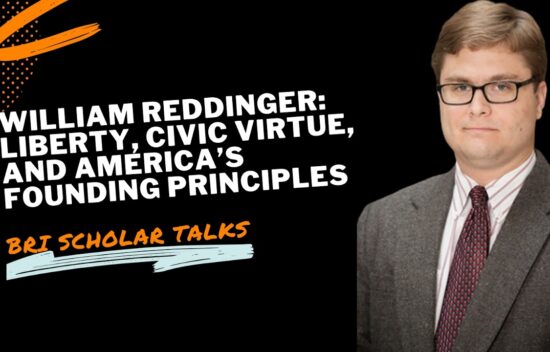
Liberty, Civic Virtue, and America’s Founding Principles with William Reddinger | BRI Scholar Talks
Watch
Founding Principles
Virtues
About this video
In this episode of BRI Scholar Talks, William Reddinger joins host Tony Williams to discuss the founding principles and civic virtues necessary for human flourishing in a free society. Drawing from his book Political Thinkers of Our Time, Reddinger explores the Anglo-American political tradition and the ideas that shaped constitutional government, individual liberty, religious freedom, and republican self-government.
This conversation examines the political thought of figures including Edmund Burke, Alexis de Tocqueville, Abraham Lincoln, George Washington, and Friedrich Hayek. Reddinger and Williams discuss ordered liberty, equality under the law, constitutionalism, religious liberty, free markets, and the role civic virtue plays in preserving a free society. From Burke’s “little platoons” to Lincoln’s defense of republican self-government, the interview explores how these ideas continue to shape American political life today.
00:00 Introduction: Founding Principles and Civic Virtues
01:40 The Anglo-American Political Tradition Explained
05:30 Edmund Burke on Tradition, Civil Society, and Ordered Liberty
10:52 Tocqueville on Equality and Democracy in America
13:30 Abraham Lincoln and Republican Self-Government
16:56 The Federalist Papers and American Constitutionalism
20:16 George Washington and Religious Liberty
23:58 Hayek, Free Markets, and Human Flourishing
30:14 Founding Principles, Civic Virtues, and a Free Society
----
About the Bill of Rights Institute:
Established in September 1999, the Bill of Rights Institute is a 501(c)(3) non-profit educational organization that works to engage, educate, and empower individuals with a passion for the freedom and opportunity that exist in a free society. The Institute develops educational resources and programs for a network of more than 50,000 educators and 70,000 students nationwide.
Official Site: http://billofrightsinstitute.org
Facebook: / billofrightsinstitute
Twitter: / brinstitute
Instagram: / brinstitute
BRI Educator Newsletter Sign Up Page: https://billofrightsinstitute.org/new...
0:05 For this episode of Scholar Talks, we will be discussing the founding principles and civic virtues necessary for human flourishing in a free society. William Reddinger is a professor of government at Regent University, where he teaches political philosophy and American politics. He is also the director of the Lincoln Program
0:26 in America’s Founding Principles. He is the author of the book Political Thinkers of Our Time, which we will discuss today. He’s a very good friend of the Bill of Rights Institute and a good personal friend of mine. I am Tony Williams, senior fellow at the Bill of Rights Institute, and I want to welcome you to another episode of Scholar Talks in the America to 50 series.
0:48 Bill, I want to thank you very much for joining me. Yeah. Of course. Thank you. Tony. Glad to be talking with you today. Yeah. You’ve written a really remarkable book. I mean, it has such an array of the important thinkers of Western American civilization. I guess you honed in on the Anglo-American tradition, both on the political side, some economists. And there too, and I felt like I was reading a book or I.
1:12 Mission statement, I mean, or, you know, a mission statement from the American founders. I guess their mission statement was the Declaration of Independence. Right. But, all of the great, founding constitutional principles, you were talking about and a civic virtues. So, just a great book, very readable, nice, brief, very digestible.
1:32 And I can’t wait to talk about it. Well. Thank you. Thank you for that, feedback on it. Yeah. I’m glad to talk with you. The, you know, the book and the introduction, and it tries to set out a series of Anglo American political ideas. And I speak of the Anglo American political tradition. Right? And in so doing, I cover people like Burke,
1:55 Tocqueville Lincoln The Federalist Papers and, and people you might not expect George Washington as a political thinker, and Friedrich Hayek and Vilhelm Roca. And so, I’m I’m happy to talk with you about this today. Great. So and you mentioned the Anglo American tradition in your book. So you start off with an introduction rooted in that Anglo American tradition.
2:20 So what are its defining characteristics that might pull together this, you know, somewhat diverse, set of political thinkers? Sure sure. Well, the phrase Anglo American political tradition, I think, is best understood by thinking about a series of of institutional, features or principles.
2:40 And so the kinds of things that some of us are used to taking for granted, I would suggest things like individual liberty, the rule of law, as opposed to arbitrary decisions of some strongman or religious liberty, due process rights, freedom of speech, and in general a kind of suspicion of central planning. And because of a belief that people are, they have a tendency to vice.
3:06 And the abuse of power, or because we simply don’t know enough to plan about any given economic or political policy. But in a word, I would say that the Anglo American political tradition is its liberalism. So the, you know, it’s not really something that I emphasize a great deal in, in the introduction.
3:26 But, you know, some, some thinkers as of late have taken to try to separate the idea of liberalism from the Anglo American political tradition. And, and the book kind of implies that that’s that’s the wrong take. That’s the wrong path to take. And so we should be referring not so much to a kind of subset of European ethnicities,
3:47 but rather to a set of ideas. And, I mean, to that extent, it’s, the Anglo American political tradition is, is a phrase which is often contrasted with other approaches to thinking about politics. In the book, you may recall and, Friedrich Hayek, one of my favorite ways
4:07 to think about it is Friedrich Hayek’s distinction of Anglican and Gallican. And, again, these don’t refer so much to ethnic groups, but to schools of thought. And so in the Anglican tradition, we have something like what? In my book, we’re calling the Anglo-American political tradition. And Hayek used Gallican to refer to a set of thinkers
4:31 who are more concerned with abstract reason. They’re concerned with central direction of political and economic life. They’re they’re generally in favor of a more secular society, if not outright antipathy toward maybe traditional religious beliefs, things like this. And so, there are other ways of thinking about this.
4:52 In the book, I cite Russell Kirk and his basic distinction of conservatism and radicalism. The, you know, kind of getting at the same thing, even if I don’t, you know, I choose not to use that that distinction as such. But, but yeah, that’s what I have in mind in the book and in particular, because it seems to me that in, in our day, there’s,
5:13 there are different voices from different historical or political camps who are, probably ready to jettison some of these principles. And, and I would suggest that it would be best that we understand what we’re jettisoning before we before we cast them off. I certainly agree with that. So let’s start with Edmund Burke, from your book.
5:34 And so how does, tradition and civil society cultivate civic virtue and liberty, according to Burke? Yeah. Well, for for Burke. First of all, it’s probably best to start out with with Burke’s anthropology. So on the one hand, there’s,
5:55 there is in Burke a suspicion of individual reason. At one point, he says that our individual stock of reason is very small, but the species is wise. And so we’re we’re at this position where we we do need virtue. We do need virtue for for liberty.
6:17 You if we are not controlled, Burke says, by ourselves, we we have to be controlled by the state effectively as a kind of substitute for anarchy. And so the question then becomes, where does this ability to restrain oneself come from? And in Burke’s anthropology that he seems to suggest that we are very social beings.
6:37 We can’t we can’t imagine that we are born with a complete stock of all the reason we need, or all the virtue that we need, but rather we need to be cultivated by people around us. And those people might be our family, dear friends. They might be local community neighborhoods.
6:58 They might be religious institutions and and other kind of civil organizations and the little platoons. He said, yeah. That’s right, that’s right. Burke’s famous phrase is the little platoon. And so, you know, it’s kind of, you know, it’s, perhaps from from a social conservative perspective, it’s it’s often a phrase that’s associated with family life and religion.
7:21 But it’s more than that. And I think the, the very phrase little platoon suggests a kind of regimentation that there’s, there’s an emphasis on discipline so that we are prepared for what’s ahead of us. And what is ahead of us is being good citizens, being good people. And so the the ability to be a good citizen is not something
7:43 which you effectively are born with, and it’s not something that you only teach rationally, but you learn to have an appropriate appreciation, but a measured appreciation for your political order. First of all, in those very small, regimented bodies of of our early lives,
8:04 the the other part of your question had to do with tradition. What does tradition do for for virtue, according to Burke. Well the the famous teaching that political philosophers will, will perhaps be somewhat familiar with here from Burke is the idea that liberty is a kind of inheritance. That’s what he calls it in his a little, a little document called his letter to Mr.
8:27 de Paul. And so he, he argues that liberty is something that we receive from past generations. And again, this is all related to his, to his anthropology, because our reason is so limited,
8:47 we must be cautious in imagining that we know for ourselves what the conditions are that would make freedom possible. And so, to overcome this, we need to rely upon political institutions from the past and, and civil customs or social customs. We don’t even know that we have from the past that we
9:09 we would be very unwise to simply get rid of because of some displeasure. It doesn’t mean that we never change them by any means. But, but there’s, there’s a bias in favor of deference toward tradition and Burke’s law. So what we receive from the past
9:29 is, is this desire to to try to pass on the good things from the past to posterity. So, again, with respect to Burke’s anthropology, he, he’s thinking about human beings as people who come into the world. And we’re already part of a social system.
9:49 We’re part of a moral system. We don’t we don’t have obligations only because we consent to them. So with perhaps with more radical thinkers associated with liberalism or the enlightenment, we are not isolated individuals existing independently of a of a moral reality.
10:10 But we’re born into a world in which we are indebted to those people who have given us a system of liberty and social order, and we also have a moral obligation to preserve it in some form. For for those who come after us and, the politics of prescription. Russell Curtis, the 20th century conservative mind, famously called it,
10:31 the it’s a kind of term from real estate law. You know, we inherit certain things and we don’t even necessarily know the reason for the things being made in the first place. But that’s part of the point is that we’re not wise enough to rebuild our system of politics if we needed to. So. All right.
10:52 Great. Well, my next question is on Tocqueville, the great author of Democracy in America. And I know that we could talk about this for basically, like a semester, at reaching here or sitting with you. But what can Tocqueville in a nutshell, teach us about the meaning of equality? Sure. Well the
11:14 for the sake of maybe being concise, I think it might be appropriate to begin with, what I suggest in the book that there is, in Tocqueville’s thought, a kind of positive definition of equality that we ought to take out of his thought and preserve. And that idea is that equality,
11:34 when rightly understood, means and equality before the law because of equal human worth or equal human dignity? It’s it’s present in his thought. But, you know, I lead with that here, not only because it’s in the book, but because sometimes we probably rightly, we we’re distracted, so to speak, by the main emphasis
11:57 of Tocqueville’s writing, which is that maybe equality is not just a good thing. And so, in a sense, equality is usually understood as a kind of neutral fact of society and democratic cultures that it’s it’s just there where relatively equal. So people become more attached to it.
12:18 And it’s, it seems obvious, of course, this is a good thing in general, but there’s also a concern here that people might drift toward appreciating equality more than liberty itself. And to that extent, he understands equality not only as this neutral fact about sociology, but also as a passion.
12:39 He’s making this observation that even more than a principle, the the danger is that instead of understanding equality as, as equal protection as a law because of equal worth, people will instead understand it to mean, something we must have more of. And we’re not even sure why all the time.
13:02 We just want more and more equality of all kinds. And the concern there is that it may drift or drift society away from, from a healthy democratic self-government that Tocqueville invasions. Right? Right. Yeah. I was just talking about, equality under law, equal protection and equal human dignity. Yesterday in my class that I, teacher, Christopher Newport,
13:24 and with Martin Luther King. So, yeah, I think I was on firm ground then. All right. So, your chapter on Lincoln is really masterful. I mean, I love Lincoln. So how does Lincoln’s words and statesmanship advance the principles of republican self-government? Again, another big question, but.
13:46 But what are you talking about in the book? Yeah. Of course. Well, thank you. Thank you for that, feedback. I mean, the, in Lincoln’s thought, one of the things that emerges pretty clearly to anyone who’s spent much time thinking about his presidency or his rhetoric is that, he was a serious statesman.
14:07 And part of the reason for his serious statesmanship is that he was a poet. And, you know, I’m taking this language from Walter Burns. Some of us, you know, I’m sure that you’re familiar with Burns book making Patriots. And in there he makes this case that Lincoln was a poet. And, but of course, that’s part of good statesmanship. It’s using language as a precept or of important ethical principles or what
14:31 the country ought to do, what the vision of the common good is. And, and to that extent, Lincoln, Lincoln is is trying to teach the American people about what the meaning of a republic is. At the same time that he’s in this process to save the union and eventually to attack the institution of slavery through legal means.
14:54 And so, in in the chapter, I just point out that for Lincoln, a Republic means, or the American republic means self-government, and in particular democratic self-government by consenting to the laws that govern us and in various ways.
15:15 He tries to point out that some of his, some of his fellow Americans, with whom he is in deep disagreement, are simply defining the terms incorrectly. There’s there’s at times a misunderstanding. At times there’s a demagogic, intentional abuse. He seems to suggest, both with respect to the word republic, but also other words,
15:38 sovereignty, famously or not, popular sovereignty. So, you know, can we really call it a republic if there is a huge portion of the country who is being systematically removed from some from self-government, from the very possibility of self-government?
15:59 And, of course, Lincoln’s answer is no. At one point he refers to popular sovereignty as as a sugarcoated poison. You know, it’s it may taste sweet to certain people in the country, but it contains something that’s poisonous to the Republic itself. And so, there are various ways in which he uses language artfully.
16:22 I mean, the, the, the most beautiful, it seems to me, of Lincoln’s speeches is the second inaugural, besides being profound, a meditation on slavery in American history and God’s justice, it’s, it’s very moving. And so, you know, it’s, we can see there an example
16:43 of what he’s trying to do with language and, and really bring the country back together at that point, hopefully, as the war is coming to, an uncertain near end. So, you know. All right. Good good. So, the Federalist, Publius, Hamilton, Madison and J.
17:03 So what is their understanding of the meaning of the principles of American constitutionalism in The Federalist? Again? Just, just a small question. Okay. Sure, sure. Well, in this chapter, I have a chapter on The Federalist, and it’s understanding the Constitution. So it’s an exposition of part of The Federalist as it relates to,
17:26 what the Constitution means and what the American Republic is and the basic principles of the Federalist that you’ll see when you read through it are primarily that, again, the people govern themselves. That’s the vision of the constitutional order of the United States. The the chapter also addresses some fairly common
17:47 objections, but important ones that are really quite plausible. I mean, is is it really the case that the American people are are intended to govern themselves if we don’t have some sort of more pure democracy, a direct democracy, is it really the case that the founders or any of the founders thought that we should be governing ourselves, if,
18:08 again, we still have slavery at the beginning of the country, what does it mean for people who might not hold property and so on? At the time, the country? So I address some of those questions. But the basic principle is that we govern ourselves and that the Constitution is, according to the Federalist, the the text of the Constitution is the true long term will of the people.
18:30 So the true long term will of the American people. And so we we must understand how we are to govern ourselves through those words. Right. And that seems really rooted in the declaration. Right. Maybe, kind of reminds me of Lincoln’s apple of gold in the picture. Silver that you know, you’re saying this, this popular sovereignty,
18:52 and consent of the governed in the declaration really is is prominent and central to the project of the Constitution and self-governance. Yeah, absolutely. Absolutely. So, to some extent, the, you know, the chapter is, an exposition of portions of The Federalist, as I said, and in some respects, it’s it’s a reminding of the reader of things
19:15 that hopefully they will have encountered in, in a civics class at some point that, you know, there’s we see in the Constitution certain flags of posts indicating the way in which it represents the principles of the declaration, you know, begins with we, the people as a kind of statement of sovereignty, that the people are sovereign of the American system.
19:37 According to the declaration, the, the first article about Congress begins with the statement that, all legislative powers herein granted are vested in a legislature and, well, who granted it? I mean, well, clearly it’s the people that that’s the declaration. And so as you move through the Constitution,
19:59 you see these different indications that, indeed, the principles that Jefferson tried to capture in the American mind of the day, as he called it, you know, the these are principles which appear in institutional form and the, the working pieces of the Constitution. Right. Great. And so let’s talk about George Washington. Right.
20:19 I loved your approach to Washington. It’s an interesting take, because most people don’t normally think about it. They think about him as general and president and so forth. But your take is that he had a profoundly important contribution to the establishment of religious liberty in this country. You know a. Little bit about that. Sure. Well, Washington is is as as you suggested,
20:43 I think he’s he’s probably underestimated as a thinker. And, you know, it’s it’s probably something that was, at least to some degree, encouraged by, you know, some of his own insecurities and never having a formal college education and so on. But he’s someone who’s deeply well read in the classics and modern thinkers. He’s someone who is is plainly very thoughtful about
21:06 the kind of precedents that he’s setting for the country. He’s he’s very mindful of these things. And part of that has to do with his language, his words. So particularly as it relates to religious liberty, the, you know, the the central documents of Washington’s contributions to, to what religious liberty means as his his letter to the Hebrew congregation in Newport.
21:29 And that. Beautiful letter. Right. Absolutely. It’s concise. It’s packed with meaning. And it’s it’s a letter in which he lays out this argument that religious liberty here, America is a natural right. It’s something given to all. It’s not granted by the government as as an act of toleration of certain sects.
21:50 And in, in making this, this philosophical claim, he’s trying to teach that that citizen good citizenship is no longer going to be intimately hitched to, to doctrinal commitment or religious confession. And so at one point in a letter, he indicates that his,
22:13 is as a metaphor at one point and a letter he, he indicates that hiring for farmhands at Mount Vernon should be open to Christians and Jews or Muslims or even atheists, as long as they’re good farmhands, as long as they’re good laborers. And in the same way, in some of his
22:35 perhaps lesser well known letters to different religious sects, he consistently repeats this theme that good citizenship in the United States must be understood as what we typically regard as good citizenship. Now, something like contributing to the common good, obedience to the laws, involvement
22:57 in the self-governing process, and so on, as opposed to religious profession and, one of the one of the more interesting things that I learned and reading, in preparation for that chapter is how much Washington was mindful of his role as a preceptor of these principles,
23:19 and particularly for sects which perhaps have a history of more radical political action because of their religion, that in America we can be a place where there is sincere, real religious belief, and we don’t have to become
23:41 another chapter in European history in which we fight about these things. And so he’s he’s, he’s teaching the country. He’s teaching the Presbyterians in this way, for example, he’s teaching other sects, contribute to the country. That’s what it means to be an American. That’s a good lesson. Okay, so, shifting to the economist now, so how do the two
24:04 economic thinkers, Hayek and go? I say if I throw out the German, how do they promote liberty and human flourishing in the free market? And what are the dangers of that centralized government intervention? Sure. Well the you know, I have one chapter in the book on it,
24:25 another chapter on broke, they’re clearly, intimately related. And and so, the difference is that Hayek is something like more of a classical economist in his own right. It’s not that Roca was not that he’s a lesser known figure, but he’s someone who’s much more interested in the cultural conditions of a healthy market society.
24:48 So these are two 20th century thinkers, and Hayek is the more well known. But but both had an immense influence on European and American politics of American. It’s true Hayek. Certainly the, in Hayek’s writing, what I try to suggest is that he, he understands a free market to be a system of free enterprise
25:13 in which certain structural conditions are met to produce free economic exchange. So the structural conditions include things like, the protection of private property. It’s it’s not really possible to think about a flourishing human society where you don’t have protection of property rights.
25:35 It disperses power. It protects individuals who hold that property. It creates as as other economists outside of the book. Suggest that it creates certain habits of mind, certain ideas of fairness that are can, the foundation of a healthy society, the another feature of the the chapter on Hayek
25:57 is his discussion of price, price mechanisms. And so, again, because of anthropology in this Anglo-American tradition and Austrian here, we’re talking about Hayek in the Anglo-American tradition. But there’s this emphasis on individual reason being limited. There’s no such thing as a wise planner or founder
26:18 who can tell us what our economic activity in, in specific cases should be. And so the substitute for that one wise planner is, as he says in this famous, seminal essay from the 40s, the Use of Knowledge in Society. He says, the the substitute is the price mechanism. It’s a kind of flag to signal to other people
26:41 how much might be demanded of certain commodities or, whether there’s a need or not, a need, how much production is going on. And to the extent that that is interfered with artificially from outside forces, you risk sending all kinds of incorrect signals. You risk creating need where there was not need before, or more scarcity,
27:05 where there was less scarcity before, and so on. The the thought of Hayek also portrays economic freedom or the free market as being contingent upon the rule of law, in this case, the law applied to economic transactions.
27:26 And so at one point, he he helpfully compares the free market when it’s operating freely under the rule of law to someone who has good balance, it’s as if it’s a natural law that continues into the economic realm. We don’t think that much unless we have vertigo about what our next step is going to be like.
27:47 And in the same way, we need predictability in the market. If we’re to have a good society, if we’re to be able to save wisely or invest wisely or spend wisely. But the the book also has this chapter on Roka because it’s a while Hayek does address cultural concerns. I think it’s in my biased perspective.
28:11 You know, it’s probably the case that Hayek does not emphasize it enough, whereas Roka is associated with, a particular school of economic thought. The auto liberal school of the Freiburg school, which is associated with these more holistic cultural concerns. And so to have a good society, according to Roka, it’s necessary
28:33 to to have a robust culture. That makes people good actors in the economic arena. So when you go to the marketplace, what kind of moral presuppositions are you bringing with you? What kind of things are you taking from your little platoons which are bringing you to be good actors?
28:53 They’re actors, hardworking thrifty etc.? And according to Roka, he wants to argue that it it’s it should be evident to you, after reflecting on it, that the market itself does not alone produce those conditions necessary for a healthy market.
29:15 And so, but instead of being a socialist, as he was in his youth, he doesn’t turn away from free enterprise, which he regards as necessary for for healthy individual and human flourishing. But he wants to understand weaknesses of it, so that we can be on guard against it.
29:36 And the weaknesses are a kind of materialism, a commercialism. It’s the same kind of concerns that you find in Adam Smith. It’s, it’s, it’s a concern that, it doesn’t quite use this language, but it’s the market may cannibalize those higher things of life which make a healthy market possible. If we’re not thoughtful about it.
29:58 We need to have community, effectively, Burke’s little platoons. We need to have the higher things of life, which are more important than market transactions to make a market possible. And so, yeah, the chapter addresses that aspect of this thought. Okay. Fantastic. And so, going back to our original, question at the beginning,
30:22 what are the founding principles and civic virtues necessary for human flourishing in a free society? Yeah. Well, in the book, go down the table of contents. You’ll see some of the things that I’m emphasizing here. You know, I’m emphasizing liberty, rightly understood. Not as not as an abstract absolute to do whatever we please, but
30:43 but a kind of ordered liberty, to to do what is good and to to have free reign for those for those good things of life. I think it’s necessary that we understand also that people, people ought to be given equal protection of the law because we are all of equal worth. We are all people who have intrinsic dignity.
31:05 The another principle, particularly in the American context, has to do with republican self-government under the US Constitution, chapters three and four, Lincoln and the Federalist Papers address that the, the idea of religious liberty as deeply important, having a commitment to religious liberty and closely related ideas
31:26 about freedom of speech, for example. These things are part of a healthy, free society. And and the free enterprise system of the free market I would regard as being, a great blessing in human history that we have experienced in the last couple of centuries and ought to be preserved, at great cost if necessary. So.
31:48 Right. Great. Well, thank you so much. Had a bill running her. Thank you for discussing your book on constitutional principles, civic virtues, and a free society, particularly important as we celebrate America 250, but eternally important in understanding who we are as Americans. So thank you very much. Yeah. Thank you, Tony.
32:09 And thank you all for joining us on this episode of Scholar Talks. Please check out the other videos in our America 250 series on our channel, and please click subscribe.
Standards
Related Resources

How do We the People are better able to protect and advance freedom and opportunity for all?

An interactive that helps students explore Founding Principles and Civic Virtues.

An interactive, device-based game that helps students explore how they can display Founding Principles and Civic Virtues in their everyday lives.