Video
John Dickinson, the American Founding, and the Constitution with Jane Calvert | BRI Scholar Talks
Watch
Founding Principles
Natural/Inalienable Rights, Liberty, Justice, Consent of the Governed
About this video
Drawing from her prizewinning biography The Penman of the Revolution: A Biography of John Dickinson, Calvert examines Dickinson’s pivotal role as a statesman, legal thinker, and writer. The discussion highlights Dickinson’s unique blend of prudence, principle, and moral courage as he grappled with independence, slavery, religious liberty, and the creation of America’s constitutional order.
0:04 For this episode of Scholar Talks, the guiding question is how did John Dickinson consistently support Republican ideals during the American Revolution and founding? Our guest, Jane Calvert, is the founding director and chief editor of the John Dickinson Writings Project. She’s the author of Quaker Constitutionalism and the Political
0:26 Thought of John Dickinson, and her latest book is The Pen Men of the founding, A Biography of John Dickinson, which is today’s topic, and incidentally, a prize winning book already. It won the James Kerby Martin History Prize and is a finalist for the illustrious George of Washington Book Prize.
0:50 I am Tony Williams, senior fellow at the Bill of Rights Institute, and I want to welcome you to another episode of Scholar Talks in our America 250 series. Jane, I want to thank you very much for joining me. Thanks, so much for having me. All right. You know, I love the book. John Dickinson, one of my favorite founders, thought I knew
1:11 him, had read some other books, and then I go and read yours. And it’s the stand. It’s already in my mind. The the standard and definitive biography of Dickinson. You obviously know Dickinson really well. And so, I hope you win all the prizes. No, that’s a nice. Thank you so much. So let’s jump into the questions.
1:33 There’s so much to talk about with Dickinson. And so he may fall under the heading of a found, forgotten founder. And so can you please briefly describe, provide us a little bit of background about him to get started and maybe a little bit about the genesis of this book.
1:54 Sure. Well, so Dickinson was, I think that’s right. That he had he is a forgotten founder. But, crucially, in his day, he was America’s first celebrity. Everybody knew, his his name, especially his pen name, which was, the Pennsylvania farmer. And he
2:16 he was the leading legal mind of his time. He wrote more documents for the founding than any other person. He held more public offices. He engaged more with ordinary Americans and brought them into the discussion. And it he was really the most central individual throughout the founding period,
2:38 from the Stamp Act crisis in 1765, all the way through. You know, the early, you know, early 1790s. And then even as a private citizen after his retirement until his death in 1808. But the reason we don’t know about him today. There are a couple reasons. One is that early 19th century historians,
3:01 sort of just glommed on to his refusal to vote on or sign the Declaration of Independence and cast him as a villain. Opposed to sort of the hero, John Adams. And so that was one thing. And then subsequent historians, they they didn’t dig deeper. But one of the reasons is that they couldn’t because,
3:25 Dickinson’s entire corpus of, of papers, his writings, his correspondence, his legal notes, all that stuff that had never been published. And, and, and, you know, collected and published and so the reason we have so many, books, biographies and studies of all of the other founders
3:45 is because for literally decades, documentary editors, people who, you know, who work with 18th century documents have collected those papers and, and, and published them and and so that hadn’t been done for Dickinson. So people just kind of kept repeating the same myths and over and over and over. And and so when I started working on him and I wrote my first book
4:08 and I just realized, oh my goodness, how many things this man had had written. I thought, well, you know, somebody ought to collect those papers and publish them. And then the the National Endowment for the Humanities, approached me about doing in addition. And I wasn’t interested because being a documentary editor is a really, really hard. And I was just like, I am a historian, strictly, I don’t do that.
4:31 But then it just became so clear that it needed to be done. And I guess, I guess I, I had to be the one to do it. So I founded the John Dickinson Writings Project and, and it it took us a long time to get started, about ten years before we got enough funding to hire a staff. But then starting in 2020, we started producing volumes,
4:52 and we have now, finished four volumes. Three are published. The next, volume four will be out in February, and we’re working on volumes five and six, which take us right into the, you know, the 250th documents, in, 1775 and 1776. But unfortunately,
5:13 the federal agencies can be very fickle with their funding. And, our a recent application for, for funding was denied by the NIH. And, this is a devastating blow to the project. It means that if we don’t find funding by September 30th, the project will stop. And, and, you know, the reasons we got for the tonight denial were not great.
5:38 It was, you know, one hostile reviewer who sort of poisoned the panel against us and, and, and one of them even said, you know, do we really need another edition of Founder’s Papers? And, you know, as though they’re sort of all the same and they’re all saying the same thing. And Dickinson was unique. His thoughts, as, you know, his ideas, his, his, his,
6:00 you know, his proposals were were unique and powerful and important and, so, you know, we’re in a we’re in a tricky situation. But, you know, I hope my biography of him shows. I mean, I mean, I could not have written that without, the John Dickinson Writings Project or work on that. And so if the biography is, you know, if it’s good, if it
6:23 if it makes a convincing case for Dickinson, we need to continue this project because more people need to be working on Dickinson. And, you know, we’re, we’re, we’re we’re almost halfway through with the project, and it would just be a shame for it to die now. So. Yes. So that’s that’s kind of why Dickinson is forgotten. And let’s hope he doesn’t, let’s hope he doesn’t go back to being forgotten.
6:47 Right. Well, I’m terribly sorry about this. This troubling development and certainly an extremely important and worthy endeavor. So, best of luck on that. So, so back to the book. So what? We’re Dickinson’s political views in this, in his important pamphlet, as you had alluded to, letters from a farmer in Pennsylvania.
7:10 Yes. He wrote that, after the towns in acts were passed and, he was very alarmed because the Americans had really resisted the Stamp Act and set from 1765. And so, you know, that that was really a good, you know, strong resistance, maybe a little bit on the violent side, which he didn’t like. But no one was seemed very concerned about the Townsend Act.
7:31 And so he wrote the series of 12 letters which he published in the newspapers beginning the end of 1767 and into 68. And it was it was, you know, his position was that Americans had rights and liberties that should be protected under the British Constitution and the respective, colonial constitutions,
7:53 and that Americans needed to understand these rights and they needed to defend these rights using peaceful means. And, and, and also, as he was, you know, explaining, you know, educating Americans about about the, the rights and how to defend them. He also gave them a really important idea. He suggested to them that they had a distinct American identity
8:18 that was apart from their British identity. They were British, they were Britons, but they were also, and maybe more importantly, Americans. And this was a new idea. And it really, you know, his farmer’s letters, turned him into an international celebrity. And everybody, you know, around the Atlantic world as far away as Poland
8:41 saw him as the spokesman for the American cause. And that’s why he became so popular and so powerful. And, and so it was really about teaching Americans, ordinary Americans how to resist rights using peaceful means of resistance. Right.
9:01 So important. And, my I can talk about the pamphlet, the, the essay all day. But so, something else you alluded to that, that really struck Manchester. What were his, his complex views about independence in 1775, 1776, that radicals like John Adams are pushing independence forward. And of course, he wrote the Olive branch petition and, you know,
9:24 eventually did oppose the Declaration of Independence. So, yes, it’s a it’s a great question. I will suggest that his views about independence were actually quite simple. He didn’t he didn’t want it. What was complex were sort of his reasons and how he went about resisting independence.
9:48 So his reasons were that, well, America was in no way ready for independence. That was sort of the big thing, you know? You know, even until, like, the eve of independence, we had no constitution. We had no, no government. We had no manufacturers. We couldn’t make arms or ammunition. You know, we we were, you know, going up, we would be going
10:10 up against the most powerful, country in the world. And with, you know, it was just very, very precarious. So he really and and he also thought, that the Pennsylvania Constitution, which, you know, existed under the British Constitution was, what protected the unique religious liberty of people in Pennsylvania.
10:33 And so, you know, he really, you know, cared about that first and foremost. So that’s that’s you know, those are the reasons he didn’t want independence and his way of trying to, but the resist the British, which of course, he was the leader of the resistance to Britain, without without going as far as independence was he.
10:55 He had basically a four pronged approach. And this is from the summer of 1775 when the Second Continental Congress met. And at this point, nobody was pushing independence yet. And, and he put forth this, this, this, this program of resistance and reconciliation.
11:15 The first element was, petitioning. So, you know, he drafted the olive branch petition, which was a humble supplication to the Crown to protect them from the rapacious ministers, you know, who were taxing them unfairly. Very humble mention no rights. Didn’t mention any grievances, just plead for protection. The second prong
11:35 was, the declaration on the Causes and Necessity of Taking up Arms. Now, Thomas Jefferson took credit for this, and he did write the first draft. But Dickinson came along and said, no, this is not sufficient. It’s not belligerent enough. And he basically sort of, you know, angry it up. He he made it bellicose and, and hostile and saber
11:57 rattling and, and so he, he, he wrote this thing. And the idea behind that, declaration was to instill fear in the British that if they came over and attacked us, we would beat them. And it was all bluster and bluff because we didn’t even have, you know, really an army at that point. But, you know,
12:17 his idea was that we would secure we would secure our rights and prevent war by, you know, basically being, you know, as scary as possible. And it also had the effect of, you know, really raising the patriot, patriot spirit in the New Continental Army. It was read to them to great. His eyes. And then the third approach was,
12:39 sending agents to negotiate. That one never, never actually came to fruition. Then he had a fourth approach that we only recently learned about some new documents in London have surfaced, and they were letters to David Barclay, who, was a banker and a Quaker abolitionist. And Dickinson was close with him and wrote to him.
13:01 And when he wrote to Barclay, he included a piece, a draft bill, a draft piece of legislation that he that Dickinson wrote. And he hoped that Barclay could take this piece of draft legislation and slip it to someone in Parliament, and Parliament would pass it, and it was to protect it was legislation to protect the colonies.
13:23 And it was very deftly written so that it would appear to give the colonies what they wanted, and it would appear to give the British what they wanted. And Dickinson did this unbeknownst to Congress, and this was very typical of Dickinson, to sort of work behind the scenes. And, and he many different legislative bodies, he got legislation passed when he wasn’t a sitting member.
13:44 So so this was just another way that he worked. He was a master strategist and, and and that, you know, really comes through in all of his work here. So, so anyway, yes, that, that, that was his that was his plan. And, you know, clearly that, that kind of fell apart when the olive branch petition was, you know, they didn’t even read it.
14:04 The king just rejected it without without looking at it. And, but, you know, Dickinson continued, you know, really until the eve of independence, speaking against the Declaration of Independence, before the big vote. But it’s very crucial to know that when he knew the vote was going to go forward, he thought it should be unanimous.
14:25 So he stepped aside and he stopped obstructing it. And he let it. He will let it pass like by removing his objection. And then when it passed, he immediately led his battalion as a colonel to the front to face the British. And then after that he enlisted as a private in the Delaware militia.
14:46 No other founder did that. And he was one of the wealthiest, most powerful men in the country. He he was supposed to be an officer, not not a private, but he enlisted as a private to actually carry a weapon. And and so thereby showed his patriotism. Right. Sounds like a statesmanship.
15:08 That that’s prudential. That courageous. That that’s, Yeah. But you know, principled as well. So. Yeah. No, I just more reasons to like him even more so. So there’s a follow up question. So his opposition to the declaration to to independence, is this where we get primarily the reputation for him being a quote unquote conservative?
15:32 Yeah. Yeah. I mean, so there’s been a lot of confusion in what little scholarship is been, you know, what happened on Dickinson and, you know, so, you know, radical, moderate, conservative, you know, all this thing, you know, none of that really makes sense, especially, you know, applying, you know, modern contemporary labels to a, an 18th century figure. It’s tempting to do. But the terms don’t map on to the 18th century.
15:55 So people like to think he’s a conservative because, you know, and yes, in a sense, mostly conservative. He wanted to conserve the relationship with Great Britain. So okay okay fine. But you know, the person who, who, who really is like the first conservative was Edmund Burke, and he earned his conservative credentials by opposing the French Revolution.
16:18 A Dickinson people have called him the American Burke, which completely does not work because Dickinson was a supporter of the French Revolution. The reason he he could not he did not want the American Revolution, but did think the French Revolution was okay. Was that in America we had the British Constitution as a protection. We could resort to that
16:39 the French did not have any such constitutional protections, and so they were engaging in just pure self-defense. And he was Dickinson was always, always an advocate for self-defense and a huge proponent of citizen militias. So even in spite of his, he was a fellow traveler with the Quakers, but which accounts for a lot of his pacifist rhetoric.
17:00 But he was not a pacifist himself. He was not a Quaker formally. Just just sort of, you know, by association. Right, right. Action. So, moving forward. Sorry. Yeah. Sorry. Can I, can I say, a word about about moderate as well? Yeah. Please do. So, that is also a misnomer, I believe.
17:23 And you know, people like, you know, I think moderation, you know, as a political principle is, is a good thing. It lends, you know, it leads to compromises that we absolutely need. But I think it’s a mistake when applied to Dickinson and people who want to sort of tout him
17:43 as a moderate don’t really understand him or his politics. So, you know, just as he had some kind of, you know, small conservative, credentials in wanting to, you know, preserve the relationship with Britain. Yes. He appears as a moderate. But but that’s really only a superficial view.
18:04 Dickinson was actually politically a radical. He was a radical who used moderate means. So his political principles were, you know, when I say radical, what I mean is that, you know, he advocated rights for, the, you know, populations apart from just the, you know, property owning white man.
18:27 He wanted rights for women. He wanted rights, you know, freedom for black people. And, and other things that his colleagues just outright rejected. And, but but he pursued these things using these peaceful measures. And this is exactly what Quakers did. Agitated for religious liberty, also something his colleagues rejected.
18:48 And, you know, wanting religious liberty for dissenters, a radical position, but advocating those through peaceful means that preserve the constitutional unity. So to see him as a moderate, it’s a superficial view. It just sort of signals a lack of deep understanding about what Dickinson was about. Right. Not yet. So he’s one of the drafters of the Articles of Confederation,
19:12 and but also comes, you know, quickly in the in the early 1780s to recognize some of the failures of, of the articles to govern the nation effectively in the 1780s. So, what might account for that, for that seeming paradox? Yeah. Well, so he was he did write the first draft
19:33 of the Articles of Confederation in, in June 1776. And, and he wrote in some really interesting provisions, a strong central government, a, like front and center was, an extensive religious liberty toleration clause that, would like basically freeze protections for religious dissenters
19:56 where they were in all the colonies, so that even if they didn’t gain more religious liberty, at least they wouldn’t lose any. And and that’s where he wrote in, protections for women’s religious liberty and also women’s freedom of public speech. Really truly radical revolutionary provisions. But all of that, almost all of the
20:17 those types of provisions Dickinson wrote into that draft were excised. So the the version that passed that was written, you know, you know, redrafted, rewritten in 1777, and passed, ratified in 1781, bore almost no resemblance to the articles that Dickinson had written.
20:38 So he when he, when he signed, you know, ratified the, the articles for Delaware, you know, he said that that even at that point like this was in 1779, he was like, these things need to change. And he became sort of a constant, you know, from that point on saying like, these are insufficient. They’re not working.
20:58 We need to do something better. So he was always sort of, you know, you know, opposed to them and wanting some kind of reform. Right right. And it ends the Annapolis Convention. Right. And the president is, in letter letters, contributions to to the Constitutional Convention, and to the ratification of the document.
21:19 Yeah. So that’s a huge topic. I’ll just give you kind of, you know, sort of the, you know, a quick little summary. I would say there are kind of two main contributions he made. There are lots of, other ones. But, the big one was that he was the person who, proposed the solution for the problem of representation in Congress.
21:42 He was the person who proposed that there should be proportional representation in one body and equal representation in the other body. And he he gave he gave the, the, convention a metaphor to understand his idea. He said that the, you know, the federal government will be like the sun and the planets will be the states will be like the planets
22:05 revolving the sun, and, and but he proposed this like 2 or 3 times, and, and his colleagues just didn’t listen to him. And I think part of the problem was that he was quite ill for most of the convention and wasn’t his speaking was not what it usually was. And and so they just kind of ignored him until,
22:25 the committee met and, and then they came back around and ended up adopting his idea. And we now call that the Connecticut Compromise. But it was Dickinson’s idea. So so that was the first, first thing. And the other thing was that he, he, he did his best to try to, limit,
22:46 slavery in the Constitution. He was the one who put forth, the motion, to, to end the slave trade in 1808. And, and he was the person, who, basically got the language changed in the fugitive Slave clause. That, that basically,
23:07 did not sort of endorse the legitimacy of slate of, of slavery laws in the states. And, and so the and he also spoke out against the 3/5 compromise. And so he, you know, he did his best. He pushed back against it. But obviously, you know, again, his colleagues didn’t listen.
23:29 All right. Well, that leads me to my next question. And so so what were his views and his words, but more importantly, his actions, regarding slavery and emancipation? Personally, but also as a public official, which you just mentioned, if you. So we have evidence that he was,
23:50 he disliked slavery very much. From since he since he was a young man. And and he disliked it for the damage that it did to both white people and black people. You know, it sort of it oppressed black people, and it turned white people into tyrants. And also it made white people sycophants and people who were who did not understand equality and would grovel
24:11 before their their superiors and tyrannized their inferiors again, because there was a hierarchy, you know, a social hierarchy at the time. But then, he didn’t really start speaking out against slavery until after he got married. And his wife was a very, very serious Quaker. And Quakers were the first abolitionists.
24:32 And so early in the 1770s, we start seeing hints that he’s kind of dropping in his public writings, where he’s opposing the idea that slavery laws are legitimate. And, so, so he starts that with that, and then after the Declaration of Independence, at the soonest opportunity that he had,
24:54 he he went home and, and, and wrote a manumission deed to conditionally free all of the people that he enslaved. And then, before, before ten years had passed, his conscience bothered him so much about it that in 1781 he freed some enslaved people unconditionally.
25:15 And then by 1786, he had freed all of the people that he had held in bondage unconditionally. And then even before then, he actually started, working, on a larger scale for abolition. He wrote an abolition bill for the state of Delaware, and he tried at least twice to get that passed and failed both times.
25:37 And then when he was president of the Delaware Constitutional Convention, he, he tried, you know, he wanted to get slavery abolished in the Constitution, but it just wasn’t going to happen. And so he tried to limit it. But yeah, it just, you know, there’s only so much he could do. And, of course, you know, Delaware didn’t even, you know, ratify the 13th amendment that that freed the slaves until,
25:59 I think, like 1901, I think, somewhere in the early, very early 20th century. So, you know, Delawareans were not like, really, you know, staunch abolitionists themselves. Right? And then, how many, enslaved people did he call in bondage? We don’t know the exact numbers. So his.
26:21 But he inherited them from his father, and, it’s. Yeah, the people at the John Dickinson plantation, just outside of, Dover. They’re doing really great work on the enslaved people, there. But, but, you know, I think, you know, could have been, you know, as many as 130.
26:41 It could have been less, but yeah, I think that, I don’t think he actually, it’s hard. It’s hard to know. I don’t know that he even had any, enslaved people in his immediate household when he was living in Philadelphia. I’m not positive about that. It’s hard to know. They just. They don’t come up, you know, a lot.
27:03 So. Yeah, but I think it was I don’t think it was more than about 130 at a time. Right? Yeah, but it’s a significant number, right? Yes yes. And that he management of them, and as you point out in the book to, add a great personal cost to himself. Yes. I mean, I think I estimated it was over $1 million in today’s money.
27:27 And he was it’s true. He was one of the largest slave, you know, enslavers in Delaware. But, yes, he took a huge financial hit for that and used a 10,000 pounds in, in, in that era, you know, over a million, I think million five maybe in today’s money and and but he was very pleased that, you know, after after all is said and done, he,
27:49 he actually became wealthier and he sort of took that as a sign from God that like, he had done the right thing. So. Yeah. Right. And one one other quick follow up is really intriguing. I so, so is he got it like an a combination maybe of a of his Quaker principles and, and you know, the principles of the founding that, you know, he’s continually espousing for, for over a decade or two.
28:13 Yes absolutely. There was really, you know, Dickinson was influenced by all of the same, you know, thinkers and writers as the rest of the founders, you know, the Commonwealth tradition and, and European, political thought, you know, Machiavelli and, and, Montesquieu and, and, you know, all the same people. And, you know, he was one of the leading legal minds.
28:35 So he had all of the, you know, English and British jurists to draw from. And also he was a great lover of literature, you know, Shakespeare and Don Quixote and, you know, all of the and the poetry. He loved poetry and, and he even wrote some himself. And so he, he was drawing from everything. But, you know, core to his life was Quakerism, the Bible.
29:01 You know, he, he, he in even like when he was arguing cases in court, he would even, you know, draw from the Bible, quote from the Bible or, you know, biblical fables and Aesop’s fables, for example. You know, he just sort of mixed everything in there. But the older he got, the more closely he used to Quakerism so much
29:22 so that even some of his closest friends mistook him for a Quaker. He he dressed plainly. He used the plain speech, which is to say, the. And though he used the plain dating systems of numbers and not, you know, the pagan months and days of the week, but he never would become an actual member of the Society of Friends because he believed in, as he put the lawfulness of defense of war
29:45 so you could, that a people was always, you know, God said that people could defend themselves against attack. So he believed that very firmly. So he could never fully unite with Quakers. Fascinating. So in a nutshell, how did John Dickinson consistently support Republican ideals during the American Revolution and founding?
30:06 A huge question, but in a nutshell there. Wrap up. Yeah. So I think that it was, you know, to get it down to the most basic elements. He cared deeply about the rights of all people. He was sort of a proponent, early proponent of human rights, whereas other people were talking about rights of Englishmen, rights of man.
30:31 Dickinson was talking about the rights of, of all people as a Quaker, you know, Quaker thing. And, and so bringing ordinary people into the discussion, of like, you know, with his Fabius letters, which he wrote to advocate the ratification of the Constitution, bringing in ordinary people and saying everybody has not just a right
30:54 but a duty to engage in public deliberations and then, you know, you know, wanting to make sure that those rights were protected, both, you know, well, through a myriad ways, but through governmental structures, and through, good sort of morally upright Republicans with a small, Republican behavior
31:18 that people should be, you know, monitoring and self, you know, governing themselves as individuals so that they could then responsibly govern themselves as a people. And so he was just about, you know, advocating those principles and then trying to put in place structures that would that would protect, you know, and facilitate those principles.
31:40 And he did that from the time he was, you know, a young man in, in, you know, his legal training in London and wanting to, you know, defend the innocent and the injured. And then as a legislator writing legislation that would protect people and then all the way through, you know, to his advocacy as, you know, as a private citizen for civic education, you know, religion and science education
32:03 very tightly woven together, not opposed as they are today. You know, he believed that science was a way to know God. And and so, you know, binding these things together to make good, informed citizens who could make good, you know, good, good decisions for their country. So that that’s what he did his entire life. Sounds like a good example for us all to like.
32:24 So that’s, great. Great way to sum that up. Well, Jane, thank you very, very much for joining me today on this very important topic, on this fascinating figure, John Dickinson, and sharing your your newest book. Good luck on the Washington Book Prize. And, also on the critically important,
32:45 funding for the John Dickinson writings Project. Thank you so much for the opportunity. All right. Thanks. And thank you all for joining us on this episode of Scholar Talks. Please check out the other interviews in our America 250 series on our channel, and go ahead and click subscribe.
Standards
Related Resources

The Constitution was written in the summer of 1787 in Philadelphia, Pennsylvania, by delegates from 12 states, in order to replace the Articles of Confederation with a new form of government. It created a federal system with a national government composed of 3 separated powers, and included both reserved and concurrent powers of states.
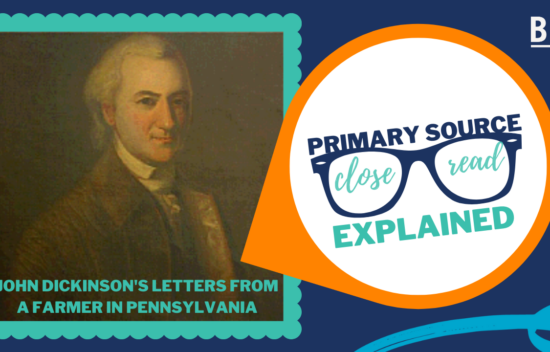
What led to British culture’s fading and American culture’s emergence in the colonies? In this episode of Primary Source Close Reads Explained, Kirk examines John Dickinson’s “Letters from a Farmer in Pennsylvania” from 1767 and 1768. Dickinson offers strong words about taxation of the colonies yet does not call for full-blown independence. Why might Dickinson be opposed to a revolution in these letters? In what ways does his writing showcase the slow emergence of American culture in the British colonies? How can words, written and spoken, change history? “Primary Source Close Reading: Explained,” dives even deeper into some of the most pivotal pieces that shaped the America we know today. Join BRI’s Director of Content, Kirk Higgins, as he takes a detailed look at the language contained in the most formative documents, speeches, and court cases throughout the history of the United States. Learn the true meaning and story behind the writing that fashioned the country in a way you can easily digest!

John Dickinson was called “The Penman of the American Revolution.” During the 1760s and 1770s, he authored numerous important essays in defense of American rights, including The Late Regulations Respecting the British Colonies, the resolutions of the Stamp Act Congress, the Letters from a Farmer in Pennsylvania, the “Petition to the King,” and the Declaration of the Causes of Taking Up Arms.